
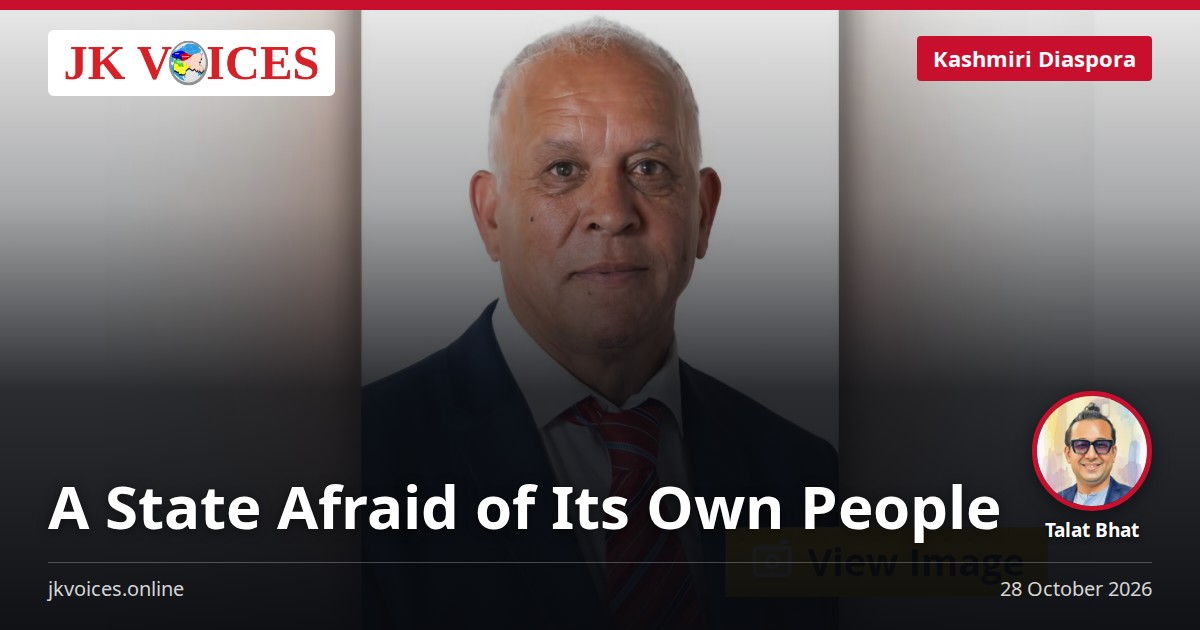
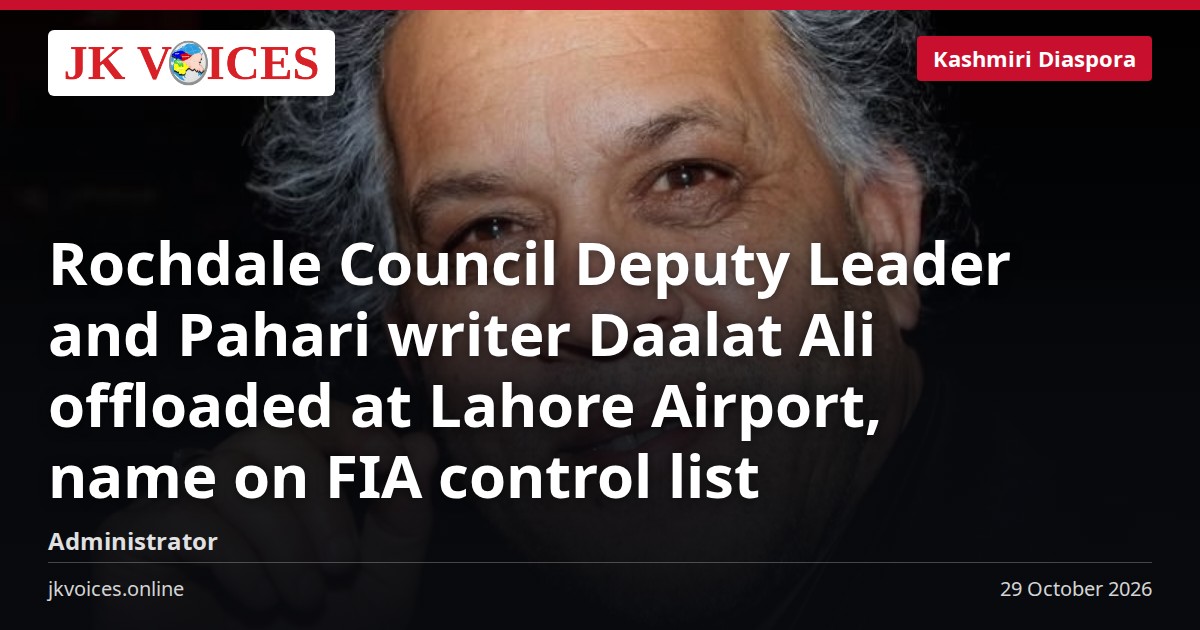
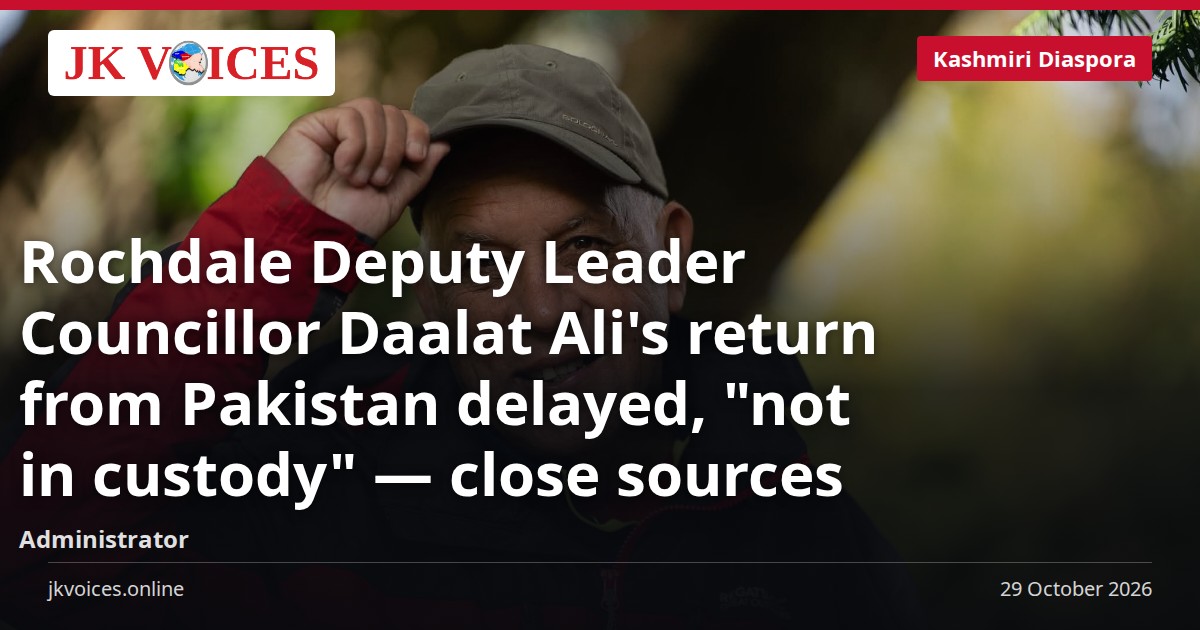
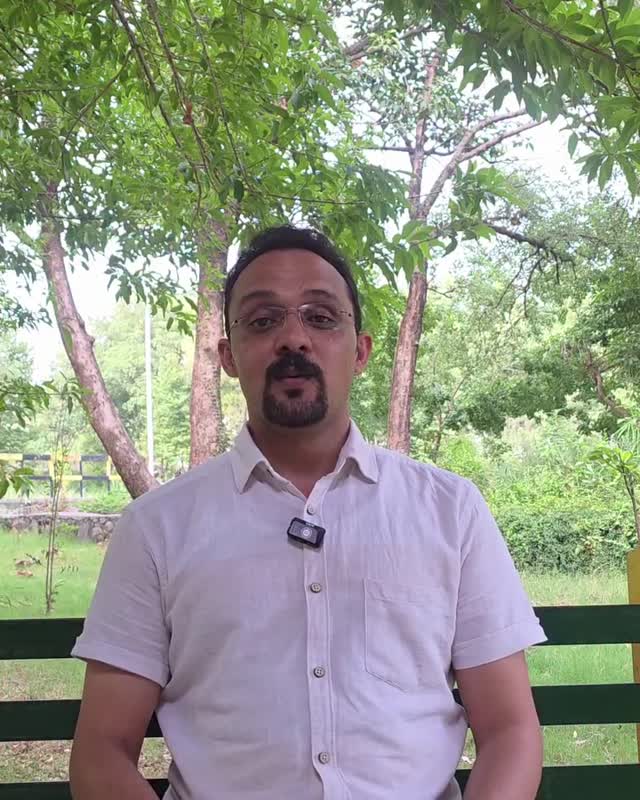
A British-Kashmiri councillor flies to Pakistan with a delegation. He is the deputy leader of a borough council in Greater Manchester, a man first elected in 2010, someone who has spent years founding Kashmiri community and cultural institutions in Rochdale, from a youth project to a research centre to a broadcaster for the languages of the region. And somewhere between the airport and his destination, he is held by the Pakistani state.
That is what we know about Councillor Daalat Ali. The Manchester Evening News reports that he was detained for a "short period" while travelling in Pakistan. No reason has been given. No authority has explained who ordered it, where he was held, or what he is supposed to have done. Neither Rochdale Borough Council, the Foreign Office nor Islamabad has made a public statement.
Into that silence, social media has poured its own story: that he has been branded a "domestic terrorist" for supporting Kashmiri separatism, and that his posts are being combed for evidence. None of this is confirmed, and we will not treat it as fact. But the fact that it sounds plausible to so many people, Kashmiris first among them, is itself the story.
A pattern, not an accident
To understand why, look at what Pakistan has done to the people it calls "Azad" Kashmiris this year.
On 5 June 2026, the authorities in Muzaffarabad proscribed the Jammu Kashmir Joint Awami Action Committee (JKJAAC) under the region's Anti-Terrorism Act. This is not an armed group. It is a coalition of traders, lawyers, transporters, students and ordinary citizens who for three years have demanded cheaper electricity, affordable wheat, an end to corruption and fairer elections. In a democracy, these are called manifesto pledges. In today's Pakistan, they are called terrorism.
What followed was a textbook crackdown. Scores arrested within a day. Sedition cases. Ten-million-rupee bounties on the heads of protest leaders, announced like wanted posters in a frontier town. Businesses of activists seized. The internet cut off. At least two dozen people dead in under two weeks, according to reports at the time. Amnesty International called the terrorism designation a dangerous escalation. Local media, under heavy censorship, could barely report any of it.
The lesson Islamabad is teaching Kashmiris is simple: ask for your rights, and the state will decide you are an enemy.
From hybrid regime to hard state
This did not come from nowhere. In November 2025, Pakistan's parliament passed the 27th Constitutional Amendment. It created a new post of Chief of Defence Forces for Field Marshal Asim Munir, placing the army, navy and air force under one man, gave him a fresh term, and granted him legal immunity for life. It also reshaped the courts with a new Federal Constitutional Court, curbing the Supreme Court that had occasionally dared to say no.
A state that can no longer deliver electricity, bread, jobs or justice reaches for the one thing it still has in abundance: force.
Chatham House described the amendment as moving Pakistan one step closer to authoritarian rule. Munir himself has spoken of turning Pakistan into a "hard state". We should take him at his word.
The country's most popular politician sits in prison. Journalists are charged under laws against "fake news". Baloch families still search for the disappeared. And now the same machinery is being turned on Kashmiris, at home and, it appears, on those who come home to visit.
Why use the word fascism?
The word should not be thrown around lightly, and some will object. Pakistan has no mass party marching in uniform; its rulers are generals and dynasties, not a charismatic movement. Strictly speaking, this is military authoritarianism.
But look at the ingredients. A single leader placed above the law for life. Courts redesigned to obey. Religion and nationalism fused into one patriotic duty, with the army as its high priest. Every critic recast as a foreign agent, a traitor, or a terrorist. Civil movements banned rather than answered. That is the logic of fascism, even if the uniforms are khaki rather than black. A state that can no longer deliver electricity, bread, jobs or justice reaches for the one thing it still has in abundance: force.
That is what a failed state looks like as it turns. It does not collapse. It hardens.
Caught between two intolerances
There is a bitter irony in how this story has been received in Britain. Far-right accounts have seized on Councillor Ali's detention to say, in effect: even Pakistan thinks he is a terrorist, so why is he running a council in England? Within hours, the words "Pakistan", "terrorist" and "Rochdale" were being thrown together as if they explained each other.
So a British-Kashmiri elected by his neighbours is suspected in Pakistan of being too Kashmiri, and in Britain of being too Pakistani. The generals in Rawalpindi and the trolls on X agree on one thing: a Kashmiri with a voice is a problem.
This is exactly why Kashmiris in the diaspora must refuse both scripts. Our loyalty is not to Islamabad or to New Delhi, and our rights do not depend on the approval of those who hate us in Europe. Kashmir remains a disputed territory whose people have never been asked what they want. Speaking about that, in Rochdale or in Rawalakot, is not terrorism. It is politics.
What must happen now
The British government owes its citizen, and the public, a clear account. Was the Foreign Office informed? Was consular help given? On what legal basis was a serving British councillor held? If there are allegations, they should be stated openly; if there are none, Pakistan should say so.
Rochdale Borough Council should also speak plainly, rather than leave its deputy leader to the rumour mill.
And Pakistan should understand this. Every activist it bans, every family it raids, every visiting Kashmiri it detains without explanation adds to the evidence that its claim to stand for Kashmiri freedom is hollow. A state that fears its own people's questions has already lost the argument.
Sources: Manchester Evening News and Manchester Mirror (28 Oct 2026); Dawn, Arab News and Amnesty International (June 2026); Chatham House (Dec 2025); AFP/Khaleej Times (Nov 2025); Rochdale Online (Oct 2023).
Comments (0)