

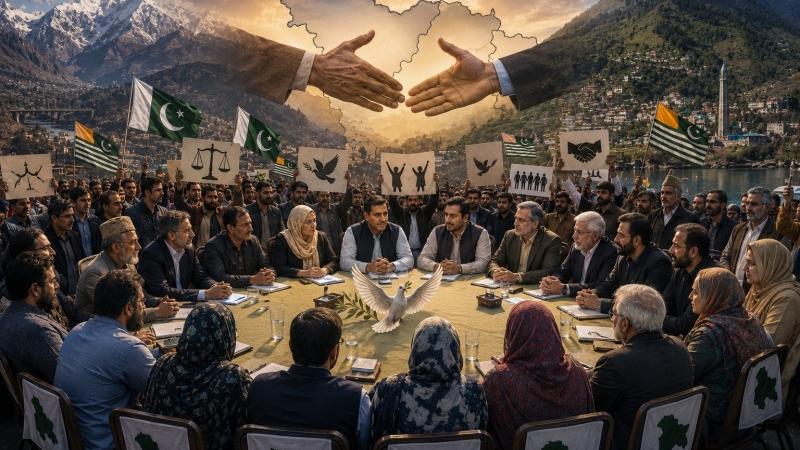
Azad Kashmir: A New Opening for Dialogue, Representation and Political Accountability
Editorial | JK Voices
26 November 2026
The resolution discussed in the Azad Jammu and Kashmir Legislative Assembly on 25 November, and the subsequent response from the Advisory Council of the Jammu Kashmir Joint Awami Action Committee (JAAC), have created a new opening for political dialogue. After months of sit-ins, security operations, loss of life, arrests and disruption to everyday life, the willingness to consider negotiations deserves serious attention. But any lasting settlement must address not only the immediate confrontation but also the underlying questions of representation, political authority and public accountability.
The first issue concerns the representative character of the present Assembly. Elections were held in stages during July and August 2026, with officially reported turnout of approximately 48 per cent. JAAC had called for a boycott, and local observers reported particularly low participation in some areas. The extent of the boycott, and allegations that official turnout figures overstated actual participation, require independent examination.
More significantly, elections in seven constituencies across Poonch and Sudhnuti were postponed, leaving communities at the centre of the present crisis without their full elected representation.
This does not automatically invalidate the Assembly's constitutional standing. It does, however, raise legitimate questions about the breadth of its democratic mandate, particularly when it discusses matters directly affecting people whose constituencies remain unrepresented.
The resolution records 34 deaths and 248 injuries among law-enforcement personnel but provides no equivalent comprehensive account of civilian casualties. The JAAC Advisory Council, in its response, cites 104 documented civilian deaths. Both sets of figures, the circumstances of the deaths and responsibility for individual incidents require independent verification.
Every life deserves equal respect. The suffering of police families must be recognised, just as the suffering of civilian families must be acknowledged. Justice cannot depend on whether someone wore a uniform or participated in a protest.
The resolution's allegation that women and children are being used as human shields at the Rawalakot sit-ins also requires credible evidence. Women have the right to participate voluntarily in peaceful political activity, while children require particular protection. Their presence at a demonstration does not, by itself, establish that they are being deliberately used as shields.
These issues underline the need for impartial investigations rather than collective accusations.
The deeper question of political authority
The People's Rights Movement began with demands concerning electricity tariffs, flour subsidies, privileges enjoyed by political elites and other everyday economic grievances. Over time, the struggle exposed a longstanding contradiction within AJK's system of government.
People elect representatives and expect them to resolve their problems. Yet important financial, administrative and security decisions involve institutions operating under Pakistani authority.
The institutions held publicly accountable are not always those possessing the power to make the decisive choices.
This unequal relationship was not created by JAAC. Nevertheless, the movement has brought its consequences into sharper public focus.
The question, therefore, is not simply whether prolonged protest has weakened the functioning of the AJK government. It is also whether the government's existing limitations contributed to the public frustration from which the movement emerged.
JAAC's own political conduct deserves examination within this context. Some of its leaders have previously dismissed the Assembly as powerless and used insulting language towards elected representatives. During earlier long marches, direct negotiations with influential Pakistani officials were also preferred over engagement through local government institutions.
Dealing with those who hold effective power may have been a practical necessity. Yet bypassing local elected institutions can also contribute to their further marginalisation.
The challenge is to secure meaningful decisions without weakening the institutions through which the people of AJK should exercise democratic control.
Similar questions arose in June 2026, when additional security forces were requested and JAAC was proscribed under anti-terrorism legislation. Formally, these steps were taken through AJK governmental procedures. Some local observers maintain that the decisive political direction came from institutions in Pakistan.
Justice cannot depend on whether someone wore a uniform or participated in a protest.
That claim requires documentary investigation. What must be established is who authorised the decisions, who exercised effective control and who is accountable for their consequences.
Negotiations must be empowered and credible
Despite these differences, the Assembly resolution and the Advisory Council's response offer a possible basis for renewed dialogue.
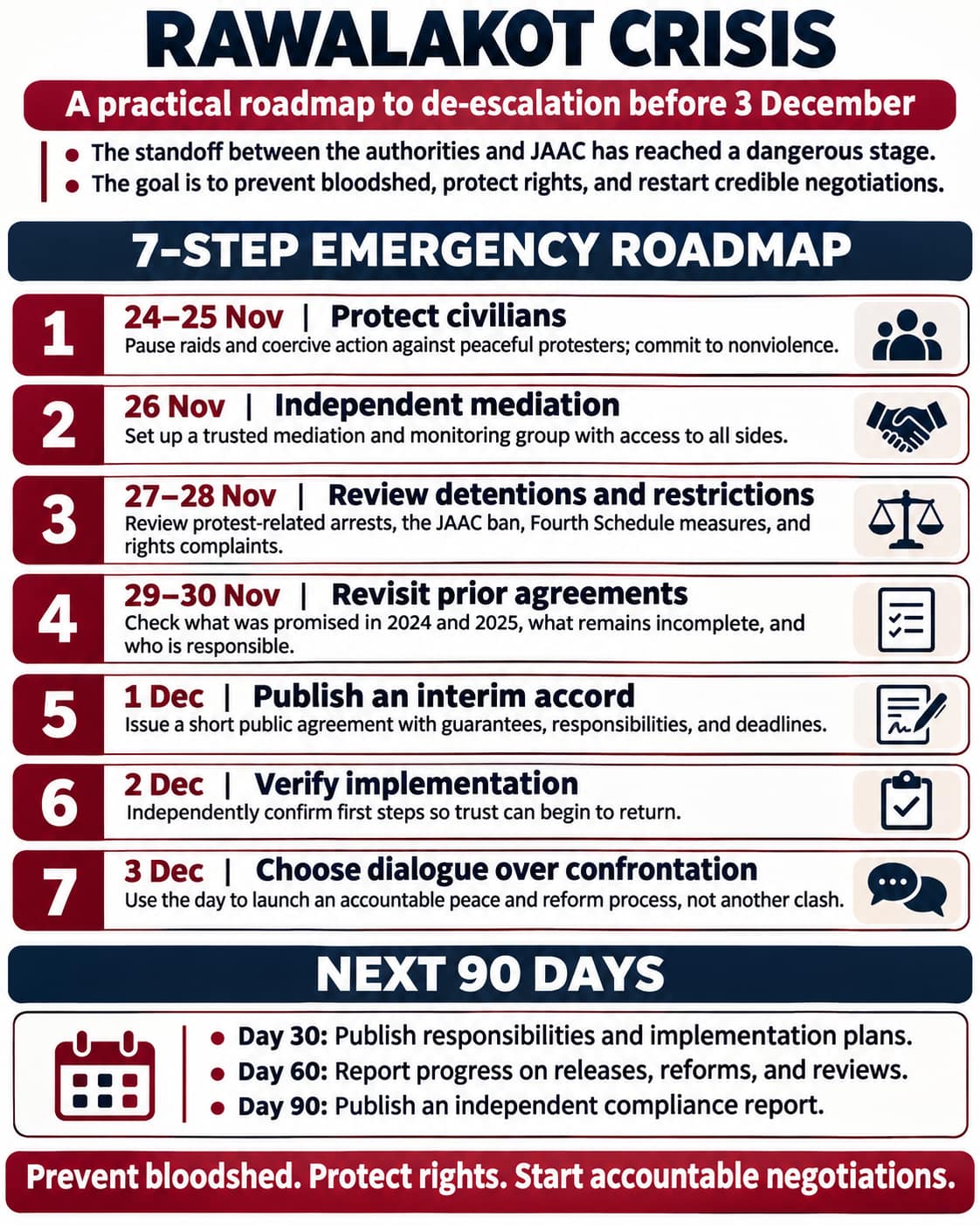
The Assembly has acknowledged the need for political engagement. JAAC has welcomed that opening and proposed the formation of an empowered government negotiating committee within 48 hours, with formal talks in Rawalakot within five days.
The Advisory Council has offered to maintain the peaceful and unarmed character of the protests, facilitate humanitarian access and voluntary movement, and cooperate with lawful investigations into specific criminal allegations.
In return, it seeks the cancellation of coercive operations, withdrawal of forces from confrontational positions, restoration of roads and communications, protection of detainees' legal rights, and written guarantees against reprisals.
These proposals will require discussion and practical arrangements. But they need not be approached as a contest over which party must surrender first.
The protection of civilian life and the right to peaceful assembly are legal obligations. The future arrangements for sit-ins, access routes and implementation of previous agreements are matters that can be addressed through negotiations.
The record of earlier agreements also makes implementation particularly important. Negotiating representatives must possess genuine decision-making authority, and any new commitments should identify responsible institutions, resources, deadlines and independent monitoring arrangements.
Where decisions depend on Pakistani institutions, their responsibilities must be clearly established.
The Assembly, meanwhile, has an opportunity to act as a forum for public accountability and political settlement rather than merely endorsing the government's security position. JAAC also has an opportunity to recognise the importance of strengthening local democratic institutions while continuing to challenge their shortcomings.
Completing electoral representation in Poonch and Sudhnuti should form part of the wider restoration of public confidence.
Public fears about AJK's constitutional future
The continuing crisis has also generated serious anxiety among sections of the population. Some fear that a breakdown in negotiations could lead to a much larger security operation, possibly involving the Pakistan Army, and further reduce the authority of AJK's civilian institutions.
Others draw comparisons with India's August 2019 decision to revoke the special constitutional status of Indian-administered Jammu and Kashmir and reorganise it into two federally administered territories.
The constitutional circumstances are different, and there is no verified evidence of a settled Pakistani plan to reproduce that outcome in AJK. The comparison should therefore not be presented as an established prediction.
More speculative claims suggest that Pakistani intelligence agencies originally encouraged JAAC in order to discredit local politicians, create instability and eventually justify greater external control. Such allegations are serious, but no independently verified evidence has been established to substantiate them.
These claims should not be repeated as facts. At the same time, the fears circulating among the public should not simply be dismissed.
They reflect, at least in part, prolonged political uncertainty, extraordinary security measures, insufficient transparency and longstanding concerns about the limited authority of elected institutions.
The most effective response would be clear constitutional assurances, independent scrutiny of security decisions, protection of civilian life and meaningful participation by AJK's elected representatives in decisions affecting their population.
A settlement that restores public order while further diminishing local civilian authority could leave the deeper political problem unresolved.
A way forward
The present crisis cannot be resolved solely by ending the sit-ins or restoring the government's administrative control. Nor can the difficulties faced by ordinary people during prolonged protests be ignored.
Both the authorities and JAAC have responsibilities, although their legal powers and obligations are not identical.
The authorities must protect life, uphold civil liberties and ensure accountability for the use of state power. JAAC must maintain peaceful protest, protect humanitarian access and engage constructively in negotiations. The Assembly must represent the entire population, including those who oppose the government. Pakistani institutions must accept responsibility for decisions falling within their effective authority.
The immediate priorities are civilian protection, impartial investigation of all deaths and serious allegations, restoration of essential services, and negotiations supported by enforceable commitments.
A sustainable settlement requires more than the restoration of order. It requires narrowing the distance between democratic representation, effective political authority and public accountability.
The Assembly's willingness to consider dialogue and the Advisory Council's positive response offer an opportunity to begin that process.
Neither the humiliation of the government nor the surrender of the movement should be its objective.
The objective should be a settlement that protects human life, restores public confidence, delivers on legitimate commitments and strengthens accountable civilian government.
Negotiations will succeed only when those at the table have the authority to make decisions, the responsibility to implement them and the confidence of the people whose future is being discussed.
— JK Voices

Comments (0)