

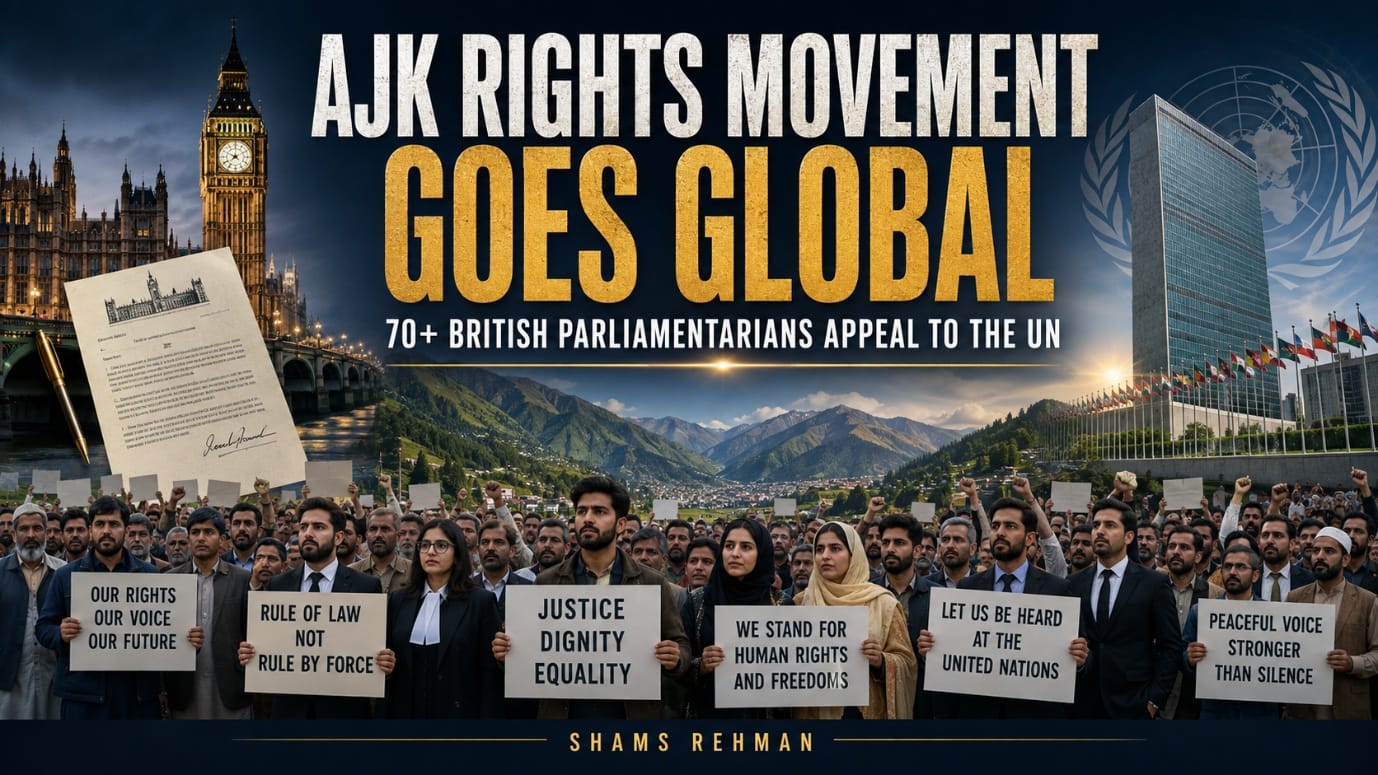
British Parliamentarians’ UN Appeal Opens a New International Chapter for AJK’s People’s Rights Movement
The letter does not confer formal recognition on JAAC, but it challenges its portrayal as a security threat and places the crisis within the wider unresolved Kashmir dispute
A letter signed by more than 70 British parliamentarians and sent to United Nations Secretary-General António Guterres could mark a significant turning point for the Joint Awami Action Committee and the wider People’s Rights Movement in Azad Jammu and Kashmir.
The signatories—comprising members of both the House of Commons and the House of Lords—have called on the UN to respond to the continuing bloodshed, communications restrictions, arbitrary arrests and humanitarian crisis in the territory. They have also demanded impartial accountability, access for independent human-rights observers and an immediate return to peaceful dialogue.
The intervention should not be mistaken for a resolution or official decision of the British Parliament. Nor does it formally recognise JAAC or endorse every demand in its charter. Its importance lies elsewhere: it reinforces an emerging international interpretation of the crisis that differs sharply from the security narrative advanced by the Pakistani and AJK authorities.
Most significantly, the parliamentarians have connected the present confrontation with the unresolved status of Jammu and Kashmir and asked what further measures the Security Council and the wider UN system may be prepared to consider.
Their letter declares: “The present situation also serves as a reminder that the wider Kashmir dispute remains unresolved.” It then refers to UN Security Council Resolution 47 and subsequent resolutions concerning Jammu and Kashmir.
This moves the issue beyond a dispute between an AJK government and a local protest organisation. It presents the crisis as a human-rights and political emergency taking place in a territory whose final status remains unresolved under a longstanding international framework.
Challenging the terrorism narrative
The greatest immediate significance for JAAC is the growing international challenge to its criminalisation under anti-terrorism legislation.
The Pakistani and AJK authorities have portrayed the organisation as a threat to security and public order. This framing seeks to transform the movement’s history from one of civic and economic agitation into a sequence leading from protest to disorder and ultimately terrorism.
The UN Human Rights Office has offered a notably different description.
During a briefing on 17 July, the Office of the UN High Commissioner for Human Rights described JAAC as a movement comprising traders, transporters, students, lawyers, activists and other sections of society. It warned that the criminalisation of a civil-society organisation under anti-terrorism legislation raised serious concerns about freedom of expression, peaceful assembly and association.
The UN office also called for detained JAAC leaders to have access to their families and lawyers, for due-process and fair-trial guarantees, for communications to be restored and for meaningful political dialogue addressing the grievances of the population.
This does not amount to a legal judgment declaring JAAC innocent of every allegation. The UN has not ordered the AJK authorities to remove the organisation’s proscription, nor can British parliamentarians abolish the ban.
Nevertheless, the political contradiction is becoming increasingly difficult to ignore. If JAAC is simply a terrorist organisation, why are international human-rights institutions discussing it as a broad civil-society movement and calling for inclusive political negotiations over the grievances it represents?
The International Bar Association’s Human Rights Institute has added to these concerns by warning against the use of counterterrorism powers to criminalise peaceful dissent. It has called for independent investigations, due process, restored communications and protection of political participation.
Together, these interventions make the proscription politically more contestable, even while it remains legally in force. They strengthen the case for an independent review of the ban, the release of those detained solely for peaceful political activity and the restoration of JAAC’s ability to participate in negotiations.
JAAC must, however, describe the international position accurately. It can legitimately say that the UN has questioned the criminalisation of the movement. It cannot claim that the UN has formally ordered its de-proscription.
From economic demands to a democratic-rights movement
The crisis has also changed the political character of the movement.
JAAC originally gained its strength through demands rooted in everyday life: affordable flour and electricity, reduced privileges for the governing elite, improved roads, healthcare and education, and greater accountability and representation.
These demands allowed it to mobilise people across conventional ideological, party and regional divisions. Its appeal came partly from the fact that it addressed the immediate material burdens faced by ordinary households.
The state’s response has now produced a much wider agenda.
The British parliamentarians’ letter refers to the right to life, arbitrary detention, legal representation, due process, freedom of expression, peaceful assembly, political participation, communications access, humanitarian relief, independent observation and accountability for excessive force.
The movement has therefore evolved from a campaign principally concerned with economic justice and accountable administration into one increasingly focused on civil liberties, democratic representation and the political agency of AJK’s population.
This transformation may prove more consequential than any single concession on flour, electricity or public expenditure. It raises fundamental questions about the relationship between AJK’s people and the institutions exercising power over them.
The parliamentarians’ reference to “political participation” is especially important. It provides a legitimate human-rights framework for examining electoral arrangements, representation, restrictions on political organisers and the credibility of institutions operating during a prolonged crisis.
The letter does not endorse JAAC’s demand concerning the 12 legislative seats reserved for refugees settled in Pakistan. Neither has the UN adopted a position on that demand. However, the principle of meaningful political participation creates space in which questions about representation and institutional legitimacy may be raised internationally.
Independent investigation could strengthen JAAC
The call for independent human-rights observers may have far-reaching consequences.
Communications restrictions, disputed casualty figures and sharply conflicting official and protester accounts have made it difficult to establish an authoritative record of events. Independent investigators could examine deaths and bullet injuries, arrests, detention conditions, terrorism cases, identification-parade procedures, access to lawyers, property damage, communications shutdowns and allegations of excessive force.
Such an inquiry would also have to investigate attacks on police officers, claims that weapons were present among protesters and any violence committed by individuals associated with demonstrations.
Their letter declares: "The present situation also serves as a reminder that the wider Kashmir dispute remains unresolved.
This is not a weakness for a movement claiming to be peaceful. It is an opportunity to establish credibility.
JAAC’s strongest position would be to demand impartial investigation of every protest-related death and every credible allegation, regardless of whether the alleged perpetrators belong to the security forces or the protest movement.
The UN Human Rights Office has itself called for investigation into deaths among both protesters and law-enforcement personnel.
The parliamentary demand for “full and impartial accountability for deaths, injuries and any excessive use of force” also shifts the debate beyond disputed casualty totals.
The central questions would become: Who authorised particular operations? What rules of engagement were issued? Who opened fire? Was lethal force necessary and proportionate? Were individual deaths unlawfully caused? What evidence supports the arrests and terrorism charges? Have credible investigations been initiated?
For that reason, the systematic preservation of evidence is now essential. Medical records, post-mortem reports, court documents, arrest records, videos, photographs and verified witness testimonies must be collected before they disappear, are altered or become impossible to obtain.
Social-media claims alone will not be sufficient for international legal or diplomatic scrutiny.
The diaspora as diplomatic infrastructure
The letter also recognises the anxiety of British Kashmiris for relatives living in AJK. This acknowledgement reflects the unusual transnational geography of the territory.
AJK is connected socially, economically and politically to both Pakistan and Britain. As a result, repression inside the territory can rapidly produce demonstrations in British cities, parliamentary lobbying, media coverage, diplomatic representations and communications with international institutions.
The diaspora is therefore no longer merely a source of remittances, fundraising and occasional solidarity campaigns. It has become part of the movement’s international political and diplomatic infrastructure.
The letter demonstrates how quickly local events can enter the British political system when a large and organised diaspora is able to contact parliamentarians and human-rights organisations.
This internationalisation also brings dangers.
The authorities may argue that external actors are interfering in an internal matter or that foreign interests are using JAAC against Pakistan. Such claims could be employed to justify further securitisation and repression.
JAAC’s response must remain disciplined: it is a locally rooted movement whose demands arise from the lived conditions of AJK’s people. It should welcome impartial international scrutiny without becoming politically dependent on any foreign government.
Its international advocacy must remain rights-based rather than geopolitical. It should avoid allowing itself to be presented as pro-India, anti-Pakistan, British-sponsored or directed by the United Nations.
A disputed territory whose people have rights now
The most politically significant section of the parliamentarians’ letter is its connection between present-day human-rights violations and the unresolved Kashmir dispute.
This raises a question that has often been postponed by arguments over the territory’s final status: what democratic, constitutional and political rights do the people of AJK possess while the Jammu and Kashmir dispute remains unresolved?
A disputed status cannot mean that the population must wait indefinitely for the enjoyment of fundamental rights. Regardless of when or how the wider dispute is settled, the people possess rights now: to life, due process, expression, peaceful assembly, accountable administration, representation and meaningful political participation.
This does not mean the letter recognises AJK as an independent state. It does not recognise JAAC as a government or national liberation movement, nor does it grant the organisation diplomatic status at the UN.
Security Council Resolution 47 addressed the restoration of peace and order and the proposed plebiscite in the former princely state of Jammu and Kashmir. The immediate legal basis for present human-rights concerns lies more directly in international standards governing life, liberty, expression, assembly and due process.
The letter nevertheless brings these two frameworks together: human rights in the present and the unresolved political status of Kashmir inherited from the past.
That combination gives the intervention its political significance.
What the United Nations may realistically do
The request for the Secretary-General to explain what steps the Security Council and wider UN system are prepared to take is notable, but its effects should not be exaggerated.
The Secretary-General cannot compel the Security Council to act. Council decisions depend on its member states and their geopolitical interests. Article 99 of the UN Charter allows the Secretary-General to bring matters threatening international peace and security before the Security Council, but invoking it would constitute an exceptional escalation. There is presently no reason to assume that the parliamentarians’ letter will produce such an outcome.
A more realistic process would involve continued engagement by the Secretary-General’s office and OHCHR, diplomatic representations to Pakistan, demands for access and monitoring, communications from UN human-rights mechanisms, support for an independent investigation and pressure for renewed negotiations.
Even these more limited measures could materially alter the political environment.
The letter gives JAAC greater diplomatic leverage, although it does not change the coercive balance on the ground. If negotiations resume, the movement can point to international concerns about its criminalisation, growing demands for accountability and the support of more than 70 British parliamentarians for peaceful dialogue.
That leverage will be valuable only if used to pursue a credible settlement. International sympathy should not be confused with inevitable victory. External attention cannot substitute for internal organisation, strategic discipline, non-violence and negotiation.
A movement entering a new stage
The People’s Rights Movement can now be understood as having passed through several phases.
Its 2023–24 period was dominated by economic and civic demands. During 2024–25 it developed mass mobilisation and secured negotiated agreements. From 2025 to June 2026, confrontation intensified over implementation and political representation. June and July 2026 brought proscription, arrests, securitisation and lethal violence. July and August saw the emergence of sustained international human-rights attention.
The letter of 21 August may mark the beginning of another phase: international political scrutiny of AJK’s governance within the context of the unresolved Kashmir dispute.
For JAAC, the immediate priorities should include creating a verified human-rights dossier, demanding impartial investigation of all deaths, adopting an unequivocal public code of non-violence, pursuing de-proscription and due process through legal and political channels, requesting access for independent observers and maintaining a disciplined international message centred on civil rights, accountability and dialogue.
The movement will also need to develop a clear post-crisis constitutional programme. If it is now raising questions about political participation and the rights of people living in disputed territory, it must eventually explain what institutional reforms it seeks, not merely which existing arrangements it opposes.
The most consequential line in the parliamentarians’ letter may therefore be its reminder that “the wider Kashmir dispute remains unresolved”.
Once the present movement is considered alongside UN resolutions, international human-rights law and the political rights of Kashmiris, the debate moves beyond whether individual JAAC demands should be accepted.
It begins to ask who possesses legitimate political authority in AJK, how that authority is exercised, how the people are represented and what rights they possess while the final status of Jammu and Kashmir remains unresolved.
The Secretary-General’s eventual response will now be closely watched. Its wording—particularly whether it refers only to human rights, Pakistan’s responsibilities, the UN’s good offices, Security Council resolutions or the unresolved dispute—may indicate how far the international organisation is prepared to become involved.
For JAAC and the People’s Rights Movement, that response could help determine whether international concern remains an expression of sympathy or develops into sustained diplomatic scrutiny.
Sources
UN Human Rights Office briefing, 17 July 2026
UN Security Council Resolution 47 (1948)
International Bar Association Human Rights Institute statement


Comments (0)