
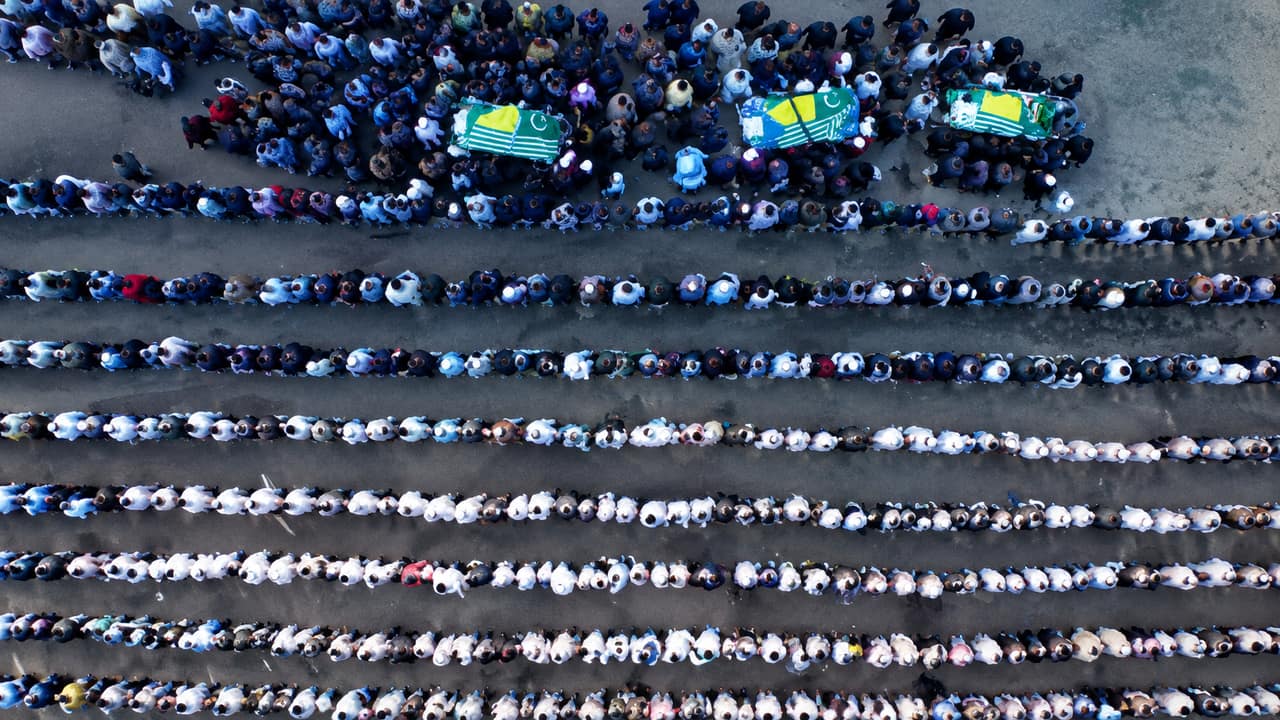
On the morning of November 5, security forces under the Pakistani administration cracked down on the protest camps of the Joint Awami Action Committee in Rawalakot. According to a Kashmir Times report and movement sources, at least three civilians were killed and eighteen injured. Some reports also mention drone strikes on residential houses, though these have not yet been independently verified. The government has not released any official figures so far.
This incident is not an isolated one. It is the latest example of a pattern where peaceful public demands in Pakistan-administered Jammu and Kashmir have repeatedly been answered with force. And each time, one thing has remained common: the telling silence of the corridors of power, political parties, and the influential Kashmiri leadership living abroad.
Demands Turned into Crimes
This movement was not started by an armed group, but by ordinary citizens. Traders, transporters, students, and workers came together on the platform of the Joint Awami Action Committee, and their demands were extremely basic.
The region's rivers generate electricity through mega-projects such as Mangla and Neelum-Jhelum, yet local consumers bear the burden of expensive bills and load-shedding. Flour prices have steadily moved out of reach for ordinary households. Meanwhile, the privileges of the ruling class remain intact. Cheap electricity, affordable flour, and an end to elite privileges: these are routine political demands in any democratic society.
These demands were not answered with dialogue. In June 2026, the government banned the Awami Action Committee under the Anti-Terrorism Act. Amnesty International described this step as a «dangerous escalation» in the crackdown and, citing media reports, stated that over a hundred people were arrested in just two days.
When demanding affordable electricity and flour falls under anti-terrorism law, the state sends a clear message to its citizens: even asking questions is a crime.
One Year, the Same Script
The record of the past twelve months shows a clear trend:
|
Time |
Event |
|---|---|
|
November 2026 |
Crackdown on protest camps in Rawalakot; three dead, eighteen injured, according to the movement |
|
Summer 2026 |
Clashes following the ban; nine deaths reported in a single day, unrest spread to Muzaffarabad |
|
June 2026 |
Ban on the Awami Action Committee under the Anti-Terrorism Act; more than a hundred arrests |
|
October 2025 |
At least nine deaths, including civilians and police personnel, during the protest wave |
After each incident, an inquiry was announced, but no inquiry report was ever made public, and no one responsible was punished. When there is no accountability, violence is not an exception—it becomes the modus operandi.
Silence Is Not Neutrality, It Is Complicity
The central stance of this article is simple: Whoever remains silent in this situation shares responsibility for these deaths, and history will remember them as a killer.
When demanding affordable electricity and flour falls under anti-terrorism law, the state sends a clear message to its citizens: even asking questions is a crime.
This is not merely an emotional slogan. State violence runs on two things: power and silence. Power acts for one day; silence permits it the next day. When no political price has to be paid for a killing, the next killing becomes easier.
This silence has many faces:
- Local government and assembly members, who claim to be representatives of the people but hesitate to issue even a single statement on the deaths of their own citizens.
- Political parties, who fear angering Islamabad for the sake of electoral interests.
- Overseas Kashmiri leadership, especially in Britain, who possess both resources and an independent platform.
- The media, a large part of which has either ignored these events or restricted itself to the official narrative.
- The international community, which, when mentioning Kashmir, usually looks only at one side of the Line of Control.
None of them pulled the trigger. But whoever has the power to speak and does not speak, their silence is a political decision, and like every decision, it will have to be accounted for. Future generations will not ask who pulled the trigger. They will ask: Where were you?
The State's Stance, and Its Weakness
The government's stance is that this is a law and order issue, and it is true that police personnel also lost their lives in the clashes of October 2025. Every loss of human life is tragic, and there is no justification for violence, regardless of which side it comes from.
Yet by this very principle, the state's stance weakens. If the issue was peace, why avoid an independent investigation? If the movement was violent, why no negotiations on its economic demands? And what legal requirement is fulfilled by cracking down on protest camps early in the morning?
A state that labels its citizens as terrorists instead of speaking to them creates alienation, not peace.
What Should Happen Now
- Independent Judicial Commission: Investigation of every death since October 2025 within a specified timeframe, and publication of the report.
- Lifting the Ban: The ban on the Awami Action Committee should be lifted, and peaceful protesters must be released.
- Withdrawal of Cases: Anti-terrorism cases against students, traders, and laborers must be dismissed.
- Negotiations: Meaningful and transparent dialogue on electricity, flour, and elite privileges.
- Access for Independent Reporting: Unhindered access to affected areas for domestic and foreign journalists and human rights observers.
Conclusion
In Muzaffarabad, instead of remaining silent after Rawalakot, students of Chehla University and the University of Kashmir demanded accountability. The new generation has understood what many people in power still avoid understanding: individuals can be suppressed, but an organized and united nation cannot.
Every citizen, every representative, and every journalist of Jammu and Kashmir now faces a single question. The time for neutrality has passed. Whoever is silent today, history will find them standing with the killers.
No silence today.
The author's views are personal. The death toll is based on Awami Action Committee and media reports; official figures have not been released.
Comments (0)