

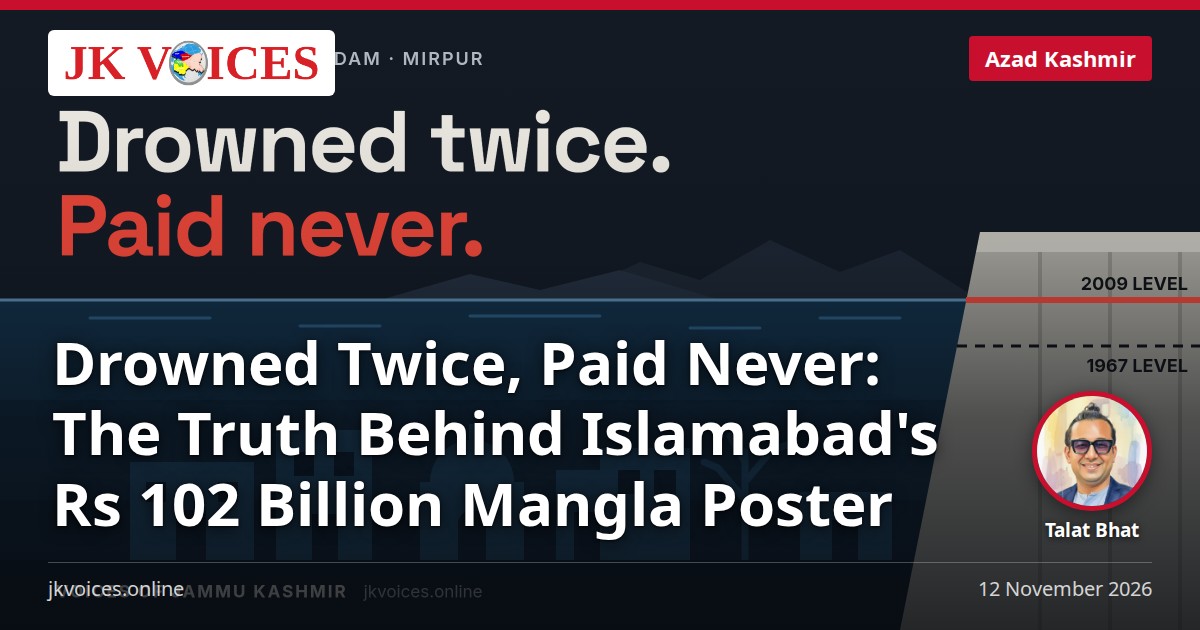
Pakistan's Planning Minister Ahsan Iqbal has told his 600,000 Facebook followers that the "Raising of Mangla Dam Project (2nd Revised PC-I)", costing Rs 102 billion, "can enhance the resilience of national water infrastructure". The graphic is green and glossy. The language is in the future tense. A reader in Mirpur could be forgiven for thinking the water is about to rise on them once more.
It is not. And that is exactly where the real story begins.
What the post does not say
There is no new raising of Mangla. The dam was raised once, by 30 feet, lifting the maximum water level by 40 feet. Work began in 2004 and the main structures were finished in 2009. Nearly all of the money, about Rs 96 billion, had already been spent years ago, according to WAPDA's own figures.
"2nd Revised PC-I" is not an engineering term. It is an accounting one. It means the cost of the same old project has been revised for the second time. A scheme that was approved at Rs 62 billion is now carried in the books at Rs 102 billion. The revision has been travelling between ministries since 2017.
And for all the talk of Rs 102 billion, the federal budget for 2026-27 gives the project just Rs 910 million, after the Planning Ministry itself had proposed Rs 4.6 billion.
So the minister is not announcing a dam. He is repackaging a bill.
Twice displaced, still unpaid
The people of Mirpur and Dadyal have paid for Mangla twice. In the 1960s the original reservoir swallowed old Mirpur, old Dadyal and some 280 villages, uprooting more than 110,000 people. Many of them ended up in Britain, which is why Bradford and Birmingham know the name Mirpur so well. The raising in the 2000s displaced more than 50,000 people again.
Why is a project "completed" in 2009 still open in 2026? Because the displaced have not been settled. In May this year Pakistan's own Ministry of Defence wrote to the Prime Minister's Office and the Finance Ministry warning that unpaid compensation could trigger protests in Pakistani-administered Jammu Kashmir. By its count, only 46 of 449 claimants in that batch had received even partial payment, and Rs 4.4 billion was stuck in Islamabad.
It is Pakistani enough to be flooded, but not Pakistani enough to be paid.
When a defence ministry has to warn a finance ministry about unpaid villagers, the problem is no longer administrative. It is political.
Whose water, whose profit?
Mangla sits on the soil of the state of Jammu Kashmir, a disputed territory whose people were never asked whether they wished to host Pakistan's second-largest reservoir. Its water irrigates Punjab. Its turbines feed the national grid.
What came back? Under the 2003 raising agreement, the Muzaffarabad government accepted 15 paisa per unit as "water use charges", while Khyber Pakhtunkhwa and Punjab were being paid Rs 1.10 per unit as net hydel profit for their dams. The reason given was constitutional: the territory is not a province of Pakistan, so it has no right to hydel profit. It is Pakistani enough to be flooded, but not Pakistani enough to be paid.
An agreement to raise the rate to Rs 1.10 was signed in 2022. A year later the Water Resources Ministry was still refusing to pay until the money could be recovered through electricity tariffs.
A raising even Pakistan's own water authority doubted
The official case deserves to be stated. WAPDA says the raising added 2.88 million acre-feet of storage, recovering capacity lost to silt, and 644 GWh of electricity a year. Officials also point out that most of the project cost went on compensation and resettlement, including New Mirpur City and four satellite towns.
But Pakistan's own Indus River System Authority called the raising a "wrong step" in 2011, warning that the reservoir could be filled to its new level only about twice in ten years. If that warning was even half right, tens of thousands of people were moved for water that mostly does not arrive.
Enough is enough
No one in the state of Jammu Kashmir is against water security for the farmers of Punjab or Sindh. The objection is to a development model in which one people gives the land, the graves and the homes, and another people takes the water, the power and the credit.
Before one more rupee is announced on a poster, Islamabad owes the people of Mangla four things:
- Every pending compensation claim paid, with a public list and a deadline.
- A full, independent audit of how Rs 62 billion became Rs 102 billion.
- Water use charges paid at the same rate as the provinces, with arrears.
- A binding guarantee that no future change to Mangla happens without the free consent of the people who live around it.
The dam was raised long ago. What has never been raised is the standing of the people who made room for it.

Comments (0)