

Rights Movement in Azad Jammu and Kashmir:
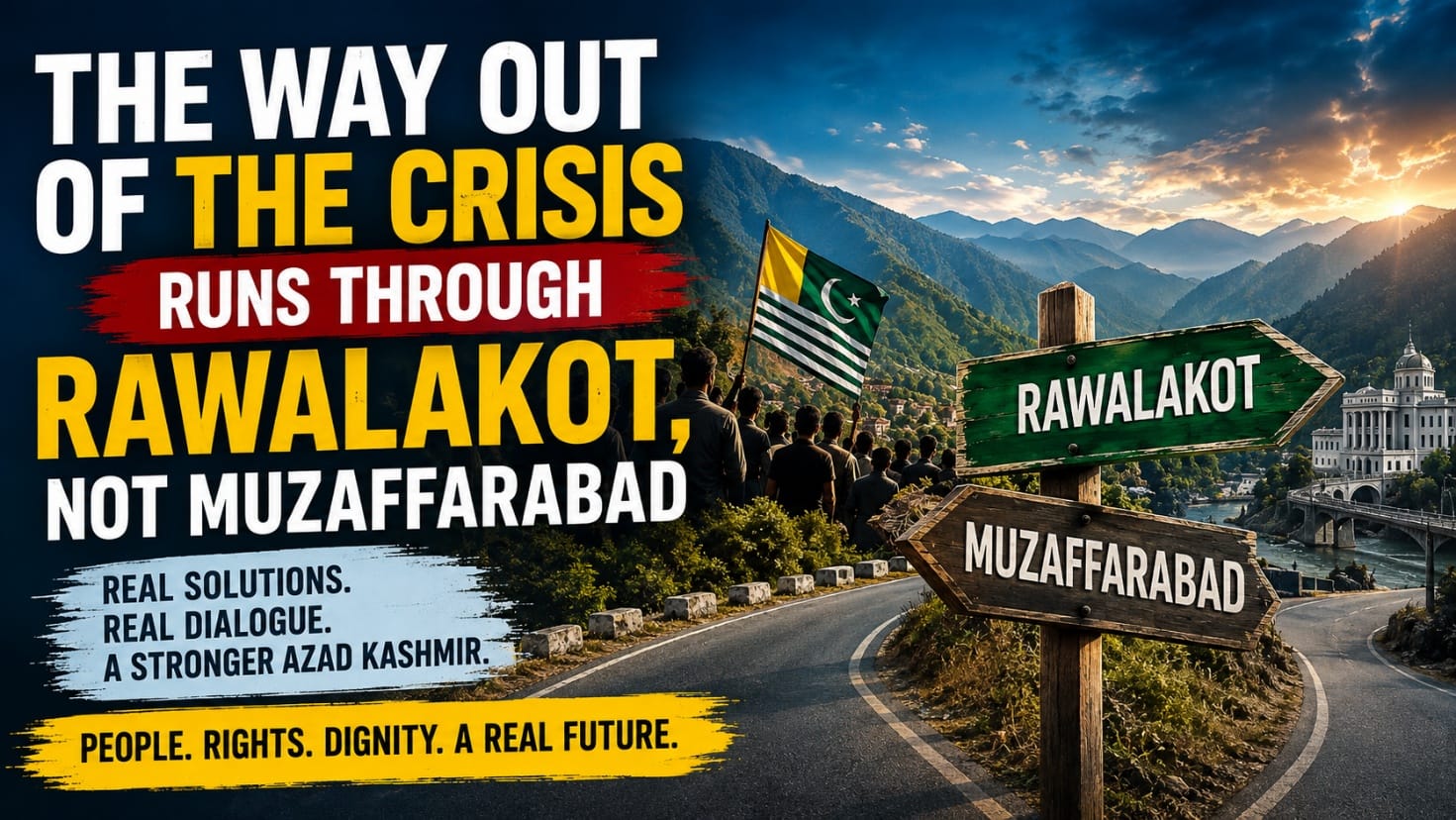
Why the Road Out of the Crisis Runs Through Rawalakot, Not Muzaffarabad
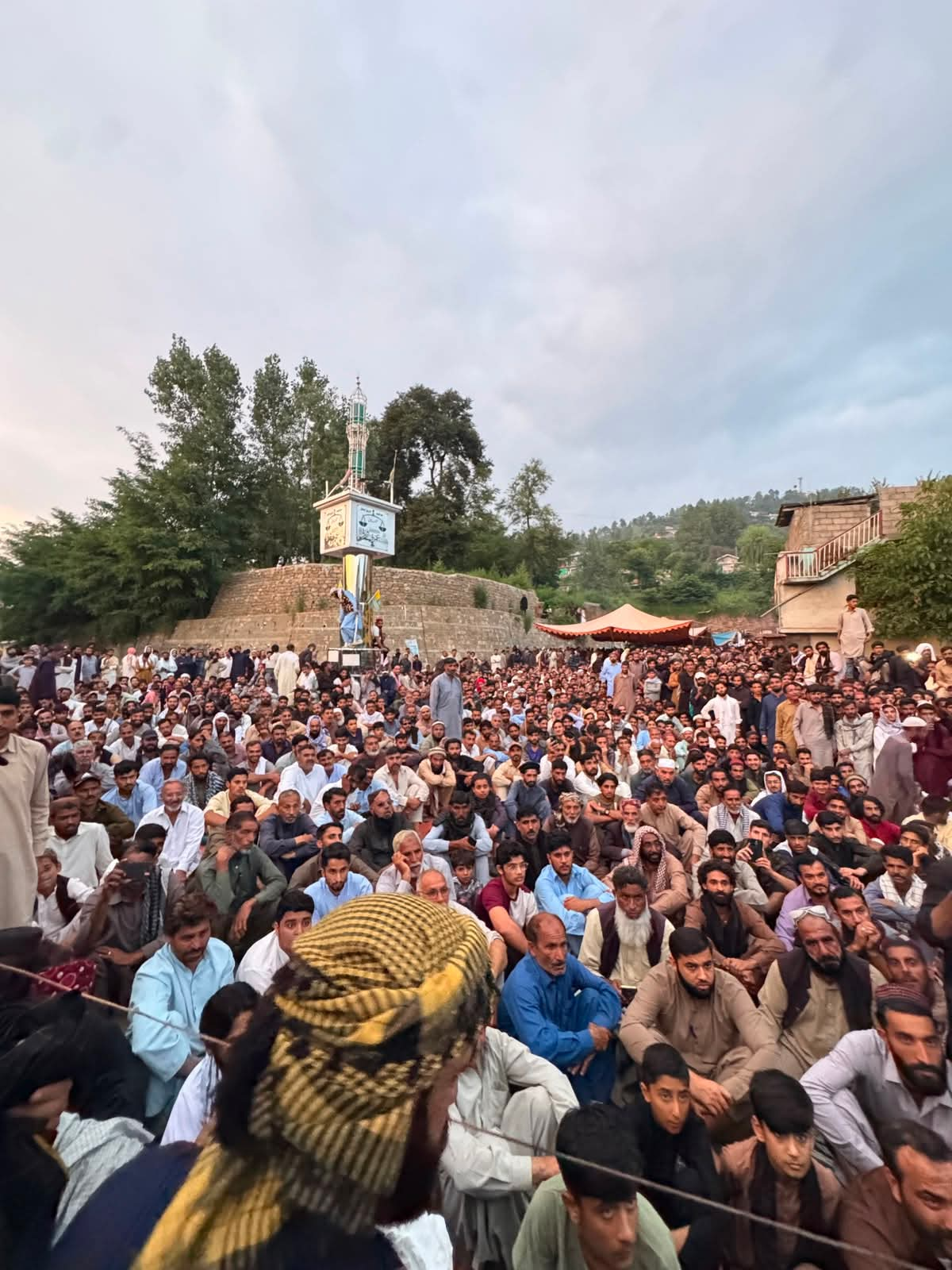
It seems from the images, slogans, speeches and video messages from the Rawalakot Dharnas (Sit-Ins) that the situation that has developed in Azad Kashmir since 5 June is no longer simply a matter of a few demands, a number of arrests, or some administrative decisions. The past two and a half months have exposed, with unprecedented intensity, a fundamental contradiction between the state and the people—one that for decades has been suppressed through temporary compromises, political manoeuvring, official narratives and decisions imposed from Islamabad.
For that very reason, the solution to this crisis cannot be found by gathering the same traditional politicians in closed rooms in Muzaffarabad, reshuffling ministries and positions, or offering a few administrative concessions. The discussion must begin from the point where the crisis itself began.
And that point is 5 June.
If there is a genuine desire to restore normality, the first requirement is to acknowledge that what has happened since 5 June has fundamentally transformed the political and social environment of Azad Kashmir. The state cannot continue speaking the political language of the period before 5 June while the people are living with the experiences and consequences of everything that has happened since.
That is why meaningful negotiations should begin in Rawalakot rather than Muzaffarabad.
Rawalakot is no longer simply a city. Over the past few months, it has become both the political and symbolic centre of the present crisis. The people gathered there do not merely represent a single organisation or a handful of leaders. They embody a much wider public discontent that has been accumulating across different parts of Azad Kashmir for years.
One of the principal political tools used by the authorities to weaken this popular movement has been an attempt to associate the Joint Awami Action Committee and those connected with it with terrorism. The assumption, perhaps, was that once a movement was labelled “terrorist”, ordinary people would become frightened and distance themselves from it.
The problem for the authorities is that a large section of the public simply does not believe this narrative.
People know that these same leaders have spent years negotiating with governments and ministers. They have been parties to agreements, attended meetings with official committees, and negotiated precisely over the demands that are now suddenly being presented as threats to state security.
The public has seen these people living among them, organising rallies and strikes and sitting across negotiating tables from government representatives. A government notification or a television narrative cannot simply erase that collective public experience.
This is why the terrorism narrative appears not only politically ineffective but increasingly absurd.
When an entire population understands a movement as a struggle for civic, economic and political rights, it cannot simply be transferred into the category of terrorism through the use of force. Narratives acquire power only when reality on the ground confirms them. In this case, the reality on the ground appears to contradict the official narrative.
There is, however, another and perhaps more fundamental dimension to the present crisis: the nature of the relationship between Pakistan and Azad Kashmir.
The state must understand that force can create temporary silence, but it cannot create political consent.
For decades, that relationship has formally operated through constitutional, political and administrative institutions. In practice, however, ordinary people in Azad Kashmir have repeatedly been left with the impression that this is not a relationship between two political entities based on mutual respect, but one between ruler and ruled.
Major decisions are often taken elsewhere. Local governments frequently appear reduced to implementing decisions made outside the territory. And whenever the people challenge those decisions, the response too often comes through administrative or security measures rather than political dialogue.
This relationship cannot continue indefinitely in its present neo-colonial form.
Any durable future relationship between Pakistan and Azad Kashmir must be rebuilt on mutual interests, mutual respect, political confidence and voluntary cooperation.
Relationships between states and peoples cannot survive on power alone. Lasting relationships require trust, and trust can only be created when people believe that their dignity, political standing and collective interests are being respected.
The events since 5 June may have brought this question before ordinary people with greater intensity than ever before.
And perhaps this can also become the most important lesson to emerge from the crisis.
The state must understand that force can create temporary silence, but it cannot create political consent.
The leadership of the movement, equally, must recognise that a prolonged popular struggle cannot advance through resistance alone. It also requires political strategy, disciplined organisation, negotiations and decisions shaped by a longer-term vision.
That is why negotiation remains the best available way forward.
But negotiations cannot mean returning to the old formula in which a few representatives arrive from Islamabad or Muzaffarabad, photographs are taken, promises are made, and a few months later everything returns to where it began.
This time, the purpose of negotiations cannot merely be to end the sit-ins.
They must address the roots of the crisis.
The first step must be the restoration of trust. The second should be a political settlement of the situation created since 5 June. The third must involve a serious conversation about a new relationship between Pakistan and Azad Kashmir—one in which mutual interest and respect, rather than the exercise of power, become the guiding principles.
That process can begin in Rawalakot.
It should begin where the resistance assumed its present form, where the political rupture has been deepest, and where the rebuilding of trust is most urgently required.
Negotiations will not necessarily be easy. There will be bitterness on both sides. Agreement may not be immediately possible on every issue.
But one fact should now be clear: the present course is taking neither side anywhere.
The state cannot permanently eliminate this movement through force, and the people cannot remain indefinitely trapped in a condition of political, economic and social paralysis.
Sooner or later, politics will have to prevail over guns, arrests, bans and propaganda.
And if all sides are genuinely prepared to learn something from the experiences of the past few months, this very crisis may contain within it the possibility of constructing a new political relationship.
A relationship in which Pakistan begins to view Azad Kashmir not merely as an administrative unit expected to comply with decisions made elsewhere, but as a political society with its own interests, sensitivities and collective dignity.
At the same time, the leadership in Azad Kashmir must move beyond the cycle of confrontation and reaction and develop a clear political programme capable of defining the terms of a new relationship for the future.
The ice may indeed begin to melt.
But the first requirement is to recognise that this is no longer simply a dispute over a list of demands.
Since 5 June, the fundamental question has become the nature of the relationship itself.
And the answer to that question may have to be found not in the corridors of power in Muzaffarabad, but on the ground in Rawalakot.

Comments (0)