
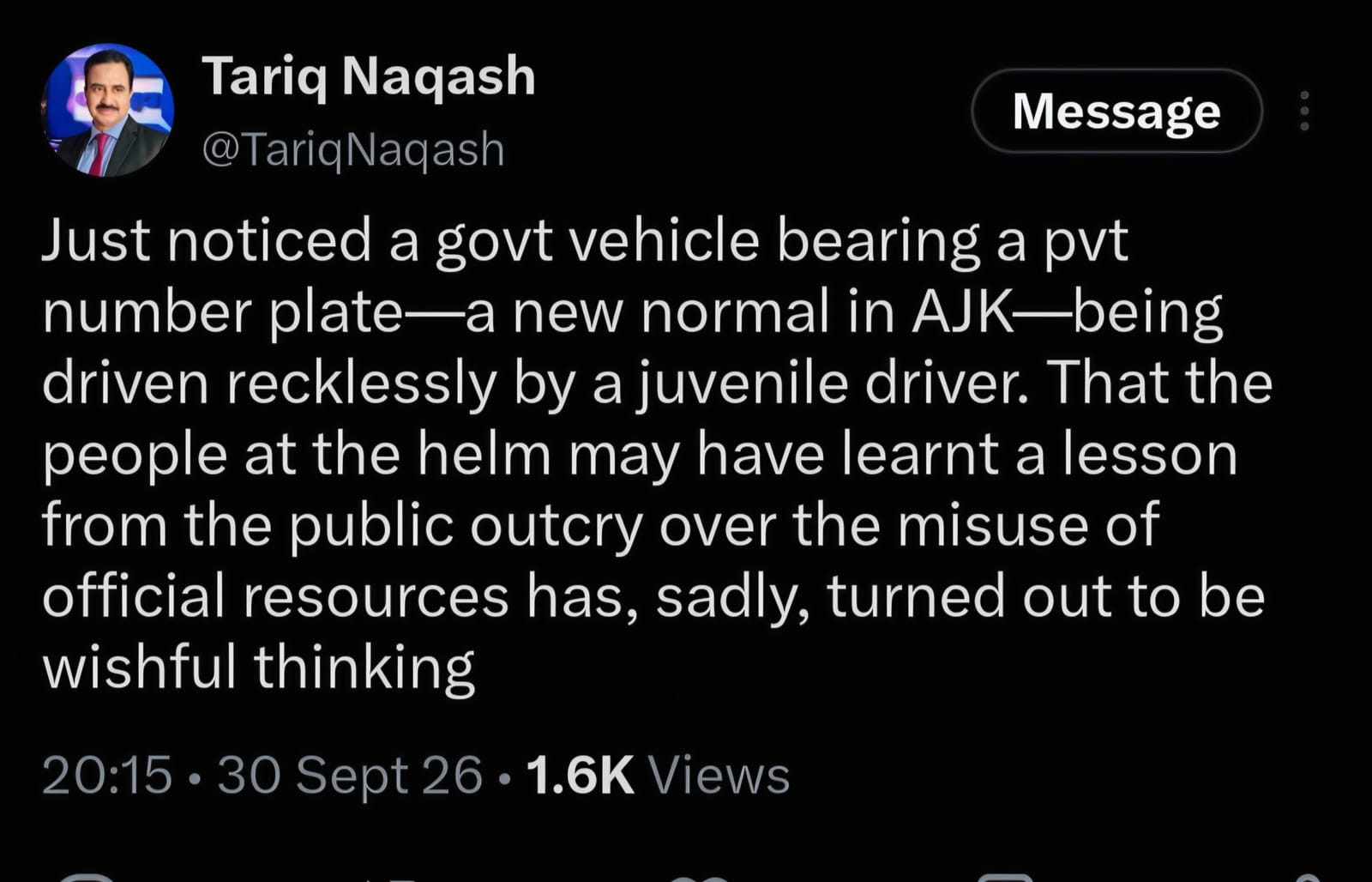
Just saw an official vehicle with a private number plate, which has now become the new normal in Azad Kashmir, being driven recklessly by an underage driver.” These words were written this week by Tariq Naqash, one of the most credible journalists in Pakistan-administered Kashmir. He had hoped that those in power would have learned some lesson from the public backlash against the misuse of official resources. That was not the case.
An official vehicle, an unruly teenager, a fake private number plate. The scene is small, but it explains why the people of Rawalakot have been sitting by the roadside for nearly four months.
How It Began
The Joint Awami Action Committee is not the creation of any “foreign hand.” It is a civic platform of traders, lawyers, transporters, and students. Its demands are not revolutionary: affordable electricity and subsidized flour, better healthcare, education, and infrastructure, an end to elite privileges, and political reforms. In other words: stop squandering our water, our electricity, and our taxes on official cars for a select few.
Islamabad and Muzaffarabad have already acknowledged on paper that these demands are legitimate. The government itself says that under the agreement of 4 October 2025, all 38 demands of the Action Committee were accepted in the wider public interest. Approved, signed, and then left to gather dust in files.
From Negotiating Partner to “Terrorists”
When people complained that promises were not fulfilled, the state found an easier solution than honoring them. On 5 June, the Azad Kashmir government declared the Action Committee a banned organization under the Anti-Terrorism Act. Traders and lawyers became terrorists overnight.
Traders and lawyers became terrorists overnight.
What followed was bloody. The Commissioner Poonch confirmed that twelve people lost their lives in a clash in June—eight protesters and four security personnel. Authorities blocked the identity cards and passports of all 31 core members of the Action Committee, and the Minister of State for Law announced that there would be no negotiations. The Action Committee claims that 67 people were killed between 5 June and 28 July, though this figure could not be independently verified. The state maintains that armed committee members killed a Rangers soldier and injured police personnel while attempting to enter the city in July. Those who died on both sides are sons of these very mountains.
A City in the Shadow of Drones
A journalist who visited the sit-in in September described the scene in clear terms: surveillance drones flying low over the protest site, restricted communications, and very little hope in the newly formed government. Many people said that the continuation of restrictions even after the elections was proof that changing the government does not change the actual system.
This is the irony. Elections were held, ministers took oaths, official vehicles were distributed. Yet Rawalakot still cannot make a phone call today.
What Lies Ahead
In early September, a delegation led by a government member of the assembly initiated preliminary contacts, but no progress was made. Now the committee is preparing for a new phase. The Action Committee has asked citizens to stockpile two months of rations by 3 October, announcing that an “extremely important call” will be given on 4 October. This day will be observed as a “Black Day” to mark one year of the agreement and its violations.
The people of Rawalakot are exhausted. Traders want to open their shops, parents want to send their children back to school. But being tired is not the same as giving up. Many people want a return to normal life, but not by surrendering, and certainly not the old normal.
The question for the rulers of Muzaffarabad and Islamabad is straightforward. You can ban a committee, block passports, and fly drones over a sit-in. But as long as a minor drives a government vehicle with a fake number plate around a city where shops are closed and phones are silent, you cannot fight terrorism.
Comments (0)