

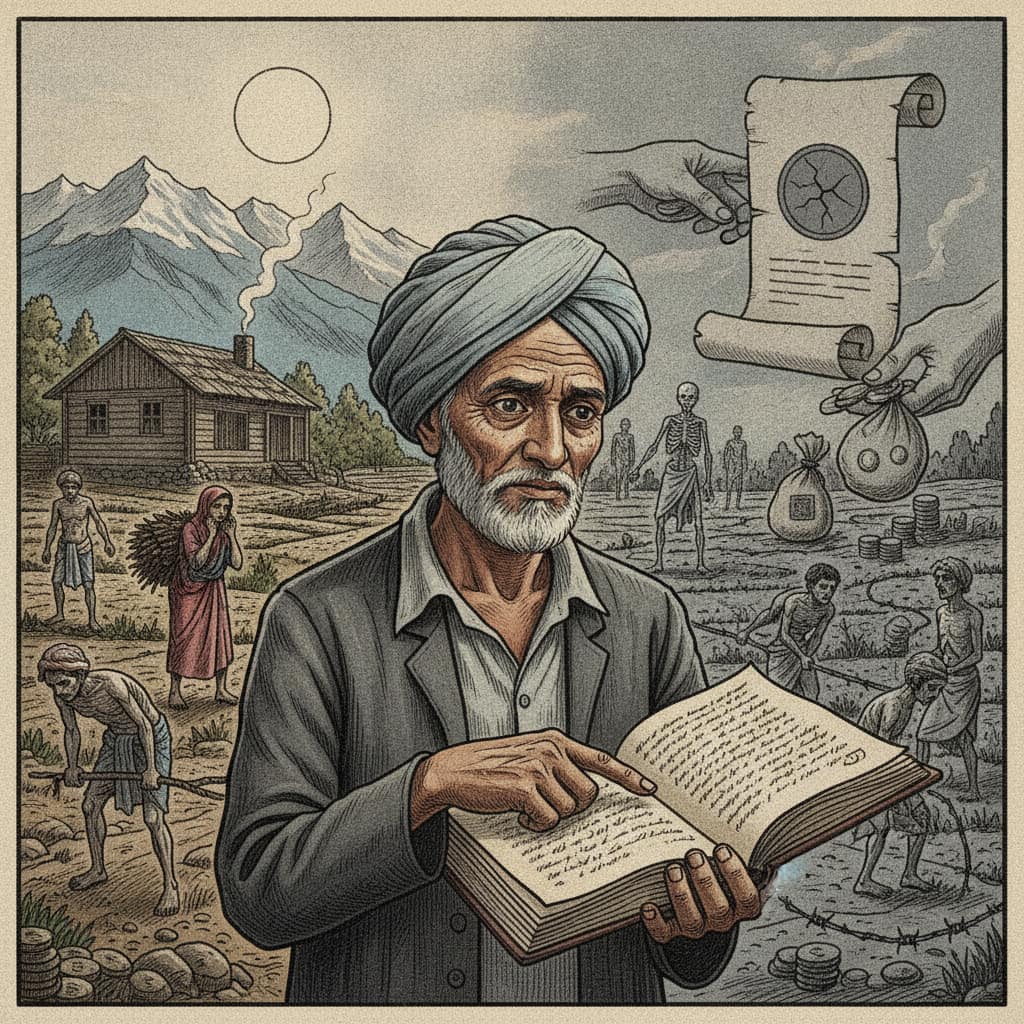
There are historical texts that acquire significance because their authors occupied positions of political power, and others whose importance lies precisely in their attempt to make visible people who rarely entered the official record except as taxpayers, labourers, tenants, subjects or statistics. Budh Singh's Dihati Zindagi belongs to the latter category.
At its centre is an apparently simple question: what was rural life actually like for the cultivators of the princely State of Jammu and Kashmir?
Budh Singh's answer is unsettling. The celebrated landscape of Jammu and Kashmir—the mountains, rivers, forests, orchards and fertile valleys—coexisted with another reality: cultivators struggling with inadequate food and clothing, poor housing, disease, indebtedness, heavy taxation, administrative coercion, begar or forced labour, inadequate education and a profound sense of powerlessness. Yet Dihati Zindagi is not merely a catalogue of misery. Its larger purpose is to explain why this condition existed, how cultivators had been made to understand their own place in society, and what would be required to change it.
Budh Singh: From Government Officer to Rural Reformer
The intellectual authority of the work comes partly from Budh Singh's unusual relationship with the world he describes. He had served within the administration of the princely State and encountered cultivators first through the machinery of government and later through prolonged direct contact with rural society. In the Preface he reflects critically upon the contradiction between the title “public servant” and the actual social relationship between officials and ordinary cultivators. Status, dress, authority and distance could turn the official into someone whom the rural poor feared rather than trusted.
Budh Singh describes abandoning some of these markers of official superiority, entering cultivators' homes and listening directly to their suffering. He records that the Settlement Commissioner went so far as to write that Budh Singh assisted cultivators to such an extent that he did not care even for rules and regulations. Budh Singh eventually concluded that the selfless service he regarded as his moral duty could not be carried out adequately while he remained in government employment. He resigned and, by the time he wrote this book, said he had lived a rural life for approximately twelve years and travelled through most parts of the State.
A Different History of Jammu and Kashmir
Much political history of modern Jammu and Kashmir is understandably written around rulers, organisations, communal identities, constitutional arrangements, wars, territorial disputes and 1947. Dihati Zindagi directs attention elsewhere—to the people working the land. Ordinary cultivators experienced the State through the crop, the land-revenue demand, the forest, the grazing ground, the moneylender, the patwari, the policeman, compulsory porterage, the household budget, the sick child and the struggle to maintain enough food to continue working.
Budh Singh's cultivator is therefore not an abstraction. He eats, works, borrows, marries, raises children, tends animals, pays revenue, becomes ill, fears officials, quarrels, performs begar, loses livestock, worries about debt and tries to keep the household alive. This materiality makes the work an unusually valuable source for the social and economic history of the princely State.
“You Are the Producers”
The conceptual turning point comes in Chapter Three, where cultivators describe themselves as servants, slaves, dust and people dependent upon the mercy of wealthier classes and officials. Budh Singh reverses the picture. Who grows the grain, produces cotton, tends cattle, supplies milk and ghee, builds roads and houses, labours in factories, provides transport, pays revenue and supplies sons to armies? His answer is encapsulated in the book's most striking sentence:
“You are the producers, and the world is the consumer.”
The socially insignificant cultivator is asked to recognise that the wider order rests upon productive labour. Budh Singh even tells cultivators that wealthy people, ministers, officers and rulers are in reality their servants, existing for their protection and service. Yet it would be misleading to recast him retrospectively as a revolutionary socialist in a modern ideological sense. His producer is also asked to become a true sevak: self-respect is joined to service, moral responsibility and social cooperation.
Poverty as Both Structural and Social
Budh Singh refuses a single-cause explanation of rural poverty. He criticises expensive marriage customs, jewellery, intoxicants, unnecessary borrowing, poor sanitation, weak agricultural practices, quarrels, superstition and wasteful household spending. But he is equally clear that many burdens lie outside the individual cultivator's control: land revenue, grazing taxation, administrative corruption, bribery, restrictions on commons, interference with mulberry-tree rights, lack of education, official arrogance and begar.
The book therefore develops two connected programmes: reforms cultivators can undertake themselves and reforms that require Government and institutional action. Self-help is not allowed to become an excuse for structural neglect; nor is structural criticism used to deny the agency of rural people.
Begar, Taxation and the Commons
Budh Singh's treatment of begar is especially important. A cultivator taken away to carry an officer's baggage loses more than the hours spent carrying the load. Crops, animals, fuel, water, family care and wages are all affected. A man may bribe an intermediary to escape, shifting the burden onto someone poorer. Budh Singh's practical alternative is voluntary paid labour and permanent transport arrangements. His objection is not to labour but to coercion without consent or wages.
His discussion of land revenue similarly distinguishes the nominal tax from its real burden. If crop prices collapse while the cash assessment remains unchanged, the cultivator must sell far more produce to raise the same amount of money. His discussion of shamilat likewise treats common land not as empty waste but as collective rural wealth providing pasture, fodder, fuel, timber, ecological protection and security for livestock-based agriculture.
Women, Health and Education
Budh Singh's treatment of women is both reformist and historically contradictory. He condemns the sale of girls, exploitative marriages, lack of girls' education, neglect of daughters after marriage and excessive labour imposed on women. He calls woman one of the two wheels of the household cart. Yet some passages retain strongly patriarchal assumptions and harsh gendered language. A historical translation should preserve both dimensions rather than manufacture a twenty-first-century author.
Health occupies an equally large place in the work. Food, water, ventilation, clothing, sanitation, infectious disease and animal health are all treated as economic questions because the cultivator's body is his principal productive resource. Education, in turn, is not meant simply to create clerks. Rural schools are to teach agriculture, crafts, health, sanitation, law, arithmetic and practical skills to boys and girls, so that knowledge strengthens rather than empties rural society.
The State: Necessary but Not Unlimited
Budh Singh does not reject the princely State. He appeals respectfully to Maharaja Bahadur and imagines an ideal relationship of mutual confidence between ruler and subjects. Yet that loyalist vocabulary sits beside substantial criticism: public servants must be accountable; taxation must be justifiable; recognised rights must be respected; forced labour must end; and Government has positive duties concerning education, health, irrigation, credit and rural welfare. The State is necessary, but its authority is not unlimited.
The Wider Corpus and Suppression
Dihati Zindagi was one of several pamphlets and booklets Budh Singh wrote and published concerning rural society and public affairs. Historical evidence concerning the confiscation of some of his writings by the princely Government under Maharaja Hari Singh deserves fuller archival documentation in a future critical apparatus. The present edition does not infer the precise grounds of confiscation where the documentary record has not yet been established, but the text itself makes clear why his writing could be uncomfortable for an authoritarian administration: he challenged forced labour and taxation, exposed bribery and administrative arrogance, defended recorded property rights and told cultivators to understand their own collective strength.
A Note on Translation
The aim of this English edition is accessibility without erasing historical character. Terms such as begar, shamilat, biradari, khaddar, seva, ishnan, gyan, dhyan, patwari, numberdar and Zamindara Bank are retained where a single English substitute would flatten their historical meaning. Period medical and nutritional claims are translated but contextualised. Damaged source text is marked rather than silently repaired.
The governing editorial principle is simple: clarify the historical text, but do not silently rewrite history.
Shams Rehman Translator and Editor
Preface Chapter One — The Present Condition of the Cultivators
- The Bearing of Children
- The Upbringing of Children
- Food
- Clothing
- Housing
- General State of Health
- Effects of Infectious Disease
- Treatment of Women
- General Condition of the Cultivators
- Living in Fear
- Begar
- Customs, Conventions and Wasteful Expenditure
- Marriage
- Death and Fourth-Year Commemorations
- Income and Expenditure
- Use of Intoxicating Substances
- Litigation
- Anxiety over Payment of Land Revenue
- Methods of Cultivation and Manure
- Vegetables
- Methods of Irrigation
Chapter Two — The Brighter Side of Rural Life Chapter Three — General Conversation Chapter Four — Reforms Which Cultivators Should Undertake Themselves
- Food: air, water and grain
- Clothing
- What Housing Should Be Like
- Care of Livestock
- Social Reforms
- Syphilis
- Jewellery
- Removal of Superstition
- Abstinence from Intoxicating Substances
- Respect for Women
- Education
- Cleanliness
- Bathing (Ishnan)
- Putting the Financial Condition in Order
- Avoiding Debt
- Improving Methods of Cultivation
- Grazing Grounds and Common Land; External Pressure, Fear, Anxiety and Grief
- Do Not Give Bribes
- Protect Your Rights
- Difficulties and Losses Connected with Mulberry Trees
- The Zamindara Bank
- Cooperation and Mutual Sympathy
Chapter Five — A Scheme for Reform
- Government Assistance
- Establishment of District Boards
- Services of Scouts
- Curriculum
- Reduction of Land Revenue and Grazing Tax
- Release of Mulberry Trees
- Abolition of Begar
- Final Appeal
- The End
When one considers the vast country of Jammu and Kashmir — its varied forms and features, conditions and influences, climate, production, geographical situation, the customs and practices of its inhabitants, their manner of living, food, clothing, physical build, health, morals and other matters — it appears, taken as a whole, difficult to describe in one article or book the condition of the cultivators and labourers of all its different regions and at the same time to put forward proposals for their reform, progress, improvement and welfare. Any person who regards it as a religious duty to assist these cultivators in every possible way may also hesitate before such great differences in conditions and, finding that until now there has been no movement of this kind, may pause before putting forward an entirely new but labour-intensive proposal and wonder how this difficult problem can be solved. Until now, despite seeing, hearing and deeply feeling these matters, I too have been unable to take any sufficiently effective step. But now that I have come to regard nishkam seva — selfless service without desire for personal gain — as the final and supreme work of my life, and have concluded that without it no real success in human life is possible, the first question requiring an answer has arisen before me: where, in fact, is service needed? Who are the people who, because of internal and external conditions — that is, the circumstances around them — and because of their ignorance, negligence or helplessness, are suffering and sustaining losses, and who spend their whole lives in misery worse even than that of animals?
During my government service this question repeatedly arose and then came to a halt, because no clear path appeared by which their condition might be reformed. It is true that from time to time, in the discharge of my official duties, some proposals were made to remedy their external hardships and losses; but these useful, reformative, practical and necessary proposals did not receive adequate attention. This caused me pain. At the same time I came to realise that the expression “public servant” existed only in words, not in practice; in actual conduct matters were often the reverse.
The lifestyle of officers, their tone, manner of conversation and behaviour were such that it was difficult to create in the hearts of poor cultivators any feeling of affection, love or sympathetic confidence. Outwardly I too belonged to the same world of official pomp. But as, day after day, I saw the painful condition of those who suffered and the losses and hardships they endured, some feeling of compassion arose within me, and my heart and mind decided that I ought to become a public servant in the true meaning of the words. I therefore had to abandon the frightening official appearance, fashionable clothing, artificial prestige and authority, and the contemptuous treatment of poor, unclean and uneducated cultivators and labourers. As soon as a visible change came into my appearance, clothing and way of life, I found opportunities to mix with these people, to sit close to them and listen to their conversations about suffering and pain. To understand their internal circumstances I also had to enter their homes; then I realised that to refuse to assist or reform them was a great sin.
For several reasons it remained difficult to participate openly in work for their assistance and reform. Nor could these people easily disclose their true circumstances or establish full mutual confidence with an official. The work I was doing went, to some extent, beyond questions of policy or ordinary official objectives; it contained real heartfelt sympathy and a current of service, and a desire to love these people sincerely. Yet even then I could not establish complete trust among them. Some intelligent cultivators welcomed this good treatment, regarded it as a sign of good fortune, valued my simple way of life, and gradually came and sat near me so that sympathetic conversations began. Even so, fear, deference, rules, personal interests and anxieties about possible gain or loss remained in their minds. The ordinary people stayed farther away and were greatly afraid. Because the conduct of ordinary employees was so often shaped by selfishness, greed and needless displays of authority, they could hardly believe that a government employee might perform selfless service from genuine affection, or that a poor cultivator or suffering person could expect sympathetic treatment from such employees.
As soon as Faryad-e-Raiyat (“The Cry/Appeal of the Subjects”) was made known and the story of their hardships, suffering and need for help was told, they realised that someone was at least raising a voice about them and extending a hand of sympathy. Gradually they began to come closer to me and some trust and confidence in me developed.
Despite this limited success, I was grateful that, in place of fear and estrangement, some expectation of affection and loving treatment towards me began to arise in their hearts.
For several reasons I did not consider myself capable of giving them the full sympathy and reform they required. One reason, among others, was that such an approach was wholly unusual for a government employee, especially a revenue officer, and it also began to create other suspicions in the minds of senior officials. The Settlement Commissioner went so far as to write: “Budh Singh assists the cultivators to such an extent that he does not even care for law and rules.” These remarks not only prevented me from extending full sympathy; in a way they hindered me even in performing the ordinary assistance that formed part of my essential duties. My direct conversations with cultivators and my efforts to establish a bond of sympathy and affection with them began themselves to be viewed with suspicion.
By then, however, I had fully understood that among the sacred duties of government service was the welfare and improvement of this class, which is the backbone of the State, the root of the tree of the Raj and its very life-breath. Without its welfare neither the condition nor the strength of the country and people can remain sound. Until the cultivators’ suffering, pain and losses are removed, and until they are taught the principles and rules of a properly human life, peace, contentment, feelings of loyalty and relations of mutual confidence cannot be created between ruler and subjects. The struggle over whether this sacred duty could be fulfilled while I remained in service, or whether resignation was necessary in order to carry it out, continued for several years. But the work remained constantly before me and its influence within me deepened. I made a permanent decision that I must do it. Beyond the honest and impartial performance of government duty, it contained genuine loyalty, goodwill and service towards both Government and subjects; personally too it brought great satisfaction and happiness and seemed to me a secret of success in human life. I therefore resolved to undertake it and not abandon it for as long as I lived.
Eventually the question was settled. I concluded that genuine work for the improvement and reform of the suffering, poor and destitute cultivators, and true sympathy and selfless service towards them, could not be carried out unless I gave up government employment. I had also become convinced of the impermanence of worldly possessions and the temporary and artificial nature of worldly ties and relationships, and resolved to set out in search of truth. So I resigned from government service.
Afterwards, as I obtained greater opportunities to live among these people and to see and hear their circumstances, I continued from time to time to describe what I observed. But the Government did not consider these matters with the same sincerity, good intention, truthfulness, openness of heart and sense of justice with which they were expressed. Instead, opposition arose and they were suppressed in one way or another.
The situation has now reached a point at which the present condition of these suffering people has become unbearable to me. I believe that delay in the work of their reform and in extending sympathy towards them is, in a sense, a grave sin against human society and Government itself. In view of these circumstances I therefore consider it essential to present, as far as my knowledge allows, proposals for improving the condition of the poor labouring and cultivating classes of this country.
For twelve years I have adopted rural life and, during that period, have tried within the limits of my ability and strength to perform service. I have come to regard this work of selfless service as the highest duty of life and as my dharma. I have also travelled through almost the whole State, apart from Gilgit and the higher regions, and have become acquainted with the different circumstances of the people of each region and gained some experience. I therefore believe that this work particularly belongs to me and that I have a right and responsibility to put it into writing.
I hope that every compassionate and sensitive person, whether a government employee or not, will keep before him the sacred duty of human sympathy and service to brothers who need assistance, and will help in this work.
Budh Singh
The Present Condition of the Cultivators
There can be no doubt that when a person sees the sky-reaching mountains, dense forests, waterfalls, meadows, rivers, springs, long and attractive roads, electric lighting, excursions in boats and houseboats, royal gardens, flowers of every kind, extraordinary natural scenery, beautiful many-coloured birds singing melodiously, pleasant air, green fields and fruit-bearing trees, he involuntarily exclaims: “This country is a paradise!” He imagines that the people who live here must be fortunate indeed, enjoying these priceless natural sights and receiving so much fresh air, abundant light, cool water, fruit and flowers.
But he does not know what kind of world exists within this beautiful setting; how far the people living there actually possess the right or opportunity to enjoy all these blessings; how much benefit they can obtain from them; or how useful these things are to them under their present conditions. Nor does he know of the hundreds of miles of desolate wilderness, how the population in the snowy mountain regions manages to live, or how people in places such as Maru Kundi pass the summer, and so forth.
This ignorance is not confined to strangers. Even people belonging to the country itself may know little if their experience consists merely of travelling along motor roads and looking casually at natural scenery, or if with the help of Government or wealth they have secured every comfort and toured beautiful valleys, forests and gardens. Until sufficient evidence is placed before them, or they are shown the reality with their own eyes, they are unwilling to accept that amid such abundant manifestations of God’s nature and so many means of recreation there can still be hardship, suffering and loss. They ask: can there really be people living in hell inside this paradise?
Come, friends! Let the wealthy who are captivated by outwardly delightful comforts and natural scenery, self-indulgent and absorbed in bodily ease, and who spend part of their lives in apparent luxury, listen.
Let those who outwardly claim responsibility for millions of poor cultivators — for protecting their lives, property and honour, thinking about their welfare, and saving them from the grip of merciless, unjust, greedy and bribe-taking subordinate employees — listen too.
Let the ministers who in reality are absorbed in hopes of salary and promotion, personal interests, comfort and ease, who dance to the signals of senior officers, become compelled to act against conscience, cannot administer sufficient justice and are almost empty of compassion, listen.
Let the faqir who, affected by the suffering of the poor, cannot endure their painful condition and seeks not only to fulfil the high and sacred human duty of selfless service and sympathy but also to relieve his own pain, listen.
And listen carefully to the prisoner confined in a fort as the price of struggling with all his strength to fulfil this duty and dharma, of feeling the pain of the poor, of creating the conditions for genuine loyalty, and of revealing truthfully the real condition of the subjects.
What is the condition of the poor cultivators? Why are they suffering? How are they living their lives?
It is not easy to answer these questions. But until a defect, an evil or a disease has been described, its treatment is difficult. I shall therefore present a picture of their present condition.
As far as possible, I shall describe events that I have personally witnessed, so that there may be little opportunity for anyone to oppose the account merely by demanding evidence, and so that instead of wasting further time on inquiry and investigation, the work of reform can begin quickly.
The Bearing of Children
When the method of marriage itself is so painful and so full of defects, how can the birth of healthy children be expected? In the past, the marriage of minors caused very serious damage to the health and future generations of the cultivating class. Fortunately a law has now been enacted against it. When I was first appointed President of the Dogra Sadar Sabha, I raised in my presidential address the questions of preventing tobacco smoking and the marriage of minors, and resolutions were submitted. Laws were passed on both matters, for which Maharaja Bahadur deserves great gratitude.
Yet the condition of the people is truly distressing. When they heard that the law would come into operation after one month, thousands of small boys and girls were married within a matter of days, thereby creating the conditions for the destruction of their lives. What ought to have happened was that all such marriages should have been declared invalid and cancelled. Even now I would say that all marriages of under-age boys and girls should be regarded as invalid. The consequences of these marriages are as clear as daylight. The relationship between husband and wife should rest upon love and affection, unity, compatibility and the responsibilities of household life; how can such a relationship be maintained when a lifelong marriage contract has been imposed by irresponsible, greedy and ignorant parents or relatives against the wishes and preferences of the boy and girl and without regard to compatibility of qualities, temperament and disposition?
When such boys and girls grow up, they naturally form attractions and affections according to their own inclinations. Budh Singh then argues, in the medical and moral language of his period, that such arrangements may lead to infertility or unhealthy children because the reproductive energies of the spouses have been expended elsewhere or because children are conceived in conditions of hostility, aversion and sorrow. He then turns to men who remain unmarried because they cannot pay the hundreds or even thousands of rupees demanded by a girl’s family, and who have no girl available to give in exchange. Such men may remain outwardly unmarried for life and live in great distress. If they eventually marry, it may be possible only through borrowing or selling the house and property; the girl may be fifteen or sixteen while the husband is forty-five, fifty or even older.
How long, he asks, can such a couple preserve affection and maintain a flourishing household? He describes an older husband who has not lived in sexual restraint and whom he believes to have exhausted his physical powers; he associates this with infertility and venereal disease. On the other side stands a young woman who, finding that her household and marital expectations are not fulfilled, may seek elsewhere. Budh Singh’s biological explanations are those of his period, but his central social accusation is clear: extreme age disparity, coercion, ignorance and the purchase of brides create conditions of unhappiness, disease, infidelity and household breakdown.
Because this practice, he says, is especially common among Hindu cultivators, he believes that families are becoming weaker and childless; genealogies show, in his view, whole lines dying out. He therefore regards the custom as deeply harmful to the cultivating population.
Those who cannot marry in their youth may turn to illicit sexual relations, bring women into the household outside recognised marriage, or elope with married women. They then incur heavy expenditure in litigation, may be punished, ruin their bodies and households and fall into debt. Similar problems exist to some degree among Muslims, though children are born; yet the procedures of marriage and divorce and the intervention of selfish and greedy intermediaries destroy households, waste the money of poor cultivators, draw them into litigation and separate social practice from genuine sympathy and responsibility. When couples are married without consent and mutual affection, wives often seek release from husbands and husbands from wives, and both begin searching again for suitable partners.
Translator’s Medical Note
The preceding passages contain early twentieth-century claims about sexuality, heredity, fertility and disease that do not represent modern medical knowledge. They are translated because they are part of Budh Singh’s historical argument, but they should not be read as present-day clinical guidance.
The Upbringing of Children
The method of bringing up children is so poor that they often remain sick and weak. Mothers, because they themselves are extremely uneducated and live in unhygienic conditions, are often not in a position to provide children with proper care. It seems that their responsibility ends with somehow giving birth to a child; what then happens to that unfortunate child is often extremely painful.
I have frequently seen that children’s eyes have been damaged while the very practice or carelessness that caused the damage continues. Children are left exposed to the sun and not protected from dust. To protect them from flies and mosquitoes, a dirty and filthy cloth is placed over the face. Their breathing becomes difficult, they become distressed and cry, and by crying continually their health is weakened. Sometimes they develop fever. When a mother then shows greater affection, she may lift the child and press it against her own unclean, foul-smelling, perspiration-soaked body and cover it with another garment. The child continues to suffer beneath it and the condition of its health and eyes becomes still worse.
This, Budh Singh says, is why some children become blind in one or both eyes or suffer weak eyesight. If a child survives the hardships of infancy and reaches childhood, there is often no arrangement for education. Nothing useful or good is taught. Children learn abusive language and aimless wandering and are then put to grazing livestock. The years in which they ought to become human beings in the fullest sense, obtain education, make themselves useful and acquire the capacity to make rural life beautiful and productive are instead spent learning bad habits.
In short, the health, upbringing, morals and education of boys and girls are left to fate. Living continually among livestock, uneducated and without knowledge, they remain at the level of animals and, Budh Singh says harshly, may become more dangerous still. The entire blame does not lie with women; men are also responsible because they burden women with so much other work that mothers have little time to bring up children properly. The greater cause is ignorance, and removing that ignorance is the work of Government.
Food
The condition of the cultivators’ food is also remarkable. Generally they live on lassi, if a fortunate household possesses a milk-giving cow or buffalo, or on dry bread with salt, chillies or chutney. Even this is not prepared in a properly clean manner. Pulses or greens are merely boiled, perhaps with a little oil, in dirty unwashed utensils on which grime and black soot have accumulated. Water is drunk without filtering regardless of how much sand or how many insects it contains. Flour is kept exposed in baskets; dust and earth fall into it, rats eat from it and leave droppings and urine in it, and insects infest it. It is generally kneaded without sifting and sometimes in darkness.
Large quantities of red chilli are used. If someone is sick or weak, he must still eat whatever has been cooked for the household, whether it benefits him or kills him. People are accustomed to stale food; even in summer they may eat food that has begun to smell.
Cultivators who take bread to work, or have it brought to them, often carry it wrapped in cloth so filthy that one hesitates even to touch it. Some tie bread in a loincloth that has become dirty, black and greasy.
The cooking hearth is often in a dark place with no outlet for smoke. Soot accumulates and continually falls into the food.
And this is only the condition of the fortunate cultivators who actually possess grain. Many others live with a daily anxiety over how they will obtain or grind enough grain. Some pass several days living only on greens or pulses. At current grain prices people elsewhere may imagine that grain is available to everyone, but they know little of the remote snowy mountain regions where scarcity is almost permanent.
There are thousands who cannot obtain ghee, oil or vegetables; milk and butter are entirely beyond them. I have seen labourers and cultivators performing the hardest physical work eating plain dry bread and swallowing it with mouthfuls of water. Sometimes even salt is unavailable. I have seen people who cannot obtain enough bread to satisfy hunger. Such scenes are especially common in distant snowy mountain regions where little grain is produced and supplies from elsewhere cannot easily reach. Rice and pulses are often cooked without properly removing earth and stones, given only a superficial look, put on the fire without adequate washing, and eaten without proper chewing.
Because strenuous labour creates a strong digestion, people do not at first pay much attention to these habits; but when the vigour of youth declines they become victims of many illnesses.
The whole method of keeping food, preparing it and eating it is extremely dirty and harmful to health. Flies are scarcely considered: thousands may settle upon food without anyone caring. If a child urinates or defecates near the eating place or hearth, the place may not be properly washed and cleaned.
Households fortunate enough to possess milk and yoghurt may themselves become breeding places for flies. Milk and lassi vessels can be so dirty that one loses the desire to drink from them, and even the cloth used for straining milk may be filthy.
Clothing
When I speak of clothing, there comes before my eyes the picture of these poor but extremely unclean cultivators, men and women alike. A dupatta, shirt and trousers — assuming they are fortunate enough to possess all the necessary garments — may be so filthy and foul-smelling that passing close to them makes breathing difficult and causes nausea.
Once a garment is put on, it is often not washed until it is torn and reduced to pieces. Clothes become saturated with perspiration; dust settles upon them and dirt accumulates. Hands covered with mud, soot, dung and other dirt are wiped upon the outer garment, shawl or shirt, making it increasingly filthy and offensive-smelling. When, after ploughing, harvesting or other labour, a person finishes work at midday and, if fortunate enough to consider bathing necessary, takes a bath, he may put the same dirty shirt back on without even drying his body. Instead of becoming clean, the body is contaminated again by the dirt in the clothing and begins to smell.
People sleep in the same clothes. If someone thinks of filtering dirty, insect-infested water, he may use these garments for that purpose; milk too may be strained through similarly filthy cloth. If there is a warm garment — a woollen shirt, loi or cap — it too may be so dirty that its smell can be detected from a distance. If ordinary clothing is not washed, how will warm clothing be washed? It is not removed until it has almost fallen into pieces. In snowy mountain regions, even during intense summer heat or the rainy season, people may continue wearing heavy warm garments filled with accumulated dirt. Cotton is not cultivated there and lighter clothing is difficult to obtain, although it might be obtained in exchange for woollen material. People have little awareness of the effects of seasonal change, heat and cold upon health. Lice infest the filthy clothes, people continually scratch their bodies, and itching persists.
This is the condition of the clothes they wear. If you heard the condition of their bedding you would be astonished.
Woollen wraps, quilts and padded bedding may not have been washed since the day they were made, nor regularly placed in the sun. Holes appear; the bedding becomes dirty, foul-smelling and heavily soiled. It continues to be used even if people suffering from infectious disease have used it or children have been born upon it.
Children may soil bedding heavily with urine and faeces, and husband and wife continue to share it, yet the cloth is not cleaned. This is so even though cleanliness is commanded not only for reasons of health but also by religion. Some men bathe their own bodies and then put the same filthy garments back on.
In short, their clothing is extremely dirty, foul-smelling and harmful to health, and it frequently contributes to illness and suffering.
Housing
Rural houses are generally cramped, dark and unclean. There may be no window, no ventilator and no effective source of light or fresh air. Floors are often unfinished and the interior damp because the foundations have not been raised above ground level. A house may be erected directly upon low ground, beside a stream or drainage channel, or on a slope; rain and snow water collects or runs around it, creating dampness inside and contributing to illness. Inferior timber is used and enormous quantities of earth are piled onto the roof; some structures collapse under their own weight. Timber becomes infested with termites and wood-boring insects; fine powder, wood dust and earth continually fall, and unpleasant smells develop. Rats and insects make their homes inside. Roofs often leak, water collects and mud forms, but the interior is not dried.
In winter residence in such a house is extremely unhealthy. Where proper clothing and bedding are unavailable, people try to overcome the cold by tying livestock inside the same room and lighting a fire. The remaining condition of the house then becomes still worse. It becomes dirty and foul-smelling; dung and urine make it wet and filthy. It may become warm, but smoke fills the room so heavily that the eyes water and headaches occur; every object turns black and breathing becomes difficult. Ceilings and walls become black and dirty. Utensils are washed inside and dirty water and leftovers are thrown on the floor, producing bad smells. Children urinate and defecate there; people spit and throw phlegm inside.
Usually there is no window at all. If a small opening exists, it may be used merely as a passage through which urine, faeces, washing water or leftovers are thrown. Filth and foul smell collect outside against the wall until it becomes difficult even to pass nearby — and this is the air the household must breathe.
General State of Health
After reading the condition of their food, clothing and housing, the answer concerning their health almost gives itself. When houses are cramped and dark, with no outlet for smoke and no entry for light and air; when doors are closed and livestock are tied inside; when clothing and bedding are filthy; when the house is filled with foul smells; and when people sleep with their faces covered, how can health be maintained?
The source breaks off here after the words “heaps of filth lie beside the houses.”
[Source defect: original printed pages 20–21 are marked as misprinted/missing in the surviving
transcription.]
Effects of Infectious Disease
This subheading is listed in the original contents. The surviving transcription is defective at the point where the section begins; the translated surviving text follows.
The surviving text resumes with the conclusion that nothing is achieved because the root causes are not corrected: rats are not controlled and cleanliness of houses is not considered first; later, heavy loss of life and property is endured.
The cultivators themselves, despite seeing and hearing what happens, are so uneducated, ignorant of the value of their own bodies and lives, negligent and careless that they neither seek treatment nor accept vaccination nor leave houses affected by plague. Leaving the house is itself regarded as a calamity. Even if, by great effort, cultivators in a village are persuaded to go outside and accept vaccination, it is difficult to compel them by official order to adopt treatment and precautions; some resist and behave aggressively. For that reason they can be protected from disease only by explanation and persuasion.
If a sick person dies, the household does not burn his clothes; often it does not even wash them, but uses them again. The same applies to cholera, which sometimes appears in Kashmir. The filth and foul smell there are well known, great carelessness is shown in food and drink, and canal and kuhl water is used whatever its condition and without filtering. If cholera exists in an upstream village, people in downstream villages may still drink water flowing from above and use it in food without filtering it.
Rotten and stale vegetables are consumed; people defecate and spit wherever they please and throw urine and faeces into rivers or watercourses. In short, they possess neither the knowledge nor judgement required to protect themselves from infectious disease, observe no systematic precautions, and cannot easily be made to understand merely through brief explanations at the moment of danger.
Unless they have first been thoroughly acquainted with the principles of health and hygiene, it is difficult to expect them to take precautions on their own initiative.
Heaps of rubbish and filth collect around houses and along the edges of water. Daily defecation nearby, especially in the rainy season, produces mosquitoes, insects, germs and flies in great numbers. Flies rise from filth and settle upon food and drink, carrying disease. People defecate beside the doors and walls of houses and do not cover the waste with earth. Until it dries it continues to smell, while countless mosquitoes and insects gather. Despite the powerful stench — people may even cover their noses and mouths with cloth while defecating — they do not understand that earth should be placed over the waste or that pits should be dug and covered afterwards.
Every year many cultivators die not only of seasonal fevers and other illnesses but of infectious diseases.
Those who develop seasonal fever often obtain no adequate treatment and observe no proper precautions. They continue working in conditions that worsen their illness, remain on a charpoy for six months or a year, and eventually die; or, if fortunate enough to survive, remain weak and become prematurely old.
I have seen many young men develop fever in a particular season. Because of obvious carelessness and the absence of treatment, the fever became prolonged and persistent. Within six months or a year they looked old. After such physical weakness it is difficult for them to regain freshness or preserve their youth.
Tuberculosis also occurs frequently; the cultivators call it the “small” or nakka tap. Budh Singh associates it with severe neglect during seasonal fevers, exhausting agricultural labour in intense heat and what he regarded, in the medical-moral vocabulary of his period, as failure of sexual restraint. Such people, he says, gradually waste away.
Typhoid fever also occurs and can take life within days. I saw with my own eyes two real brothers in one household, aged twenty-five and nineteen, die one after the other; the household was ruined and other people took charge of the livestock. They were so poor that they could spend nothing on treatment, and there was no doctor. A traditional practitioner was called only when they were dying, and village healers often work by guesswork and may give the opposite of the required treatment because diagnosis is difficult. In this way, carelessness and lack of treatment cause a great loss of life.
How far can one describe the evil consequences produced by negligence and lack of precaution? Whole households become empty. I have often seen every member of a household lying ill, with no one to look after them or even give them water. In utter neglect and helplessness they lie upon their charpoys or on the floor and die in agony. I have also seen that when one or two people become ill, other relatives show great indifference, obtain no treatment and pay insufficient attention, appearing without sympathy or compassion. On one side the sick person is dying; on the other people curse him: “Look, this is the time for work. Seed has to be sown, the plough has to be driven, the crop has to be harvested, and now he chooses to become ill. If he dies, at least we shall be rid of the trouble. Are we to sit by his head and nurse him, or do the agricultural work?” It is a painfully strange condition, one that must be seen. There is illness in the house; work is pressing; there is no money; no doctor or hakim is present; medicine cannot be obtained; the family does not know what precautions to take. Compared with nursing the sick person, cultivation — upon which the household’s life depends and which is the result of six months or a year of exhausting labour and risk —becomes the greater immediate concern.
Grazing livestock, cutting grass, taking grain to the watermill, protecting the crop, weeding and the many other tasks are so numerous that people genuinely cannot look after the sick. When they finally have time at night they are so exhausted that they scarcely know what is happening to their own bodies. Who, then, is to care for the patient?
Treatment of Women
A woman in the household may be about to give birth or may be seriously ill, yet she is still required to cook bread and make dung-cakes for fuel —
[Source defect: original printed pages 28–29 are absent from the surviving transcription.]
The surviving text resumes by saying that women themselves become victims of customs and practices, and their children become involved in the same conditions.
In truth, any nation or country in which the condition of women is poor, where their worth, dignity and honour are not recognised, where there is no proper attention to their physical health, mental condition, education and upbringing, and where they receive no systematic training in household work, cannot expect women to live out a natural human lifespan in peace and comfort. On the contrary, under such conditions the lives of women may become unproductive and harmful to themselves, their relatives and the wider nation and country.
General Condition of the Cultivators
Their moral condition is weak, indeed often bad. Obscene conversation, abusive language, the habit of uttering several curses in almost every sentence without purpose or reason, harsh speech, sourness, rude and ignorant behaviour, together with hostility, jealousy, revenge and hatred, make them appear badly behaved. They quarrel over very small matters; fighting and disorder break out; brother may turn against brother and father against son; litigation begins. Some harbour grudges so deeply that anger and hostility are preserved not merely for years but across generations.
They use extremely obscene and filthy abuse towards women, and even curse oxen and other livestock. Abusive speech is customary in almost every matter and bad language reaches an extreme degree. Anger, resentment, jealousy and hostility keep them continually uneasy. Together with exhaustion from work and worry over the inability to provide the household with necessary things, they live constantly in distress and agitation. This results from the absence of education and social reform.
Living in Fear
In addition, the following anxieties continually hang over them:
Repayment of debt.
The moneylender and the bank employee appear to them almost like angels of death. They continually worry about when these creditors will close in upon them. There is little property in the house, the crop is inadequate, household expenditure is high, illness may be present, money may be required for a marriage or death, interest is increasing, a legal claim may be filed, and they may have to wander from court to court in order to answer it. Meanwhile they fear for the livestock, children and cultivation left behind and remain anxious that an employee of the Zamindara Bank may attach their property.
Begar
The hardship of begar, which continues in the rural districts and villages, is always before them. A cultivator may be seized by force for compulsory labour without his consent, while all the work he leaves behind suffers. His children remain distressed; livestock may be taken to the pound or become prey to a lion or leopard; flour cannot be brought from the watermill on time; grass cannot be cut and brought home; crops cannot be protected. All manner of painful and damaging events follow.
Besides this, he may have to perform free labour for the moneylender, numberdar and zaildar: cutting grass, delivering wood, weeding, harvesting, transporting grain, taking flour to be milled and other tasks. In conditions of severe hardship and helplessness he leaves all his own work, crying and protesting inwardly, yet cannot utter a word. He bears the loss and pain silently.
Nor does the burden end there. During official tours, cultivators must provide charpoys, firewood, grass, tent-pegs and wooden items without payment, and in turn also supply milk, ghee and provisions. At night, no matter how cold or rainy, they may be required to stand guard at the camp. This is a severe calamity and source of suffering.
At night the cultivator’s own children, livestock, property and belongings are left unprotected, yet he must attend the official camp, guard it and serve the officers’ horses and servants. In the morning he may then be required to remain present all day with the cultivators of the village even if he has no case or mutation of his own, merely to satisfy the formality that a particular mutation was presented in the presence of the cultivators of the estate. Keeping all cultivators sitting in this way is a serious hardship.
If a cultivator fails to provide patwaris and other minor employees with whatever articles they desire for free, he may face false reports for alleged breaches of law, unauthorised cultivation, absence during crop inspection, cutting a branch from a mulberry tree, passing through a hunting reserve, and similar matters. He may then have to wander for months, even years, to tehsil headquarters to answer these accusations, spending several days away from home, livestock and children while suffering serious loss behind him. How far can one describe the state of their hearts, the grief, sorrow and loss that remain with them and how frightened they are? There is scarcely a moment when they are free from fear, danger, anxiety and conditions causing loss.
Without doubt these things have a very harmful effect upon health and life, and cultivators pass their days in suffering and die before their natural time.
Customs, Conventions and Wasteful Expenditure
Their customs are so irrational that many forms of superstition fill their lives. They are so credulous that whenever the body or mind suffers pain or illness, instead of seeking treatment from a hakim or doctor they call a spirit-medium, run to those who claim power over ghosts, spirits and witches, have charms and incantations performed, obtain amulets and tie them around the neck, and visit temples, shrines, graves, marhis and samadhis to make vows. Whatever is demanded from them at such a moment they somehow provide.
Marriage
Marriage is a great source of anxiety. In the mountain and plains tehsils where Hindus live, a particularly harmful custom has become strong: parents take a substantial price for their daughters, demanding hundreds and even thousands of rupees. Cultivators do not possess the money for such marriages, so they borrow, sell livestock, mortgage houses or land, and by every device arrange a marriage. Many remain unmarried until forty or fifty, some for life.
In youth, unable to control sexual desire, some are drawn towards behaviour Budh Singh condemns as immoral and destructive; he believes this weakens the body and wastes youth. If marriage finally takes place only after physical strength and youthful vigour have declined, he argues that satisfying and maintaining the marriage becomes very difficult.
[Source defect: original printed pages 36–37 are marked as misprinted/missing in the surviving
transcription.]
Death and Fourth-Year Commemorations
This subheading appears in the original contents. The beginning of the section falls within the defective source pages.
The surviving text resumes with the statement that a darehna ceremony is held after a year and a chaubarsi after four years with great display and considerable expense. Debt may again have to be taken for these ceremonies, and there may also be expenditure on pilgrimage. Thus, apart from the real necessities of life —adequate food, clothing and a shelter — cultivators often borrow for weddings, deaths and ceremonies, and the debt may remain unpaid for life. A debtor cannot live even for a minute in complete peace; life passes in deep anxiety, anger, fear and insecurity.
Under such conditions, how can cultivation, the care of livestock and the upbringing of children be carried out properly? When health itself is poor and the heart is distressed and anxious, how can any work be completed well?
People do not understand that they themselves require money to arrange proper food, clothing and housing. There are also hungry and inadequately clothed people in the village whom it is a duty to assist; not a single coin may be given to them, yet hundreds of rupees may be borrowed and spent upon pilgrimage or Hajj.
Among Muslims too food is prepared and distributed after a death and considerable money is spent. Even when people are extremely weak financially and already indebted, social expectations compel one another to spend. Similarly, matters connected with divorce, dower and related questions may lead to litigation and further expense.
In short, amid all these conditions poor cultivators can scarcely imagine that a day of complete happiness and peace will ever come into their lives. For a single day at a festival, fair or game — if a suitable opportunity happens to be nearby — they may forget their sorrow. But as soon as they return home, they remove the clothes specially kept for such occasions, which are somewhat cleaner, and put on again the same filthy, dirty and foul-smelling garments already described.
It seems as though perhaps one day in an entire year has brought them happiness because of a wedding, festival or fair, and then the old condition of grief and sorrow returns.
Income and Expenditure
The sources of income are almost entirely agricultural production and, sometimes, wage labour. In both forms of work the body and life are exhausted and blood and sweat are mingled in labour. A large part of crop production goes in land revenue, grazing dues and repayment of debt; money is also consumed in litigation, weddings and deaths. What remains is insufficient even to fill the stomach. One or two months before the next crop is ready, many households must take grain on credit merely to live. Clothing and jewellery are out of the question; wage labour is undertaken simply to keep life going.
The price of agricultural produce has fallen greatly while the burdens upon it remain. Fruit, where it exists in a village or region, is sold for nominal prices to traders from whom money has often been borrowed at revenue-payment time. Cultivators receive very little for crops and fruit. I have seen apple, pear, walnut and almond trees taken so cheaply that the cultivator receives scarcely two annas out of a rupee of their value. The fruit of a single apple tree may be worth twenty or twenty-five rupees, yet the cultivator receives only one to three rupees.
In short, the prices of grain and other goods are fixed as shopkeepers and traders please. Expenditure is many times greater than income: hospitality, weddings and funerals, entertainment of government employees, gifts and offerings to numberdars, zaildars and moneylenders, and many kinds of religious offerings and vows.
Thus many forms of expenditure have either been enlarged by cultivators themselves or imposed upon them. Some are described below.
Use of Intoxicating and Addictive Substances
Alcohol is not widely used among cultivators, but tobacco, cigarettes and naswar are consumed extensively. Lakhs of rupees are wasted upon these harmful and poisonous substances. Their use brings direct financial and physical loss. The habit, Budh Singh says, has made cultivators so lethargic, slow and weak that the effect upon agricultural work is beyond description. Work is interrupted and obvious loss is suffered. A particularly foolish practice is that people do not even put down the hookah while ploughing: it is almost as though one hand holds the hookah and the other the plough. With one hand the cultivator controls both the plough and the oxen, so the plough cannot go deep. He cannot wait until the work is finished and then sit in one place to satisfy the habit.
People are seen wandering about in search of tobacco and fire. If they cannot obtain them at the right time they abandon the work. Harvesting, sowing, ploughing and other agricultural tasks are all interrupted. Even when tobacco is used while working, people stop every two hours to attend to the hookah and cannot bring themselves to leave it alone.
Travel becomes still more difficult. People sit down on the road and ask passers-by for a matchbox, cigarette, tobacco or a pipe. I once made a rough calculation: the State’s revenue is about two crores of rupees, and almost as much, I estimated, is spent on tobacco and cigarettes alone. Expenditure on naswar is additional.
Lakhs of Kashmiris have become burdened not only by the hookah but by naswar and tea. They use these things even if they must borrow money or remain hungry. It seems to them that life is impossible without them. Tobacco and cigarettes have already been prohibited for minors and a law has been passed, for which the Government deserves thanks; but adults do little to enforce the prohibition. They see small boys smoking and do not stop them; indeed they may ask them to prepare the hookah. People have not valued this useful reform as they should or considered how much financial and physical benefit it might bring to the country and people.
Since the helplessness of human society in this matter is evident, Budh Singh hopes that Government itself will enforce the law strictly and provide proper supervision so that this evil and loss can be removed.
Litigation
Because there is no effective panchayat system, every dispute and quarrel, however small, is taken to court. Cultivators are generally uneducated, easily angered and strongly inclined to revenge. If they quarrel over a field boundary, damage caused by livestock to a crop, cutting a tree or some other minor matter, they do not merely exchange angry words but may become ready to kill one another; people are injured, criminal proceedings follow, hundreds or thousands of rupees are spent, and some are imprisoned.
Patwaris may provoke them into quarrels over minor matters and litigation begins. Once litigating cultivators come into contact with lawyers, Budh Singh alleges, they may be shown false hopes, encouraged by appeals to honour and pride, and kept in the case until it has reached the highest court. Settlement is discouraged and withdrawal becomes difficult. The result can be that, in exchange for a tiny piece of boundary land or a single tree, if not all then nearly half the land is sold. Money needed immediately is available only at high interest, or land has to be sold at once for a low price.
Apart from stamp duty, writing and documentation, and lawyers’ fees, it is difficult to estimate how much money is spent on bribes during litigation. I have asked cultivators where they had been, and they replied in deeply painful words: “What can we say? Through bad luck we have become involved in such-and-such a case and went for the hearing. We have become paupers. The household has been looted. What are these courts? There is plunder everywhere. Clerks, scribes and officials search us from head to foot and will not speak without money. They do not even tell us the next date. We are exhausted.” Yet shame prevents them from retreating, and while they remain alive they find it difficult to abandon the case.
Anxiety over Payment of Land Revenue
At present the price of produce has fallen from one rupee to four annas while the land-revenue demand remains unchanged. Cultivators possess no source from which to pay land revenue and grazing tax other than the crop itself. Shopkeepers control the price of produce and Government controls the amount of revenue. It has become difficult to pay the revenue even if the entire crop is sold. The question “Where will we obtain the revenue money?” has therefore become a constant source of suffering.
Moneylenders no longer readily advance loans because, under the moneylenders’ legislation, they have little confidence that they will recover them. Cultivators are reluctant to borrow from the Zamindara Bank because its employees press hard for repayment at the due time and because departmental procedure can lead to attachment and sale of land without the ordinary delay of a civil suit and decree.
In some regions cultivators earn a little money through wage labour in addition to the crop, but the amount is comparatively small because work is not available for everyone. The revenue that is paid is often paid either by wage labour or by borrowing; agricultural production itself is not sufficient to meet it.
Thus, compared with expenditure, sources of income are almost nominal — indeed nearly nil.
Methods of Cultivation and Manure
Centuries have passed. Other countries have adopted many reforms and advances in agriculture, but here the same old plough, the same weak, short oxen and the same methods continue. A two-pronged iron plough might be useful, yet in many villages no cultivator has attempted to use it. In some regions the oxen are extremely weak and the soil stony or hard, so the plough merely scratches the surface as though drawing lines. The cultivator himself may be sick, weak, old or a boy; if he is young, a hookah may be in his hand. Nor are the oxen capable of drawing a deep plough. If a young man presses the plough strongly into the soil, the oxen stop after a few steps, are beaten, and eventually one or both collapse. The cruelty then inflicted upon them is beyond description.
I have often seen oxen extremely weak and hungry. Some merciless cultivators do not even give them grass while tethered, relying on whatever little food they can obtain while grazing. In the morning they are released only to be yoked to the plough and made to work eight or ten hours hungry and thirsty. If someone gives grass at night it may be very little; generally none is given. More sensible cultivators sometimes provide grain.
A field full of weeds and scrub may be ploughed without first being cleared. When the plough catches in the roots, drawing it becomes difficult. Large clods remain and are not broken down; they may remain until the crop ripens. Weeds are not adequately removed.
For the winter crop the land is prepared to some extent. Although eight or ten ploughings may be needed, usually four or five are given, and often by weak, old or hookah-smoking cultivators who plough only the surface before sowing. I have repeatedly seen that those who did not plough deeply and did not remove weeds obtained scarcely any crop. Where someone worked properly, ploughed eight or ten times and sowed carefully, the crop remained comparatively good even when rain was insufficient or late and could benefit from only a little rainfall.
For the summer crop, as soon as rain falls the field may be ploughed once and seed hurriedly sown. Except for the manured fields near the house, usually planted with maize and requiring weeding, other crops are often left almost unattended; weeds become excessive and production is negligible. Budh Singh mentions millet, sesame, black gram, mung, lentils, sorghum and others.
Because the breed of oxen is poor, there is inadequate management and little special effort to improve cultivation, cultivators cannot obtain satisfactory output. They have not been taught how many times different kinds of land should be ploughed, what kind of seed should be used in which soil and at what time, or how to benefit from higher-value crops and vegetables.
They follow the line laid down by their fathers and grandfathers. Even some intelligent cultivators who understand existing cultivation methods do not know how to increase output or profit from more valuable crops. Others sow old and defective seed and give little attention to keeping or purchasing good seed. Whatever is available, or can be borrowed quickly, is sown.
Often even grain reserved for seed is eaten because the family must fill its stomach and there is little chance for grain to remain in the house. When sowing time arrives, whatever seed can be obtained on credit is brought in.
Weeding and hoeing are often not done at the proper time. Some misjudge the weather; others remain careless or occupied with different work. If hoeing or thinning is delayed, and heavy rain then prevents the soil from becoming workable, weeds may increase until almost the whole crop is spoiled.
Many fields are damaged because they lie on slopes. Gullies and channels form and the topsoil washes away. No effort is made to level the field, construct embankments or hold water; the cultivator simply ploughs superficially and sows in the same damaged condition.
Such land becomes poorer every year until even the seed is scarcely recovered. It is pleasing, however, that in Mirpur tehsil and adjoining plains considerable care is taken of sloping fields. With great labour embankments are built, fields levelled, boundaries made and rainwater not allowed to escape. This is why, even on rain-fed land and when rainfall is inadequate, crop production is comparatively better.
The people there value land highly, are strong workers, possess better oxen than in the mountain tehsils, and feed grass to their animals.
But land is scarce compared with population, and they pay land revenue by working for wages; crop production alone cannot meet it.
Vegetables
Cultivators generally show little interest in growing vegetables. Yet even where there is no irrigation at all, the water wasted every day in washing utensils, hands and faces could be used to grow enough vegetables for a household.
Where irrigation and manure are available, instead of growing higher-value produce such as sugarcane, turmeric, ginger, potatoes, onions and vegetables, people may still sow maize, wheat or gram. They do not realise that irrigated and heavily manured land can yield many times more value from such crops than from ordinary grain. They will eat bread with pickle and chutney, which Budh Singh regards as unhealthy, but will not grow leafy vegetables.
Manure
Village manure is generally cattle dung. Unfortunately, in some plains areas dung is made into cakes and burnt as fuel. Other rubbish is piled outside where it dries and loses much of its fertilising strength in the sun. This weakened material is then spread on fields as manure and a full crop is expected. People have little knowledge of how manure should be prepared or stored.
Manure is the life of the soil; adequate crop production depends upon it, yet it is burnt. What little remains is dried. In mountain regions where wood is available and dung is not normally burnt, dung may still be spread openly in fields or left exposed in heaps; its strength is reduced by sun and weather.
Methods of Irrigation
The method of irrigation is poor. First, adequate water itself is often unavailable because, Budh Singh says, Government has for reasons unknown to him made arrangements under which very little water is taken from the State’s own rivers. Second, water cannot remain on sloping fields and is wasted. Field beds are generally not formed; fields are not levelled; broken embankments are not repaired; holes made by rats are not closed.
Rice fields must of course be kept level because water must remain in them continuously. But when other crops are irrigated, water escapes through rat holes and sloping boundaries and cannot reach the whole field, wasting great amounts of time. If beds were formed, small level plots made and boundaries and embankments strengthened, water could be conserved. Where canal water deposits sand — Budh Singh notes that the Chenab carries much sand — sufficient manure is not added to restore soil strength, nor is the upper sand removed or the lower soil brought upward by deep ploughing.
THE BRIGHTER SIDE OF RURAL LIFE
People who live in towns, often in cramped and dark houses and without sufficient fresh air or good water, commonly become weak and ill and speak very highly of rural life. Yet when a townsman actually has to go to a village and stay in the house of a cultivator, he repents of the experience and runs back to the town. Similarly, village boys who study in schools often become uncomfortable when they return to their villages. Conversely, when a cultivator accustomed to village life comes to a town and, through misfortune, has to spend the night there, he becomes greatly distressed and gives a thousand thanks when at last he gets beyond the municipal limits.
Since so dark a side of rural life has already been described, and since outwardly few people seem to like it, why then do cultivators regard it as life-giving? There are special reasons, which are as follows.
Open Air
Cultivators work throughout the day in their fields in the open air. They derive great benefit from fresh air.
Exercise
Their work itself gives them abundant exercise. Whatever harmful material, as Budh Singh understood it, accumulates in the body is expelled through perspiration and the bowels.
Appetite, Digestion and Physical Hardiness
Work and hard labour create a strong appetite, and cultivators can usually digest what they eat. In summer they often work with much of the upper body uncovered; sun and air harden the body, making it capable of enduring heat and cold. Ordinary bodily discomforts consequently have less effect upon them.
Fresh Water
They can obtain fresh water, provided they fetch it from a well, spring or river. Water from agricultural kuhls, however, is often bad.
Raw Food from the Fields
They eat uncooked food such as millet, gram, leafy greens and vegetables, radishes, carrots, peas, turnips and whatever else may be available in the fields. Budh Singh believed that uncooked foods retained more strength than food altered by fire; because cultivators could digest these foods, he thought they helped preserve their strength.
Translator's Medical/Nutritional Note: This is a historical nutritional claim. It is translated as Budh
Singh states it and should not be read as universal present-day dietary advice.
Deep Sleep
When they finish their agricultural work and sleep at night, they generally obtain full and deep sleep. As far as possible they may have to sleep in the open fields while guarding the crop, where there are fewer flies and mosquitoes and air is continually moving.
Simple Food
Apart from ordinary foods such as pulses and bread, greens and bread, dry bread, or lassi and bread, they do not usually obtain the sour and sweet delicacies, sweets, rich cooked dishes and other foods available in towns. They have little access to oily foods. Budh Singh therefore considers their simple diet, together with labour and exercise, one reason why indigestion and weakness do not affect them as quickly as many urban people.
Less Mental Strain
They do not usually perform sustained intellectual work. Consequently, Budh Singh says, there is less pressure upon body and mind. They are not constantly absorbed in calculation and anxious reflection. Whatever happiness or suffering appears at a particular time is generally endured when it comes, rather than being mentally rehearsed continuously. Therefore, he remarks, they suffer little from diseases of the mind—apart from ignorance, which he calls the greatest disease of all.
Hospitality and Generosity
There is a strong element of hospitality among cultivators. Whatever is available in the house, they are bold enough to offer it to a guest. In particular, when crops are being harvested or grain is being cleaned, anyone who comes asking may be given grain or grass. Generally they are generous in giving and, after giving something, do not continually regret having done so.
Fewer Urban Temptations
The villages do not contain, to the same extent as towns, the attractions that distract the mind and stimulate sensual desires. Their passions are therefore less continually excited by their surroundings.
Comparative Freedom from Sectarian Agitation
Cultivators often do not have the same opportunities to listen to religiously fanatical, narrow-minded and selfish preachers, padeshaks, pandits, maulvis, bhais and pretended gyanis whose sectarian teachings create hatred, division, enmity, jealousy and ill-will between people. They are therefore relatively protected from religious frenzy, quarrels, riots and ideas of communal hostility, and their mutual tolerance, affection and unity are less disturbed.
Straightforwardness
They are generally above deceit, fraud, trickery and cunning. In simple dealings they are straightforward. They stand by their promises and honour their spoken word, provided they do not fall into the hands of some wicked, selfish or dishonest person who corrupts them.
Faith in God
They place complete trust in God. Relying upon that trust, they sow hundreds of thousands of maunds of seed in open fields and then look towards the sky. In this sense, Budh Singh says, they are genuinely people of God and believers. They are also patient, enduring and grateful, and accept the will of the Divine.
Once, while I was in a village, an educated young man who had become a sadhu came to me. He was an atheist—that is, he denied the existence of God—and wanted to discover whether God really existed.
He stayed with me for two days and argued. I offered him many kinds of reasoning and tried to explain that the power of God is working everywhere, that God is present, and that all of us are illuminated and moved by the light and power given by Him. I also referred to religious teaching. At this point the surviving transcription contains a defective or misprinted quotation.
[Text corrupt/misprinted in the surviving source: a scriptural quotation follows in the original but cannot be recovered reliably from this transcription.]
My arguments and discussion did not affect the young man as much as the answer of a cultivator who happened to pass by.
I asked the cultivator, “Tell me, how are things?”
He replied, “All is well. Every breath that passes—wah, wah.”
I said, “But still, tell me.”
He replied, “There has been a little shortage of rain, and that is causing some worry.”
I asked, “Why has there been a shortage?”
The cultivator replied, “It is the result of our bad deeds. It is the fruit of our sins.”
I asked, “Where will the rain come from?”
He replied, “From the sky. Where else?”
I asked, “When will it come, and how?”
He replied, “Whenever and however Parmatma causes it to rain.”
I asked, “Where is Parmatma—God?”
He replied, “In the sky, and also present everywhere.”
I asked, “How is He present everywhere?”
The cultivator replied, “We walk, we see, we eat and drink. All of this is His power.”
I said, “But He cannot be seen.”
He replied, “Look at the work He is carrying on. The wind blows. The sun shines. He is giving water. He is making our fields green. Then He will produce the grain and give us food. Grain, fruit and everything else are produced by Him.”
I asked, “Do you expect it to rain?”
He replied, “Certainly. It is on that hope that we live. When the wind blows from such-and-such a direction and the colour of the sky becomes a little darker, it will rain—and by such-and-such a date it will certainly rain.”
When the young sadhu heard these answers from a cultivator who was completely illiterate and could not read or write a single word, he was astonished. The cultivator's simple answer convinced him far more quickly than my philosophical argument had done.
Practical Agricultural Knowledge
Cultivators also possess knowledge of sowing seed, the condition of moisture in the soil, the effect of moonlight and wind, certain stars, signs of approaching rain, the time when a crop is raw or ripe, and the methods by which grain is threshed and cleaned. In the work they have inherited from their forefathers, they are practically knowledgeable. They have not progressed beyond the old methods because nobody has shown or educated them in better ones; nevertheless, they remain firmly grounded in the practical knowledge they have received.
Plain Speaking
Cultivators are straightforward and fearless in speech. They say things plainly. They are not complicated people who present one face outwardly and another inwardly. When they describe actual events, they do not always calculate the possible consequences or imaginary dangers before telling the truth as they understand it.
Gratitude
Cultivators are not ungrateful. If even a small amount of assistance is given to them, or they are treated with affection, sympathy and love, they remember it for the rest of their lives and, when the occasion arises, will place body and life at one's disposal.
Endurance
They possess a remarkable capacity to endure difficulty, disaster, suffering and loss. They are patient, obedient, enduring and grateful. Even a great calamity does not easily make them panic. They maintain courage and, even after loss of life or property, they do not necessarily make prolonged lamentation. They often endure in silence.
Trust in Difficulty
In difficulties and illnesses they place trust in God and believe that the difficulty may pass or health return. They do not become overwhelmed by the anticipated result before it actually arrives. Whatever suffering or difficulty falls upon them at a particular moment, they somehow endure it. Their bodies and lives may be weakened, but they do not continually cry out as urban people may. They do not make prolonged noise even in mourning. After some days they forget much of the anguish, and often begin their work again the very same day.
In short, when suffering, illness or calamity arises from their own carelessness, lack of caution or wrongdoing, or comes naturally, they may regard it as the fruit of their deeds and as justice received under the order of Parmatma, and endure it with patience and gratitude. But when greedy, selfish, devilish and merciless human beings inflict severity upon cultivators, cause them torment or deliberately damage them, that is far more difficult for them to bear and leaves a very bad effect upon their hearts.
Why, Then, Do They Appear Strong?
A question may now arise. Given their extremely poor way of life, inadequate food, clothing and housing, their filth, bad smells and exposure to disease, why do cultivators nevertheless appear stronger, healthier and more courageous than townspeople, especially when their many sufferings and losses have already been described?
The answer is plain. If they did not possess the qualities described above, and if they were not compelled to spend perhaps sixteen hours of the day outside their houses in open air and sunlight, they would certainly die much sooner. Their life outdoors, fresh air, automatic exercise, concentration upon work, natural appetite and ability to sleep enable them to resist many of the unhealthy conditions surrounding them. They live comparatively close to nature.
For this reason they are still considered stronger and healthier than townspeople. But they are not as strong and healthy as a rural cultivator ought to be, given the duties he must perform and the rural climate in which he lives. They die before completing their natural span of life and grow old prematurely.
The benefits of fresh air and sunlight obtained outside are undermined when they return to dark, smoky, dirty and badly ventilated houses. Their ignorance of the principles of health and cleanliness, and what Budh Singh calls brahmacharya, also harms them.
Translator's Note on Brahmacharya: Budh Singh uses the term in the broad reformist sense of sexual restraint, bodily discipline and control of desire. The physiological assumptions attached to it belong to the intellectual and medical world of his period and should not be treated as modern clinical claims.
There can be no doubt that if the evils, defects and weaknesses already described were removed from rural life; if cultivators were educated in health and cleanliness; if they received moral education; and if they understood their own worth, rights and responsibilities, rural life would become genuinely enviable—a model of paradise.
Indeed, once rural reform had been carried out, people living in the unhealthy and dangerous conditions of towns might themselves wish to move towards the countryside. But before outsiders think of settling in villages, the villages themselves must first be improved.
All the natural resources required for beauty and comfort are already present. The labourers who create the gardens, flowerbeds, avenues and attractive surroundings enjoyed by wealthy people are themselves rural people. If the same knowledge, education, supervision and effort were applied to their own villages, the countryside too could be made clean, beautiful, healthy and life-giving.
GENERAL CONVERSATION
Whenever I go into the villages with the intention of seeing the condition of the cultivators and serving them, I have opportunities, while trying to understand all the circumstances described above, to talk with them. Those who have seen the towns, or who often have occasion to visit towns and meet urban people, shopkeepers and moneylenders, ask many kinds of questions.
These people have affection for me and, because of my present way of life, now regard me as a sadhu or faqir, although I have not yet become a complete human being. They have also come to believe, to some extent, that I share their suffering and wish to serve them. For that reason they speak openly about everything and reveal every suffering, difficulty, loss and compulsion. I wish to record below some of the questions they ask me and the answers I give, so that readers may understand what kinds of thoughts are circulating in the hearts and minds of the cultivators.
Why Are You Wandering Among Us?
Cultivator: Sain Ji! Why are you wandering about like this, enduring hardship, travelling alone and without possessions through forests and mountains, asking about our circumstances and expressing sympathy with us?
Faqir: My brother! I have come to regard service to the poor and suffering as the means by which life becomes successful and liberation is attained. I regard that service as worship, devotion and spiritual discipline. When I see suffering and people afflicted by calamity, I myself become distressed, and the sight of their torment has produced pain within me. I therefore wish to find a remedy. There are only two ways: either their suffering must be removed, or one must exhaust oneself in the effort to remove it. Your condition is deserving of compassion and you face many forms of hardship and calamity. I therefore consider it necessary to try to improve your condition.
Cultivator: What benefit is there for you in this? When so many wealthy men, nobles, ministers, employees and officers do not love us or show sympathy towards us, why should you do so? Why endure suffering without reason? And in this condition, without resources, how can you help us? You possess neither wealth nor government authority; your bodily health is not particularly strong; and you do not even have another person accompanying you.
Faqir: I shall gain great peace and contentment from it. My suffering heart will become calm. By serving you I shall be able to stand with a clear conscience before Parmatma and make my life fruitful. Moreover, by working for your improvement and welfare, service is also rendered to the Raja. A relationship like that of father and son can be established between the Raja and you, his subjects, and both will become happy. When no kind of suffering remains among you and there is peace, contentment and comfort, you will naturally pray for the Raja, respect him and carry love and affection for him in your hearts. You are the roots of the tree of the Raj; in truth, you are the Raja's life and breath. When you are healthy, free from anxiety, prosperous, good and pure, the Raja's honour, reputation and strength remain secure.
You ask why wealthy men, nobles, ministers and others do not enquire after you. Perhaps they do not understand the true meaning of loyalty or do not recognise their duty. And if they do understand, they are too concerned with salary, personal interests, pleasure and comfort. Until something is sacrificed, and until compassion, sympathy, humility and modesty are developed, a suffering person cannot truly be served. These people are intoxicated by government and wealth. Instead of serving, they rule and pursue their own interests. They consider it beneath their dignity to sit and talk with you or work for your reform. Even when they know your condition, they do not care whether you suffer or sustain loss. Their concern is to complete their term, collect a good amount in salaries and then depart. The spirit of service and compassion for the poor has simply not developed in many of their hearts. If some possess a little of it, they consider themselves helpless and fear that Government may become displeased.
As to your question about how I can help when I have no resources, followers, wealth or government, the answer is plain. Your real assistance cannot come from my wealth, from men accompanying me, or from my bodily strength. It can come from making your own existence clear to you; from making you acquainted with your true condition; from educating you in the things required for your daily work and for living a human life in peace and happiness; and from enabling you to avoid the losses and sufferings you are enduring because of negligence, ignorance and lack of knowledge.
If I possessed wealth and government authority and two or four servants accompanied me, perhaps you would never even have seen my face. You would have remained in the condition in which you were already lying. It is precisely because I do not possess these things that I have been able to practise human sympathy. Therefore do not pay attention to my outward possessions or apparent strength. I possess a compassionate heart sufficient to serve you and love you. And Waheguru, God—the owner of all the world's wealth, beauty, light, strength, knowledge and wisdom—is present with me at every moment. Tell me freely about every pain and hardship, so that to the extent I am able I may try to remove it.
Prayer and Practical Service
Cultivator: Wonderful, holy man! Now we understand that the person who truly loves the poor and tries in every way to help them is one who is dear to God, fears God and possesses a compassionate heart. We now understand your work, but please rest and do not continue enduring hardship. You have suffered because of us and will suffer more, and we shall bear the sin of it. Please simply show us this kindness: pray, offer prarthana and ardas for us. Surely that alone will carry our boat across.
Faqir: Friend! It is true that prayer, prarthana and ardas possess great power. But not everyone's prayer is accepted. For true prayer one needs a pure heart, must become the embodiment of love, must be ready to sacrifice everything in the service of humanity, and must then place complete trust in God. These qualities can be developed only when one ceases to care excessively for body and life, possessions, artificial honour and reputation.
Until one has seen the condition of suffering people with one's own eyes and become acquainted with their pitiful condition, how can one know where help and service are required, or for whom prayer and prarthana should be offered? Until one performs selfless service with body, mind and resources, the substance of true and selfless love cannot develop, nor can the heart become pure.
You must understand that merely sitting at home—or sitting beside a beautiful spring, meadow, forest or mountain, eating fruit, milk and butter, enjoying cool air and water, flowers and natural scenery, turning prayer beads and offering only verbal prayer—does not accomplish the work. One has to become the embodiment of another person's pain. If a poor person is trapped in mud, marsh or thorns, drowning in a river, afflicted by disease, or caught in the claws of oppression, a lion or some wild beast, one must oneself confront those sufferings in order to rescue him.
Although I possess natural means of personal comfort—a place to live among pleasant forests and mountains, and milk and fruit to eat—the suffering of you people has made me unhappy even in the midst of those comforts. Until the suffering of those in distress is removed, comfort feels forbidden to me. Food and drink now serve principally to keep my life going so that it may be used in service to humanity.
Let me also make this clear: this journey, the endurance of cold and heat, hunger and thirst, and sharing your suffering—all of this forms part of prayer. It is practical prayer. Just as one must make ardas and prarthana before Parmatma and appeal for mercy so that suffering and calamity may be removed, one must also make an appeal before the Raja and obtain his assistance. But before both these appeals, one must appeal to you yourselves: have mercy upon your own condition; remove those evils and causes of suffering that you yourselves have created; understand your true condition, your rights, duties and responsibilities; and change your direction.
“We Are Servants and Slaves”
Cultivator: Baba Ji! Your loving words and hopeful thoughts have given us great comfort. We do not know when our suffering and losses will actually disappear, but seeing you at this moment gives us some consolation. Thanks be to God that some reform may now take place. Tell us what we should do first. How can we help ourselves? We believe that perhaps we were created only to endure suffering, hardships and calamities. We are servants and slaves. We are dust and earth. Our lives depend upon the mercy of the wealthy, ministers, government employees and moneylenders.
They live in the towns. They possess great treasuries. They live in huge mansions and palaces. Every means of life—light, water and roads—exists for their comfort. They have abundant varieties of food, drink and clothing. They possess no plough, no oxen, no hoe or hand-weeding tool. They are not subjected to begar. Nobody questions them. They lie absorbed in pleasure and comfort, and their lives and property are well protected. In short, everything seems to exist for them. We are the ones living in hell.
Faqir: Although I know your circumstances, I want you to describe briefly how you are living in hell and what sufferings you face.
Cultivator: You can see for yourself. There is sickness in the house, and then unemployment, poverty and destitution. Treatment is unavailable. We are in debt. We cannot meet the land-revenue demand. Wages are insufficient. The house has collapsed and we have no means to rebuild it. Livestock have died and we cannot afford to replace them. There are insufficient clothes on our bodies. We survive beside the fire in great hardship. We perform extremely hard labour and yet do not obtain enough nourishing food.
If someone becomes ill and is confined to bed, it becomes difficult even for him to live. We possess no money. We cannot buy medicine. There is no hakim or doctor available, and we ourselves possess no knowledge. On one side the woman of the household is ill; on the other, a child is writhing in pain. Work is pressing. There may be nobody to bake the bread or fetch the water. Somewhere we are being seized for begar; elsewhere we wander from hearing to hearing. False reports are turned into cases, and officials and employees thoroughly plunder us. Whoever comes drinks our blood and troubles us. We are already as good as dead, and still they beat us.
If a cultivator happens to be a little prosperous, clever or influential, or is respectably dressed or a numberdar, he too does not allow us a moment's peace. He becomes our supreme authority. In the distant mountainous and snowy regions, the treatment of extremely poor, destitute and ignorant subjects by government employees is particularly painful. Nobody listens there; there is no hearing of complaints; no senior authority tours those places. In reality, we are sheep handed over to wolves—wolves left entirely free, without supervision. Whenever they wish and however they please, they devour and beat us.
We cannot pay the land revenue. Production is low. Prices are cheap. We can barely fill our own stomachs. Credit is not available. We are treated harshly and humiliated. Summons and warrants are issued. There is assistance from nowhere. We live in severe suffering and calamity.
“You Do Not Know Your Own Reality”
Faqir: My brothers, you are right that loving words from a compassionate person can give you courage. But when I see that you do not understand your own reality and that you are victims of many illusions and superstitions, I feel sorrow. Before anything else, therefore, I want to make your own existence clear to you and explain how the conditions you have described came into being—how so much material wealth arose in the cities, and how urban people became wealthy men, ministers and moneylenders.
It is a great illusion and mistake for you to regard yourselves as mere dust, servants and slaves. You must understand that if there were no earth and land, nothing you see could exist. And if there were no people like you who labour and produce, catastrophe would follow and the cities would become a wilderness.
It is as though rain or a river were to ask, “Where did all these green fields, forests, trees, gardens, fruits and flowers come from?” Or the sun were to ask, “Where did this light come from? Who produced it?” Or the wind were to ask, “Why are these leaves moving? Where are people obtaining the breath by which they live?” Or the earth were to ask where its power of germination and growth came from. Or a fragrant flower were to ask, “Why do people smell me and hold me close to their eyes and head? Whose fragrance is this, and where did it come from?”
My friend! It is from this earth, when your severe labour—your blood and sweat—is added to it, that grain, fruit, flowers and trees arise, and people live by eating what you produce. It is the result of this earth and the work of your hands and feet that so many palaces, mansions, great houses and bungalows have been built. The bricks, stones, lime and mortar in them carry the contribution of your own body and life. You gathered these things; you built with your own hands; you performed the labour. Then wealthy men and ministers sit inside these buildings enjoying the fruit of your labour.
Because of you, every kind of sweet and fruit is available, delicious meals are eaten and parties are held. The heaps of every kind of grain piled in the grain market are the result of the strength of your arms, the fruit of your labour. Milk, yoghurt, butter and ghee are produced by your livestock; you fed and raised those animals and then carried their produce on your own heads into the cities. Fruits, vegetables and the heaps in the vegetable market are the result of your hoe, hand-weeding tool and agricultural labour.
All the cloth merchants' shops filled with fabrics of every kind and colour exist because of you. You sowed the cotton and gathered every cotton flower. You cleaned it, made cotton fibre and prepared the cloth. You produced dyes and prepared fabrics in many colours. Factories are running through your hands. Whatever useful and beautiful things emerge from them are the result of your labour. You also make the machines. In factories and among machines, your sweat and blood become one. You have to work amid coal and fire, shedding your blood throughout the day before these colourful things can appear.
Motor cars are made by your hands, and you also extract the petrol, which comes from your earth. Railways move through your strength. You supply water and coal; you are the people who build what they need. Whatever goods and materials are loaded onto and unloaded from ships are moved by the strength of your arms and your labour. There too, every kind of necessity of life is supplied through you.
[Text missing/defective in the surviving source: original printed pages 82–83 are explicitly marked
as misprinted.]
The surviving text resumes in the middle of the same argument:
Cannons are operated; you provide and manufacture weapons and ammunition; you lift them and carry them to the particular places where they are required.
You build forts and defensive positions. Your brothers and sons are recruited into armies. They are the ones mounted upon horses, spears in their hands. And you yourselves provide food for all these people. In other words, you provide the necessities of life, and you also provide the human beings required for the defence of the country and service under governments and rulers. Artillery units, cavalry, armies and regiments are filled with your own brothers and sons.
It is through your labour that these cities are illuminated and kept moving. Electricity is running and the market of pleasure and luxury is flourishing. The roads that are being widened, improved and decorated are also being paid for from your earnings. The wealthy people of the towns and the ministers enjoy these facilities and obtain comfort, yet they do not bear these same taxes. It is you who pay land revenue and grazing tax. You pay the road cess and provide the school fund. Then you also perform the manual work. You do the labour and employment. Every kind of service and protection is placed upon your shoulders.
In short, advantage is taken of your ignorance and simplicity. Because you do not know your own worth, value and strength, you are being sold for pennies.
Just as the eye cannot see itself although it sees the whole world, and remains astonished as to where the light comes from and what it is that enables it to see, so you do not know what you yourselves are. You do not know who you are, what your strength is, what authority you possess, what your worth and value are, what your responsibilities are, or what your rights are.
His answer is encapsulated in the book's most striking sentence: "You are the producers, and the world is the consumer.
My brothers! After God, it is your blessed existence that makes possible the comfort, ease, pleasure and prosperity of this world. Therefore you are not helpless or powerless. You are not merely dust and earth. You were not made to live in hell. You cannot remain permanently poor and helpless. You were not created merely to receive the kicks of others.
Your life does not depend upon their mercy. That is merely a veil, an illusion. As soon as the veil is lifted, you will discover yourselves to be leaders, masters and possessors of authority—and at the same time true sevaks. You will then understand that in reality the whole world depends upon your assistance and support and that it is the strength of your arms that keeps it moving and illuminated.
“In reality, you are the producers, and the world is the consumer.”
Those whom you regard as great wealthy men, ministers, officers and rulers are your servants. They exist for your protection and service; you are not their slaves.
Now do you understand who you are? Removing this veil required neither wealth nor government nor bodily power. The mirror has simply been placed before you so that you can see your true form. It is the power of a loving and sympathetic heart that has changed the picture inside you. As for the brief story of suffering and hardship you have described, it is indeed painful. Those are precisely the conditions that have tormented me. There is also a remedy, and I shall explain it in the next section.
“You Have Brought the Dead Back to Life”
Cultivator: Wonderful, beloved Sain! You have brought the dead back to life. You have taken us out of a narrow, dark pit and placed us in the light. You have made us aware of our true condition. A veil had covered our reason. We were lost, and merely because of ignorance we were suffering and sustaining losses. Now please advise us and show us the straight path by following which we can remove all these difficulties. You know our present condition very well. You have drawn before us the picture of our food, clothing, housing, anxieties, grief and suffering, and we have heard it. These conditions are causing our destruction. Tell us the remedy as well.
Faqir: I shall take my leave now. I will explain these matters another time, because Government has not yet inclined itself towards your reform, improvement and welfare. Instead, when your story is told and your true existence is made clear, Government becomes displeased and does things far removed from humanity and justice.
Cultivator: Bawa Ji! You have given us hope, a breath of life-giving air and a glimpse of light, and now you are leaving? What worldly burden is waiting for you? Do you have some ploughing or hoeing to do? At the very beginning you clearly said, and made a pledge, that you intended to help poor and suffering people. Why then fear anyone's displeasure, and why care for your own life? Please rescue us from these present anxieties, sufferings, pains and grief. We believe what you say and shall certainly act upon it. Do not leave us in this condition of helplessness and suffering. Have some mercy upon us. If you have extended a sympathetic hand of love and affection, then lift us up and enable us to live as human beings, with a status equal to that of others.
Reform Will Take Time
Faqir: My brothers! It is difficult to bring all your sufferings, pains and losses to an end immediately. This condition has continued for centuries and has deteriorated greatly. Correcting it will require much time and great sacrifice; body and life will have to be devoted to the task. But once this torment of darkness is removed, there will be peace, contentment and prosperity.
I know that many matters are not within your power. For those, assistance will also be required from the Raja and from human society. It is said that the Raja approves of your improvement and wishes reforms to be carried out. Now that your detailed circumstances, sufferings and pain will be placed before him, I hope that assistance will quickly be provided. If God wills, such compassion and justice will arise that your calamities and hardships will be brought to an end.
It seems to me that the time has now arrived when no human being—and especially no one who performs hard physical labour and earns by work—should remain hungry, unclothed and miserable. All should live as free human beings, as brothers with one another, in peace, contentment and prosperity, fulfilling their common responsibilities through truthfulness, honesty, justice and equality; and ruler and subjects should become as one life and one soul.
Human society too is beginning to turn. Good-hearted people possessing sympathy and compassion are emerging who will serve those afflicted by calamity and suffering.
For now, therefore, I shall explain those reforms that lie within your own power.
REFORMS WHICH CULTIVATORS SHOULD UNDERTAKE THEMSELVES
Food
Air, water and grain are all, in reality, included in nourishment. Air and water are two absolutely necessary things and are continually provided by Parmatma in abundance, yet you do not take full advantage of them. Here I shall first speak of food and grain.
Use fresh vegetables and clean flour. Do not leave flour or pulses exposed. Put them into an earthen vessel and cover it so that insects do not enter, rats do not spoil them and dampness does not damage them. Protect them also from earth, dust and dirt.
Cooking utensils must be kept clean. If they are earthenware, wash them daily, wipe them clean with a cloth and put them in the sun. If there is no sunshine, dry them by the fire. They should not be blackened by smoke, and you should make sure no bad smell remains in them.
If a utensil is made of brass, have it properly tinned; otherwise sour substances and the deposits from oil and ghee may spoil the food.
Never eat stale food or food contaminated by another person's eating. When eating with somebody, pay attention to whether that person is filthy, ill or suffering from an infectious disease, for in this way disease may also pass to a healthy person.
Keep bread, pulses and other food in a clean place. Put a clean cloth over them. A filthy cloth will contaminate the food. In short, do not leave cooked or partly eaten food exposed; cover it properly and keep it in a clean place. Food will be life-giving only when the air and water are also good. If the air itself smells foul, even good food will not have its proper effect.
Do not eat sandy flour. Sift it properly before cooking. Put a little raw flour into your mouth and test it; if there is sand in it, do not eat it. Clean the grain before milling. Do not use flour ground so finely that it becomes like refined maida. Eat coarse flour in which the bran remains. Budh Singh regards it as strengthening and easily digested. Wheat flour, in his view, is the best, but the outer covering should remain with it.
In Kashmir, rice is the customary food and people there consider it suited to the climate. But, Budh Singh says, rice by itself is not sufficiently strengthening, although flour is now also used. In other regions the use of rice should therefore be reduced. If rice is eaten, its water—the pachh, or starchy water—should not be drained away. It is a mistake, he says, to throw away the nourishing part and cook only what remains. Add only as much water as the rice will absorb. If Kashmiris made greater use of flour, he believes, their strength and health would be better maintained.
Rice, wheat, maize, jowar, barley, bajra, gram and the various pulses all have their place according to season, climate and locality. Vegetables should be an essential part of the diet.
Milk and lassi should likewise be regarded as essential foods. Budh Singh considers wheat the most strengthening of the grains. Reduce other expenditure in whatever way possible and try to keep a milk-producing animal. For cultivators, he says, this is not exceptionally difficult; the expense is relatively small and the benefit great. Milk, yoghurt, butter and lassi are powerful, life-sustaining foods for people who perform hard physical labour. But milk from a diseased animal may itself spread disease. Do not sell all the milk and ghee and then yourselves live on dry bread, salt, chillies, chutney or pickle while doing severe labour. That is knowingly to destroy your own bodies.
A cultivator who demands hard and continuous work from his body but does not feed it properly cannot remain healthy and strong or continue earning effectively. Understand that food is for maintaining health and producing strength, not merely for pleasing the tongue. Reduce other expenses and eat food that is clean, nourishing and digestible so that life and strength are preserved.
Remember: before all payments and taxes, arrange your food first, because everything depends upon bodily strength and health.
Budh Singh recommends eating as much suitable fruit and vegetables as possible in their natural condition and suggests that some foods may be eaten uncooked rather than boiled or fried. He notes that cultivators often eat raw grain and vegetables in the fields and says he is experimenting with this himself. Importantly, he adds that he cannot insist upon the claim and will make his conclusion known only after reaching a sound result. The main difficulty, he says, is overcoming the demands of the tongue for taste.
He regards heavy use of chillies, spices, cloves, cumin, turmeric and fried foods as harmful to health and largely a matter of taste. Cultivators who must work continuously, he says, need lifelong health not only for themselves but in order to serve the world. He questions the idea that spices truly create healthy appetite: a person may eat more because food tastes stronger, but that does not prove that it is digested better.
Since poor cultivators often possess neither medicine nor money, have no doctor or hakim nearby and cannot afford even a day without work, prevention is especially important. Avoid rotten fruit and vegetables and other food believed to be harmful. Look at food before eating it. Do not swallow it like an animal without chewing. Even an animal refuses sandy or foul-smelling grass.
Remember that, unlike a ruminating animal, you will not chew the cud afterwards. If food is swallowed without being properly chewed and broken down, the stomach is forced to do excessive work, producing indigestion and illness.
Do not eat hurriedly as though eating were another form of begar. Wash your hands, sit in a clean place in fresh air where there are no flies, mosquitoes or bad smells, and eat slowly and peacefully. Your oxen, cows and buffaloes eat gradually and then chew the cud for hours. The ox is thereby prepared for ploughing and the cow or buffalo gives milk. You, upon whom the maintenance of animals and human lives depends and who must perform work requiring great strength, should therefore eat enough clean food and chew it properly.
If the place inside or outside the house is dirty, foul-smelling or full of flies, do not eat there. Until the house is cleaned, take your bread into an open field and eat in fresh air. If a bad smell reaches you or filth lies before your eyes while you are eating, Budh Singh believes, the mind is disturbed and digestion suffers.
When you sit down to eat, do not fill your heart with grief, anger or resentment. Do not immediately turn your thoughts to the work that must follow. Do not discuss quarrels. Do not despise the food merely because additional dishes are absent. Eat in a calm state.
Do not eat in darkness. Look at whatever you eat. Give thanks to Parmatma, and while eating let this be your prayer: may the food be digested; may it create freshness in body and life; may it produce light and strength within us; may we live contented and healthy lives so that we can serve humanity; and through that service may we come to recognise our Master, the Supreme Father, Parmatma. Until the body is properly nourished and healthy, Budh Singh says, one cannot properly understand oneself, serve others or know God. Health is necessary in every respect.
Translator's Medical/Nutritional Note: This section records Budh Singh's early twentieth-century
views on nutrition and digestion. Some general principles—clean food, adequate nutrition,
handwashing and safe storage—remain recognisable public-health advice; other assertions about
spices, raw foods and digestion are historical claims and are not presented here as contemporary
medical guidance.
Water
Filter drinking water, because ponds, kuhls and some wells contain insects, while canal water often contains much sand and earth. Never drink water containing mud, sand or insects. Fill the household water pot through a filter; only a small piece of cloth is required. Keep the pot covered. Before drinking, look carefully at the water because insects may enter it. Do not drink hurriedly or in darkness. Budh Singh associates bad water with the formation of stones.
Do not drink water from a kuhl after it has passed through an inhabited village where clothes are washed and filth is thrown into it. Nor should you drink from ponds or kuhls in a village where infectious disease is present. If a sick person has spat, thrown contaminated material, washed infected clothes, or if the urine or faeces of a person suffering from tuberculosis or cholera have entered the water, the water may spread disease.
No matter how severe the thirst, do not put your mouth directly into a pond or kuhl and drink like an animal, and do not immerse your nose. Budh Singh recounts that he personally saw a cultivator into whose nose a leech had entered. A large quantity of blood began coming from the man's nose each day and he became desperately weak. Eventually a hakim had dirty pond water brought and told him to immerse his nose in it. When the leech moved down towards the water, it was seized and removed, and the cultivator recovered.
Pond water should be filtered and heated, then cooled before drinking. Budh Singh warns of what the transcription calls a “narwa worm” capable of causing severe suffering and disabling parts of the body.
Translator's Note: The exact historical medical referent of narwa ka keera is uncertain in the surviving transcription. It is therefore not silently equated here with a modern diagnostic term.
The place where food is cooked should be extremely clean. Soot and dust should not be allowed to accumulate around the hearth because they will fall into the food. Pulses, vegetables and other food being cooked should be covered. Pots should not be left open, because along with earth from the roof, insects and lizards may fall into them.
Do not wrap bread in a dirty loincloth or previously soiled fabric, and do not put food into a greasy, blackened, foul-smelling cap. Budh Singh says he was deeply distressed to see some Kashmiris pour water into such caps to drink it or put food into them. Food preserves health and strength, and the real pleasure of life lies in health, freedom from anxiety and liberty; therefore do not consume what is dirty or harmful.
This does not require great expenditure. It requires understanding, intelligence and attention. Poverty and cleanliness are not the same thing. Whoever works has a right to eat his fill. Food comes first; other responsibilities and payments follow. First keep enough food for yourself, and from what remains meet land revenue, debt, marriage and mourning expenditure and other obligations. Once this principle is understood and practised, much anxiety, illness and worry will disappear.
Air is life; without it a human being cannot remain alive for more than a few minutes. Water is scarcely less important. Budh Singh observes that the human body itself contains a large proportion of water and that water enters vegetables, pulses and other foods. Therefore, for health, air, water and food must all be clean.
He then quotes the poet Nazir:
Health, my friends, is a mighty kingdom;
Truly, it is a blessing bestowed by God.
Be helpless or poor—but be healthy;
Be without wealth or rich—but be healthy;
Be a prisoner or captive—but be healthy;
Be destitute or poor—but be healthy.
Within health are gathered all the virtues of the world,
If there is health, and bread and water are obtained with honour.
Clothing
If you do not wish to see the bodies of your cows, oxen and other animals filthy, unclean and diseased, why keep your own clothing filthy? Keep your clothes clean. They need not be expensive, brightly coloured or fashionable. Coarse khaddar woven at home is sufficient, provided it is clean. Wash clothing regularly with soap.
If clothes are allowed to remain very dirty they wear out quickly; regular washing can make them last longer. You do not require a large quantity of clothing, but whatever is necessary to protect you from heat and cold should be clean. Dirty, unwashed and foul-smelling clothes damage health. People may refuse to sit near you, deny you respect, and regard you with contempt.
When clothes become soaked in perspiration and covered with dust and soot, they begin to smell and lice develop. The body itches and boils and sores may appear.
People often object that clothing cannot remain clean during agricultural work. That is partly true: work clothes cannot remain white and shining. But dust, earth, sweat and smell can certainly be removed. If soap is unavailable every day, wash the clothes daily in plain water and with soap once a week.
Keep working clothes separately. As soon as ploughing or agricultural labour ends, bathe and put on clean clothes. In short, have separate clothes for work and for other times.
It is true that some are so poor they cannot obtain enough cloth even to cover themselves. Yet when a little money becomes available, it may be spent on unnecessary things while clothing remains neglected. Budh Singh estimates that washing one cultivator's clothing requires only a small monthly expenditure on soap and asks why a person who spends on tobacco, cigarettes, tea or naswar cannot spend something on cleanliness.
Do not leave clothing hanging against a wall where smoke blackens it and produces smell. Keep it in a basket, chest or box, or fold and secure it properly. Bedding—quilts, padded bedding, khes, loi and similar items—should also be kept clean. When a smell develops, wash them. A coarse washable cover or inner sheet can keep padded bedding clean longer. Dust and grime enter bedding just as they enter clothing; it too should be washed regularly.
Remember that a considerable part of life is spent inside clothes and bedding. Never allow them to remain dirty or foul-smelling, otherwise the health of you, your wife and your children will suffer and healthy bodies will become unhealthy.
Put bedding in sunlight so that insects do not make homes inside it and bad smells disappear. Do not leave it permanently spread on the bed where dust and smoke will soil it; roll it and store it. Extremely filthy, foul-smelling and torn rags, quilts and padded bedding should be discarded. They are homes of disease.
Budh Singh observes that a cultivator dressed in filthy torn clothing may be seized for begar in a town, denied entry to a lecture, religious discourse or entertainment, and suspected of being a thief, robber or criminal. Dirty clothing therefore brings neither health, happiness nor honour, but illness, suffering and humiliation.
What Should Housing Be Like?
Whether houses are made of mud or are grass huts, keep them clean. Repair and plaster them at the proper time so that rain does not leak in and mud and dampness do not develop. There should be at least two, and preferably three or four, windows so that sufficient light and air can enter. These are essential to life.
People object that windows create a danger of theft. Budh Singh replies that most cultivators possess little cash and not all can afford jewellery; in any case, is money more valuable than the body and life that disease, weakness, suffering and death may steal? Body and life are more valuable than all worldly possessions.
Never tie livestock inside the room where the family lives. Build a separate shed beside or apart from it. A closed room containing fire and smoke together with the urine, dung and smell of animals is certain to damage health. Budh Singh associates such conditions with cough, asthma, headache, fever, damaged eyesight, weak lungs, typhoid and tuberculosis.
There should be a chimney or smoke outlet above the hearth so that smoke leaves the house rather than contaminating everything inside. Every room in which a fire must be lit in severe cold or snow should have an outlet. Exhaled air, smoke and tightly closed rooms all make the air unhealthy.
If possible, plaster the inside with white earth. Snakes, scorpions, rats and other creatures can then be seen more easily, and people may hesitate before blackening clean white walls.
Sweep the house every day. Keep objects raised above the ground so that no hidden dark and dirty space becomes a home for rats, mosquitoes, scorpions or snakes. Arrange the dwelling so that it can be cleaned thoroughly every day. Keep things neatly in their proper places; objects piled together or scattered deteriorate and cannot be found quickly when needed.
The places for cooking, eating and sleeping should be separate. Grain should also be stored separately; otherwise rats running through it, their noise and smell, disturb sleep. The eating place should be airy, light and clean. Rather than placing food directly on the ground, put it upon a stool, stone or some other surface roughly a foot above the floor so that crawling insects do not easily enter it.
When a house is built, raise the plinth above surrounding ground so that rainwater or water from nearby irrigated land does not create dampness inside. Living in a damp house is inviting illness. Keep the floor dry. If possible, make the living-room floor solid or paved. Budh Singh acknowledges the cultivators' weak financial condition even as he gives this advice, but insists that health must come first.
Do not use unsuitable roof timber, especially wood cut at the wrong season and vulnerable to boring insects, which produces continual powder and smell. As far as possible, use timber resistant to termites.
The livestock shed must also be clean. Remove dung, urine, excrement and rubbish daily. Provide windows so that air and light enter and the interior dries. A wet, dirty shed causes animal disease.
Budh Singh condemns cultivators who, during severe winter and snowfall, refuse to keep the shed dry or remove animal waste, who tie all livestock to one rope, or tether animals so tightly that they suffer. He says he has seen the skin rubbed away from animals where their bodies rested on the ground, leaving wounds and weakness.
Similarly, excessive heat can harm animals. When fire is lit and the door remains closed, the animals' own breath adds further warmth. If the shed becomes too hot and airless, disease may result.
In short, three things—food, clothing and housing—must be clean, orderly and health-giving. Much of life depends upon them. Once these instructions are followed, people will be freed from many losses caused by their own neglect and carelessness. When cultivators themselves live cleanly and healthily within the limits of their own power and understand their true condition, it will become easier to remove external causes of suffering that lie beyond their control.
Health, indeed life itself, depends upon air. Whatever contaminates air should be removed or covered with earth. Air cannot be seen, but it affects the body just as water and food do. The cleaner and fresher it is, the healthier people will remain.
Care of Livestock
It has already been explained that animals tied in dirty, cramped, dark, damp and muddy sheds and deprived of air, light and sunlight frequently become ill. Keep good oxen, because your own life depends upon them, and indeed the lives of others depend upon the agricultural work they make possible.
Keeping weak, old, sick and worn-out oxen is like making your own body and life weak. A cultivator who has the ability to care for his animals but neglects them is foolish and cruel.
Love your oxen as dearly as life itself. Give them enough clean fodder, and when ploughing is heavy give them grain as well. Keep them healthy and strong and take only reasonable work from them.
Some cultivators are so harsh that, merely because a little land remains unploughed and they want the work finished that same day, they beat tired, hungry and thirsty oxen and work them through the day. Afterwards they imagine the wrong can be repaired simply by giving the animals a large quantity of grass. But food denied at the proper time and labour demanded beyond strength create weakness and suffering that cannot immediately be undone. The same cruelty occurs during threshing when oxen are worked all day in severe sunlight. Take reasonable work and provide proper food.
Budh Singh accepts that many cultivators cannot afford good oxen and says Government responsibilities will be discussed later. But he asks whether money now spent unnecessarily on marriage, mourning, jewellery, expensive clothing and other things might instead purchase productive animals. Once cultivators understand that their agricultural work and capacity to meet every other expense depend upon oxen, they will recognise the animals' value.
Raise calves of good breeds. A pair of oxen should, as far as possible, be similar in strength, height, build and age. Do not pair an old animal with a young one, a small one with a large one, or an ox with a buffalo. Do not treat ploughing as though it were begar imposed upon the animals, and do not expect weak, emaciated old oxen to produce good cultivation. Your oxen are your life-breath; look after them carefully.
Every household should, if possible, have a milk-producing cow or buffalo. Where milk, yoghurt and lassi are available, the means of health and strength exist. Extremely strenuous labour requires nourishing food.
Do not keep large numbers of useless animals. Keep productive livestock that can actually be maintained—perhaps one or two pairs of oxen and one or two cows or buffaloes. Otherwise valuable animals are neglected along with the rest of the herd.
Never leave animals hungry. It is a great injustice and sin to eat your own fill two or even four times a day while an animal is tied before your eyes without food and suffers through the night. Budh Singh treats cruelty towards voiceless animals as a moral wrong whose consequences return upon the household. He condemns cultivators who sell grass and spend the money on unnecessary things while leaving livestock hungry.
More sheep should be kept where appropriate because wool is continually useful. Goats should be of good breeds capable of giving a reasonable quantity of milk. Do not maintain large useless herds merely for their number.
SOCIAL REFORMS
The Sale of Girls and Marriage Payments
There are many harmful customs that should be ended. Taking a price for a girl—selling her—is a grave sin and an act of cruelty. To treat a human being like a sheep or goat is contrary to humanity and civilisation. Budh Singh uses extremely severe moral language for those who do this, calling the practice degrading, cruel, irreligious and sinful.
Demanding an exchange girl as compensation is also objectionable. This is not an exchange of animals; it is an agreement concerning the lifetime of human beings, a matter of life and death.
Those who practise such customs, Budh Singh argues, contribute to future childlessness, family destruction, disease and social ruin. He links the sale of girls to trafficking, illicit sexual relations, abduction, bad conduct and crime. Do not take money and hand young women over to old, sick, weak or unsuitable men. Do not place them upon a living funeral pyre or bury them alive. Have mercy. A girl's whole life may otherwise pass in torment.
Budh Singh further argues, in the moral language of his period, that those who profit from the sale of girls themselves often end in disease, poverty and misery.
A great part of cultivators' debt, he says, arises from marriage payments because marriage is considered necessary to household life. People therefore use every possible means, borrow and become indebted. If cultivators cannot abolish this destructive custom themselves, they should petition Government to enact a law against it.
Death, Mourning and Anniversary Ceremonies
Among Dogra Hindus, Budh Singh says, considerable money is spent upon death ceremonies and the chaubarsi or later commemorative observance. People borrow in order to feed or give to those who do not actually need assistance, while genuinely hungry poor people may receive nothing. Such expenditure should either be ended or reduced to a modest level.
Parents and elders should be properly served while they are alive. That, he says, is the true yag and shraddh: care for them in life. To borrow money or mortgage land and house after their death merely to perform a custom is not merit but sin when the resulting debt condemns the family to years of suffering and humiliation.
Syphilis
Syphilis, Budh Singh says, is common in the mountainous areas and is spreading. Its treatment should begin quickly. Government has responsibilities for controlling it, but cultivators too should act. Men should treat other women as mothers and sisters and abandon illicit sexual relations. Young men and women should not have sexual contact with people suffering from the disease, and an infected person should not marry until the danger has been addressed. Budh Singh believes such marriage spreads disease and produces sickly offspring. His principal remedy is higher moral conduct, mature marriage after proper inquiry, and prevention among the next generation.
He argues that syphilis should be controlled as other infectious diseases are controlled, including examination of infected persons, making infection known so others may avoid exposure, treatment, and where necessary separate arrangements for residence and food.
The source then records a specific herbal treatment involving a plant called neel-kanthi booti, black pepper and water, together with forty days of restraint and dietary avoidance. It also urges abstinence from stimulating foods and sexual relations during illness.
Translator's Medical Note: Syphilis is a bacterial infection caused by Treponema pallidum and is effectively treated with appropriate antibiotics. Budh Singh's herbal prescription and his claims about heredity and “hot” foods reflect historical medical belief and must not be treated as present-day
medical advice. The prescription is summarised here for textual completeness, not endorsed.
Jewellery
A woman's beauty, Budh Singh says, does not lie in jewellery but in modesty, health and good character. The cleaner, simpler, healthier and more skilful a woman is, the more beautiful she is. He argues that compatibility with a suitable husband is a more valuable “ornament” than jewellery, and a healthy child a more radiant adornment.
He criticises households in which a husband, already eating poor food, labouring hard, in debt and without good oxen or milk animals, is pressured to purchase jewellery. Some women, he says, threaten to leave if ornaments are not provided. His language towards such women is harsh and patriarchal; the historical text presents their duty primarily in relation to protecting a husband's honour, health and strength.
Translator's Gender Note: The source uses derogatory expressions for women whom Budh Singh believes ruin husbands through demands for jewellery. These terms belong to his historical gender vocabulary and are not adopted as the translator's judgement.
Budh Singh advises men not to commission unnecessary jewellery. If a girl receives ornaments from her parents, he suggests wearing them on festivals, weddings and special occasions rather than continually. Constant jewellery, he says, brings fear of theft and even physical danger; he refers to women mutilated by thieves seeking ornaments.
Parents should not regard jewellery as essential dowry. Give a daughter instead health, education and a good upbringing, and continue supporting and enquiring after her welfare throughout her life. What benefit is gained by borrowing heavily for jewellery and clothing at marriage if afterwards a daughter is left struggling even for a small coin?
Budh Singh also regards jewellery as a poor store of value for the poor. Manufacture immediately consumes part of the money spent; wear reduces value further; and while ornaments remain, there is anxiety over theft and physical discomfort to hands, feet, nose and ears. What is presented as beauty may therefore become ugliness, fear and loss.
Remove Superstition
Do not practise sorcery, amulets, charms, threads, incantations and magical formulas. Abandon waham and toham—superstition and irrational fears. A person properly brought up and educated, keeping good company, living with sound conduct and health, trusting God and acting honestly should not be ruled by such fears.
Budh Singh says fraudulent and cunning people dressed as sadhus and faqirs exploit cultivators' ignorance and superstition and rob them. He also connects supposed possession and supernatural affliction with unhappy marriages, sexual frustration, weakness and illness—a framework that belongs to his historical moral psychology.
If somebody becomes ill, obtain treatment from a doctor or hakim. Proper food, water, living conditions, cleanliness, fresh air and light may prevent much illness; where illness occurs, treat it systematically. Budh Singh places great emphasis on restraint and dietary care and also expresses historical beliefs concerning fasting and “natural treatment.”
Translator's Medical Note: These passages are preserved as historical evidence. They should not be
read as instructions to replace modern diagnosis or treatment with fasting, dietary restriction or traditional remedies.
Abstain from Intoxicating and Addictive Substances
Budh Singh calls for abstinence from alcohol, bhang, hookah tobacco, cigarettes, naswar, charas, chandu, opium and tea, all of which he regards as harmful and destructive.
He is pleased that alcohol is not widespread among cultivators and argues that everyone knows how drinking has destroyed families and young lives. His language is strongly moral and religious.
Tobacco, cigarettes, naswar and tea, however, consume enormous sums of money. In a country marked by poverty, unemployment and urgent needs, he regards such spending as deeply distressing. He claims that the annual amount spent on tobacco and related products rivals or exceeds the State's revenue. The exact economic comparison belongs to his rhetoric, but his argument is clear: scarce household income that could support children's education, health, cleanliness and assistance to the poor is being burnt away.
He says people cut their own food expenditure, live on dry bread and then spend the savings on substances that weaken the body. If even half this expenditure were saved, he argues, much less government assistance would be required.
Budh Singh attributes cough, phlegm, asthma, poor digestion, bad smell and dependency to tobacco and cigarettes and describes the distress of habitual users when the substance is unavailable. He condemns the contradiction of a Government ban on tobacco for minors while adults themselves ask children to prepare hookahs.
He also opposes naswar, widely used in Kashmir, because of cost, smell and dirt, and recommends spending that money on milk, ghee, children's education, food, clothing and better housing.
He regards tea and coffee as unnecessary stimulants and records that he himself had a fifty-two-year habit of tea but abandoned it without difficulty and believed he benefited. This is a historical personal testimony, not a modern medical claim.
Cultivators who consume charas or bhang in the company of certain sadhus or faqirs should abandon them. Budh Singh describes such drugs as destroying body and life and as burying a person alive while still living.
Bad Language
Give up abuse and foul speech. Speak to one another with sweetness, courtesy and respect. Harsh speech, Budh Singh says, makes both body and mind bitter. It hurts another person's heart and also damages the speaker's relationships. Quarrels may escalate to beatings and even bloodshed.
“The tongue can raise a person to a throne, and the same tongue can take him to the gallows.”
Inner love, sympathy and sincerity first become visible in words and are then proved by action and seva. If the language itself is filthy and hurtful, where are love and sympathy?
Respect Women
Do not confine women merely to cleaning rubbish, shaping dung cakes, clearing animal waste, washing clothes, cooking bread, cleaning utensils, carrying water and then also doing harvesting, hoeing, cutting grass and digging in the fields. Do not dedicate them solely to the hardest and lowest-status labour.
Women should also have time for what Budh Singh regards as their central household responsibilities: bringing up, training and educating children; keeping the home clean; preparing wholesome food; spinning yarn; sewing; and maintaining cleanliness of clothing, food and housing.
If they have time and are healthy, they can gladly assist in other work. But they should not be forced under every condition, nor treated with harshness and abuse.
It is not necessary, Budh Singh says pointedly, for men to sit stiffly in the courtyard with a hookah, wasting time in idle talk while every task is placed upon women.
Work should be shared. If a woman is occupied with another necessary task, men should themselves clean rubbish, fetch water, wash clothes, hoe or harvest as needed. Work required for cleanliness and health must not be neglected. Women should be given the time and opportunity to care properly for children, protect their health and maintain an orderly home.
Those who force women to perform hard work even when they are ill or weak are enemies of themselves and their own children. Where women are not respected there can be no unity, blessing, comfort or honour; such a house becomes a hell in which anxiety and grief continually circulate. Pay particular attention to women's health and dignity.
Remember that a woman is one wheel of the household cart. The cart moves properly only when both wheels are sound. She is called ardhangi, half of the husband's body—his companion in faith, life and death, sorrow and happiness, and every difficulty.
Human life itself comes through women. Sages, prophets, saints, gurus, mahatmas, kings and Maharajas—all, from the lowliest to the greatest—are born through women. The more women are respected and cared for, the healthier the next generation can become. Where husband and wife live in mutual love and sympathy, the household becomes a model of paradise.
Education
Everyone should receive education—not only language and literacy, but knowledge of child-rearing, agricultural methods and how to conduct human life in an orderly, healthy, happy and peaceful manner. Without education, neither men nor women can live comfortably. Budh Singh attributes many weaknesses, quarrels, sufferings and losses to ignorance.
Girls' education is as necessary as boys', indeed especially necessary because girls will become mothers and establish households. Every girl, he says, is like a fruit-bearing tree.
To consider girls inferior, less valuable or useless compared with boys is a grave mistake and sin. If girls are adorned with the “ornament” of education—especially what Budh Singh calls true and pure education—they may become exceptionally compassionate, loving and devoted to service, and can transform the household.
Cultivators' sons need not necessarily pursue high classes and colleges. They should attend rural schools of the kind proposed later in the book, receiving education that enables them to live peacefully and healthily while improving agricultural work.
Do not educate boys merely so that they become clerks and babus, return to exploit villagers and abandon rural life. Rural schools should teach necessary literacy together with crafts, technical skills and agriculture. Education aimed only at salaried employment and dependence is, in Budh Singh's view, wasteful.
The same principle applies to contemporary technical schools. If boys learn crafts only in the hope of obtaining jobs after passing, they are mistaken: no factory can employ everybody. Industrial and craft education should enable a young man to return to his village, work independently with his hands, earn a livelihood and serve his brothers.
As soon as rural schools are opened, enrol boys and girls and give all of them the benefit of education. Education is a light and a power through which people can pass more successfully through every stage of life and remove many forms of suffering and loss.
Cleanliness
Do not allow heaps of rubbish and filth to accumulate around houses, and do not defecate around the home. Dig a pit in one place, put rubbish, dung and waste into it and cover it with earth. Similarly, small pits can be dug in fields for defecation and covered afterwards, preventing smell and reducing flies, mosquitoes and insects. Air, essential to life, should not be made foul.
Make it a rule that wherever you defecate, urinate or spit, the place should be covered with earth. Then the village and surrounding fields will be freer of bad smell and polluted air. This requires no expenditure, only a little understanding and attention.
Plant fragrant flowers and climbing plants in courtyards and around houses so that fragrance replaces foul smell and the house becomes pleasant. Instead of thorn trees such as kikar and phulai alone, plant fruit trees. Even without a dedicated irrigation supply, eight or ten trees near a household may be watered from water already used daily. They can provide flowers, fruit and shade. Budh Singh says he has experimented with such planting and found trees to grow and yield well even outside canal-irrigated orchards.
Do not leave pits beside houses or roads where water collects, rots, smells and breeds mosquitoes. Dirty ponds and stagnant pools should not be kept around inhabited areas, nor should timber, hemp and similar materials be left soaking there until the water putrefies.
Where water is used for drinking, bathing, washing clothes and throwing refuse are grave offences against the community because they spoil the water. Keep the areas around wells free of mud and filth. Do not plant trees directly over wells, since leaves and bird droppings can contaminate the water; plant shade trees at some distance instead.
Ordinary wells may also become dirty when animals live or die in them and weeds accumulate. Drinking ponds should not be used for bathing livestock. Bring animals to the edge and give them water outside; if they enter they may urinate and defecate, making the water foul and encouraging insects. Remember: water is your life. Keep it extremely clean. If possible, make separate ponds for livestock and keep those clean too, because animals also require clean water.
Do not lower dirty or contaminated vessels into wells or ponds to wash them. Clean them outside first. Do not sit at the edge and wash clothes so that dirty water returns to the source; remove water and wash at a distance. On a kuhl or canal used for drinking water, wash clothes downstream rather than above the place where water is collected.
Bathing — Ishnan
Bathe every day. Budh Singh expresses astonishment that some people go days, months and, in some regions, even years without bathing. He associates this with smell, itching, boils, fever, jaundice, liver weakness, headache and other illnesses.
In very cold and snowy areas people may feel less immediate discomfort, but in warm regions, he says, failure to bathe is inviting disease. Some cultivators do not bathe even in summer and do not consider it necessary. For health, cleanliness and freshness of mind, bathing is essential.
Women may go months without washing their hair, leading to lice and smell. Budh Singh recommends washing the head weekly. What purpose is jewellery or decoration if the body itself is not clean? Merely washing hands and face cannot remove dirt from the whole body, nor is a superficial splash sufficient.
He also criticises failure to wash after defecation or sexual intercourse and then quotes Guru teaching. The transcription preserves the following couplets in damaged orthography:
[Historical verse quoted in the source; wording in the surviving transcription is partially corrupt.]
Budh Singh explains the meaning: if hands, feet and body become dirty with dust or mud, water can clean them. If clothing is contaminated by urine or faeces, soap can wash it. And when the heart is polluted by wrongdoing, oppression and injustice, it is purified by the Name of God—that is, by obeying divine command and living through love, justice and mercy.
Thus, just as every religion stresses remembrance of God and the acquisition of true knowledge, it also places emphasis upon bathing and bodily cleanliness. Budh Singh summarises the three as Ishnan, Gyan, Dhyan — Bathing, Knowledge and Meditation—and regards all three as important to a successful human life.
Putting the Financial Condition in Order
Your financial condition is undoubtedly weak. High land revenue, debt and other expenses are burdens, but Budh Singh says lack of knowledge and neglect also contribute.
Do not burn dung. Put it into the soil as manure. Instead of leaving it exposed outside where its strength is lost, put it into a pit and continually cover it with earth. After a year or two, when it is removed for the fields, there will be a larger quantity of stronger manure and crop production will improve.
Increasing agricultural production requires hard work in ploughing and adequate manure. To burn dung is, in Budh Singh's phrase, almost to burn the grain that might have grown from it. Dung-burning weakens and exhausts the land.
[Text missing in the surviving source: original printed pages 142–143 are explicitly marked as missing.]
The text resumes in the midst of a discussion of revenue. Whatever produce has actually been obtained should be placed before the authorities, Budh Singh says, and a respectful request made that the household's reasonable food needs first be deducted and Government's revenue taken from what remains. This is not a refusal to pay; it is a reasonable plea that the State take its share from actual production. If a private landowner cannot recover a crop-share when the crop has failed, he asks, by what justice can Government insist upon a full cash demand when production is inadequate or prices have collapsed—and moreover value produce for revenue at an old high price when the current market price is far lower?
A great mistake is to run immediately to a moneylender or bank whenever someone threatens or pressures you, borrowing at heavy interest merely to meet the revenue demand. In that way, Budh Singh warns, cultivators can never become free. Permanent indebtedness damages not only the individual but human society and the Raja, because a poor, hungry, debt-ridden cultivator cannot effectively serve himself, his country or the State.
If cultivators understand that land revenue—Government's share—should ultimately be paid from the produce of the land, they should not borrow merely for the purpose of paying it. In this way they may ultimately escape the permanent burden of debt.
Cultivators have also increased voluntary expenses themselves: competitive spending on weddings and mourning, jewellery, imported or externally purchased cloth and payments for brides. These expenses should be reduced. Form committees within each biradari and obtain collective agreements to abolish harmful customs.
If, through misfortune, livestock die from disease, a shed collapses or a building burns accidentally, apply to Government for assistance. Budh Singh considers it a Government duty to assist cultivators particularly in matters beyond their control, including interest-free money for replacing oxen or rebuilding essential structures. Do not automatically run from door to door taking interest-bearing loans before making a legitimate application for help.
Where interest-free assistance can be obtained for genuine needs, becoming unnecessarily burdened by interest is harmful. In spare time, undertake wage labour. If work is unavailable nearby, it may be sought farther away, provided someone remains to care for the farm or the agricultural season has ended.
Spin yarn and weave cloth. Use khaddar. It is durable, can be made at home and keeps money within the household and country. Budh Singh condemns the large sums spent on purchased cloth and colourful garments for weddings as money leaving the rural economy.
Every cultivator should learn at least one useful craft. Ideally he should know something of several: sewing, blacksmithing, carpentry and basic knowledge of medicines and treatment. Acquire practical knowledge useful to everyday life. Until large-scale training arrangements exist, village craftsmen should teach boys.
Improve the Methods of Cultivation
Remove the defects already described: level land; build strong embankments so water is not wasted; plough more deeply; break soil and large clods; remove weeds; undertake proper weeding and hoeing; divide fields into suitable small beds; sow seed at the proper time; conserve soil moisture; tether livestock in open fields so dung enriches the soil; and place flocks of sheep and goats on fields so their manure increases fertility.
Instead of cultivating all available poor-quality land, cultivate a smaller area of better land and give it greater labour so that production is higher. Clear scrub and protect fields with proper boundaries or fencing.
Grazing Grounds and Common Land
Grazing land is absolutely necessary because livestock cannot be maintained without it. From barren, common or Government land in villages, an adequate area should be reserved for grazing and grass. Such land should not be indiscriminately broken for new cultivation. Cultivators who convert every grazing area into fields may gain a crop but deprive livestock of their right to pasture.
Where there is no grazing land, there should still be an open area where animals can move and rest. Livestock tied permanently to a stake day and night cannot remain healthy.
If no pasture whatsoever is provided, object before paying grazing tax. Ask that the thing for which the charge is made be supplied: where is the grass for which tax is demanded? Grazing tax, Budh Singh argues, should be paid only where adequate pasture exists for the animals through the year.
Plant Trees on Common Land
This question is especially important. In the mountain tehsils, areas of shamilat belonging to village proprietors had been included together with Government land inside demarcated forests. Budh Singh recalls that when he was serving as Forest Settlement Officer, cultivators protested strongly. He submitted a detailed report to higher authorities. After considerable discussion, proprietors' common lands were excluded from the forest demarcation and cultivators were given eight years to plant trees and convert empty areas into woodland; otherwise Government would take possession and order forest to be raised.
Budh Singh warns cultivators that the deadline is approaching and that common lands recorded as their property, worth very large sums, may be taken away if they remain neglected.
He says he argued at the time that if the objective was to create forest, proprietors should receive notice and time rather than have ownership simply removed from revenue records. In no circumstances, he says, should Government take privately owned land without consent, compensation and a fair price and hand it to the Forest Department. The eight-year period was eventually granted.
The earlier order, made in the time of the previous Maharaja, was in Budh Singh's view contrary to justice and existing law, yet it had not been fully cancelled; the eight-year period merely postponed the threat.
Why had afforestation been ordered? First, bare hills allow rainwater to rush downward, swelling streams and rivers, carrying away plains land and causing loss of life and property. Second, it had been argued that forest would later supply wood to cultivators. Budh Singh says this second justification was unconvincing if cultivators' names were simultaneously removed from the ownership records; if the intention was ultimately to return forest to them, their ownership should have remained recorded.
Common land is your property and possession just as cultivated land is. Rights recorded over inherited and separately possessed agricultural land also exist over shamilat. Land suitable for cultivation may be cultivated when necessary, but land better used for grazing or trees should not automatically be broken. A good first or second crop may tempt people, but new cultivation can subsequently bring new revenue liability for years. If existing fields cannot already be properly managed and their revenue cannot be met, indiscriminate expansion merely creates additional hardship.
Protect these common areas, plant trees and obtain benefit from them. If joint management is possible, Budh Singh regards it as preferable. If not, areas may be divided with Revenue Department assistance. Once separate or adjoining areas are placed under villagers' protection, fence and preserve them. After eight years a useful woodland can arise, supplying wood, grass and thorn bushes for fencing.
At the beginning of the rains sow seeds of phulai, kikar, ber, tali, khair and other trees suited to dry land. Where the ground can be ploughed, bring the village ploughs together, work the soil and sow tree seed. By the following year, thousands of young trees may appear.
Plant bamboo at suitable places and sow kharkana or similar useful vegetation for thatched roofs and huts. After five or six years, when trees are established, one-third or one-quarter of the area, according to circumstances, can be opened for use of wood and grass. The first two or three years require careful protection. Once trees are as tall as a person or larger, ordinary livestock may graze among them, but goats and camels should be kept out until trees are much larger.
When grass, kharkana, trees and bamboo are established, the village gains in every way. The land remains in village possession rather than being taken as apparently useless Government land; wood is available nearby; and people are less compelled to burn dung for fuel. Mango trees may also grow in suitable dry kandi areas.
Where no shamilat exists but Government pabbi, ravine or waste land is available, that too should be afforested. Villagers should seek Revenue Department assistance to close and protect it. Budh Singh envisages such areas as village forests. Protecting portions for four or five years can create woodland, supply grass and fuel and reduce erosion and the widening of ravines and khads.
If Government assists in protecting such land and then hands the developed forest to villagers for regulated use, cultivators should cooperate fully, because the benefit is ultimately theirs. Budh Singh even suggests that villages willing to make the effort begin the work themselves under the guidance and permission of revenue officers.
Remedy for External Pressure, Fear, Anxiety and Grief
It is true that cultivators remain continually worried and subject to many fears, and that treatment by others is often poor. But Budh Singh argues that some of this suffering continues because people do not understand their own rights.
Refuse unpaid work imposed without consent—hoeing, harvesting, cutting grass, carrying loads and similar labour demanded by numberdars, zaildars or moneylenders. No one has the right to compel labour without consent.
Similarly, if a Government employee seizes you for begar, refuse to carry the burden. If full wages are offered and you are free from urgent work at home, someone else can care for livestock and children and no crop will be endangered, there is no objection to voluntary paid labour. The wrong lies in compulsion without consent.
If an animal—donkey, horse, camel or other pack animal—is seized on a road or in a bazaar and a peon or policeman attempts to take it away without consent, refuse. Where Government transport is genuinely required, formal arrangements should be made rather than random seizure.
Budh Singh argues that the proper solution is for Government to maintain permanent porters and pack animals for officers' tours. He cites the example of a Settlement Commissioner, Mr Tabbitt, whom he describes as compassionate and honest, who maintained permanent transport arrangements during his long Kashmir service.
No one has the right to seize a person or animal from a road or market. If force is used, Budh Singh says, the cultivator possesses lawful means of protecting himself and his animal.
He recalls that when Maharaja Bahadur toured towards Kishora, no begar was taken; pack animals accompanied the party and nothing was requisitioned without a prior indent. If the Maharaja himself does not wish people to be compelled into unpaid work, why should cultivators fear subordinate officers and bow before unlawful conduct?
Present your objection. Refuse. If coercion is used, complain.
Do not throw your wife and children onto the ground merely to supply charpoys to an official camp. Do not provide milk and ghee without consent and payment when your own household barely has enough. Whoever needs such things can buy them from a shop or from a person who has surplus and wishes to sell. If something is not spare and you do not wish to sell it, do not give it merely because somebody orders you.
Do not go at night to guard an officer's camp when you must protect your own house, property, children and crop. Camp security is not a cultivator's unpaid responsibility. Government peons or police may perform it, or paid guards can be employed.
If an officer summons all villagers to another place merely because mutations are to be verified, those with no relevant case should refuse unnecessary attendance. Only the people concerned need be summoned. Where a village-wide revenue inspection or common matter genuinely requires attendance, appear, give the necessary statement and return.
No employee has the right to keep people waiting all day, or for several days, without any case or mutation concerning them. Nor should cultivators go in rotating groups of ten to perform unpaid settlement work. Budh Singh calls the daily taking of ten men's free labour for settlement plainly contrary to law and coercive. Work for wages; otherwise refuse. Settlement is Government's own undertaking, not a service requested by cultivators.
Do Not Give Bribes
When officers or patwaris responsible for verifying mutations ask for “contributions” or bribes, refuse and ask why money should be paid when they receive salaries and are already required to perform Government work. Do not bribe other employees either.
Do not knowingly commit offences or violations that then compel you to purchase escape through bribery. Budh Singh calls deliberate wrongdoing followed by bribery a double—or even triple—betrayal: of God, of the Raja and of one's own conscience. Commit no offence and give no bribe.
Remember that bribery is itself shameful and sinful. Whoever gives a bribe cuts both his own throat and that of his poor brothers, because officials become accustomed to unearned money and then force poorer cultivators to pay.
Both taking and giving bribes are offences. Do not participate in them.
[Text defective in the surviving source: original printed page 161 is explicitly marked as
misprinted.]
Never tell lies or give false statements because some wicked or selfish person has persuaded you. Once your credibility is lost, nobody respects or hears you; you become known as a liar and schemer.
If police seize an innocent person in a case and detain the whole village, complain immediately and do not be afraid. Hand over the actual offender rather than allowing every innocent poor person to suffer. Budh Singh argues that failure to state the true facts and refusal to surrender offenders are among the reasons police pressure spreads across the whole village.
Those who shelter a guilty criminal, conceal a thief, robber or violent offender, or hide knowledge of theft, robbery or murder place the whole village in danger. A few wicked cultivators or influential numberdars may become accomplices, enabling corrupt officials to exploit everyone else. A dangerous offender should not be allowed to make the village infamous and turn it into a permanent police camp.
Protect Your Rights
Do not be afraid to claim what you understand to be your right—especially what has already been recognised by law and Government record.
If forest notices recognise rights to obtain leaves, wood for agricultural implements, timber for a house or fuel, grass and other concessions, use those rights. Likewise, if ancient paths through hunting reserves remain recognised, you have a right to pass along them. Do not be frightened away from cutting grass or grazing where such rights exist, especially when you pay grazing dues and livestock cannot survive the winter without stored grass. Without livestock there is no manure; without manure production falls; and if production falls, Government revenue itself becomes difficult to pay.
If access is blocked, make a proper application and objection. If it is genuinely true that without the adjoining hunting reserve or protected tract you possess no adequate grazing ground, cannot store winter grass and have no other source of fallen dry wood, seek permission. If you are not heard, permission is refused and recorded rights are taken away, explain your inability to pay grazing dues and compel the authorities, through investigation, to make arrangements compatible with the welfare of agriculture and livestock rather than openly violating settlement records and recognised rights.
If wild animals enter your fields and damage crops or livestock, drive them out. If they attack, defend yourselves. Where hunting restrictions prevent the use of firearms or prohibit killing animals near reserves, Budh Singh argues that compensation should be claimed from the responsible department for crop, livestock or human loss. At revenue collection, present the loss and say plainly that Government may take its due from what actually remains. Cultivators possess a right to protect life, property, crops and trees and to seek compensation when others cause damage.
In such matters the whole village should act together and assist every poor cultivator who suffers loss. Shared action can bring coercion and unlawful treatment to an end; disunity, negligence, fear and ignorance leave people permanently vulnerable.
Mulberry Trees: Difficulty and Loss
Mulberry trees themselves have become a source of difficulty and loss. If a branch or piece of wood is cut, cultivators may be prosecuted, even though the trees stand on land recorded as their own inherited property and Government has imposed control over them.
The Silk Department receives income while leaves are taken free from cultivators' trees. No price is paid, yet owners may be prevented from using leaves, branches and timber. Even fallen trees may require months of permission before they can be removed. Budh Singh calls this direct loss and hardship. He says repeated representations and resolutions have sought release of the trees, without adequate hearing.
He argues from the general principle that where a thing is in a person's possession, recorded in his ownership and attached to his land, taking it without consent or preventing the owner from using it is unlawful. What would be an offence for a private individual should not become legitimate merely because the person interfering is a Government employee.
Cultivators should therefore use the timber, branches and leaves of their own mulberry trees, and where urgently needed for a house and no other wood is available, use the tree. Fallen and dry wood should be removed and used or sold according to need. If challenged, state that the right arises from ownership and existing law.
Budh Singh adds an important qualification: if cultivators are paid a fair price for mulberry leaves, the trees become a valuable productive resource and should then be carefully protected rather than cut. If cultivators themselves are allowed to rear silkworms, or private firms purchase leaves, greater benefit may result and more mulberry trees may need to be planted.
Branches may be used for basket-making, leaves for feeding livestock where appropriate, and timber for genuine needs. But healthy green mulberry trees should not be cut without serious necessity because both fruit and leaves are useful.
If you rear silkworms yourselves, the leaves directly benefit you. If another rearer wishes to take leaves from your tree, demand payment for the leaves in addition to whatever return you may receive from cocoons.
The Zamindara Bank
Besides Revenue, Settlement, Police and Forest officers, employees of the Silk Department and Cooperative or Zamindara Bank also exercise influence over cultivators. Budh Singh says some behave as though they were no less powerful than a tehsildar or minister. But they too have no right to obtain goods without consent or payment, make people carry loads or seize them for begar. If they attempt this, refuse and tell them to make whatever report they wish at the tehsil.
Only sympathetic, affectionate and just treatment deserves voluntary respect and hospitality, because these institutions were created for cultivators' support.
The Bank was established for your benefit, but you have not understood how to use it. At genuine need you can obtain a loan, but borrow from the Bank only when the need cannot be met elsewhere, because the loan must be repaid on time or land may be lost. Budh Singh notes that a private lender may sometimes show personal consideration, whereas an institution will enforce repayment. Where a fair private loan is available on reasonable terms from someone trustworthy, he does not treat it as inherently wrong.
It is reported, however, that clever and selfish cultivators and numberdars borrow substantial sums cheaply from the Bank and then lend to poorer cultivators at high interest, pocketing the difference. If true, Budh Singh says, this is a serious defect and should be brought to the Bank's attention.
Where borrowing is genuinely necessary, it is generally better to borrow from the Bank than from a large landholder, numberdar or moneylender charging higher interest. The Bank was not created to make you permanently indebted and fill your life with grief and anxiety; it was intended to rescue you from moneylenders, enable you to stand upon your own feet, bring some security and help you help yourselves.
[Text missing/defective in the surviving source: original printed page 170 is explicitly marked as
half missing/misprinted.]
The text resumes by saying that a cultivators' society or association can arrange to sell every kind of produce at a reasonable price, either directly or with assistance from the relevant Government department.
Form your own associations and societies. They can arrange supplies for crafts and industries, agricultural implements and other equipment, undertake productive work themselves and obtain Government assistance. If you cooperate sufficiently and establish your own bank and society, you may eventually have no need to remain dependent upon outside borrowing.
Employees of the Zamindara Bank should continually think about proposals for your welfare and remove your difficulties. Make them fully acquainted with your circumstances. Stay in communication rather than running away from the institution. Discuss reform and assistance openly.
At the same time, understand clearly that if a clever, narrow-minded or selfish private person—or even a Bank employee—incites you to deny a legitimate debt, do not follow him. Money genuinely owed to someone who assisted you in severe necessity should be repaid to the last coin. To refuse is dishonesty. Budh Singh expresses the principle in very severe moral terms: even if life is lost or the house must be sold, do not become dishonest. Every person is answerable before God. Abandoning truth, honesty and one's promise is a grave sin.
Prosperous cultivators have responsibilities too. They should deposit money in the Bank for improving the condition of people in their own village so that common needs can be met. A cultivator who acquires surplus money should not immediately build an enormous show-house or accumulate luxury merely for display. He should help poorer brothers so that they cease to be indebted, hungry and unclothed. Such sympathy will bring greater honour and prosperity to the whole village.
Budh Singh next discusses laws restricting transfer of agricultural land. These were ostensibly made to protect cultivators, but he warns that selfish and clever cultivators themselves may exploit poorer neighbours: arranging loans, becoming guarantors and then bidding cheaply for the debtor's land. If such a situation occurs, the owner should seek the full value of the land. If a better price can be obtained from another agriculturist, permission should be sought rather than allowing land worth two hundred rupees to be sold for thirty or forty—or even less—merely because no competing purchaser is permitted.
In the first place, land should not be sold at all. For a cultivator, Budh Singh says, losing land is like life leaving the body. Do not behave in a way that brings land to attachment and auction; and if sale becomes unavoidable, obtain a fair price. Do not allow the big fish to swallow the small—your own people consuming you for almost nothing.
However many protective laws are enacted, cultivators must ultimately learn to protect themselves and understand their own profit and loss. Increasing legal complexity can itself create new anxieties and opportunities for exploitation. Budh Singh fears that reliance on protective devices may even weaken older habits of honour, tolerance, honesty and promise-keeping. Reject any advantage that destroys integrity. Faith and moral character are dearer than life and consist, for him, in truth, justice, love, selfless service and regarding humanity as one family.
Cooperation and Mutual Sympathy
Live together in love. Helping one another and performing selfless service are human duties. If you remain united like brothers, outside powers will find it far more difficult to harm you. Do not turn minor matters—a small loss, a boundary, a sitting place or the branch of a tree—into quarrels and litigation.
Beyond every external cause of suffering, hostility, jealousy and revenge burn an inner fire. People live afraid of one another. Litigation consumes money often borrowed at interest or obtained by selling land, while brother becomes permanently separated from brother.
People living on the same soil and in the same village, who must assist one another every day, are divided. Love and sympathy are replaced by hatred and mercilessness, damaging both sides.
Form associations and committees and settle disputes through them. Encourage a panchayat system. If Government establishes panchayats, choose as panches people who are intelligent, honest, just and compassionate. If, out of favour, flattery or fear, you appoint a cruel or dishonest person, you will suffer greatly.
Reconciliation, unity and love are life-giving. They save money and bring peace. How can joy and contentment appear in a heart continually troubled, anxious and afraid?
Create good conditions around yourselves. Help needy brothers in every possible way. Desire good for everyone. Conduct your work with good intentions and truthfulness. Do not take another person's right or cause another loss.
Remember: mutual love, sympathy and justice are life; hatred, hostility, jealousy and cruelty are death. A merciless and oppressive person will himself remain unhappy and, Budh Singh says, ultimately suffer severe distress.
It is through your own quarrels and litigation that lawyers have filled their houses and bribe-taking employees have collected vast sums from you. Internal conflict and court cases have caused enormous loss and restlessness. It is like setting fire to one's own house merely to watch the spectacle.
When rain fails, crops are damaged, or disease spreads among human beings or livestock, cultivators often say it is the result of their deeds, punishment for sin or God's anger. Budh Singh replies that God is merciful, generous, just, sustaining and protective; people do, however, suffer the consequences of bad actions. Do not therefore do anything contrary to divine justice or based upon oppression and excess, or anything that harms another person's life or property. If you wish to receive divine blessings, serve creation and treat others with love and sympathy.
The more you assist a poor person in need, the greater the blessing and peace of heart. Treating others as brothers with love gives peace to both. A person assisted at a moment of need will remember the kindness and, when you require help, may place life and property at your disposal.
By living together in agreement and love, you can confront every difficulty and remove much suffering and loss. In a village where there is unity and brotherly affection, Budh Singh says, the blessings of God are present; where there is division, conflict and cruelty, destructive forces rule.
Continually look after one another. If someone is hungry, give him bread. If he needs grain for seed, give good seed. If his ox has died and ploughing or sowing time has arrived, lend your ox and cultivate his land. If someone is alone and weak and sowing time is passing, bring several ploughs and finish his work quickly. Help with harvesting. If a shed has collapsed or burned, rebuild it together.
Assist one another at marriage and mourning as well. Then, when you have eaten your bread, drunk cool water and sit peacefully among your children, give thanks to God for body and life, family, house, milk, grain, fruit and flowers. Bow before Him and obey His command. Budh Singh insists that the world's blessings were created for all; if selfish and merciless people deprive you of the necessities of life, you have a right to obtain what is due to you and live in peace and contentment. Once you understand your reality, remember God and begin the work of love and service, your path is open.
Before taking leave, Budh Singh gives one special warning. If a preacher, teacher, propagandist, maulvi, pandit or bhai gives you instruction that fills your heart with hatred and hostility towards another religious community, producing conflict and anxiety instead of love, sympathy and fellow-feeling, do not listen to him.
Every founder of religion, he says, has taught reconciliation, peace, tolerance, love, mercy, justice and goodwill towards humanity and indeed every living being. A teaching that makes people restless, miserable and murderous cannot be the religion taught by God or by one beloved of God. Spreading hatred, jealousy and merciless conflict is the work of evil.
The mark of a true God-fearing preacher is that he is not selfish; he is truthful, pure-hearted and compassionate, teaches love and sympathy towards every human being, directs people towards service of humanity, earns honestly through labour and teaches the feeding of the hungry. The teaching that purifies the heart, fills it with love, gives inner peace and brings a person closer to God is the teaching worth following.
Finally, whenever Government asks you to select a representative, choose with great care. A representative is someone capable, without fear, flattery, personal selfishness or greed, of stating your true circumstances, demands and suffering. A narrow-minded, wicked, selfish, greedy or dishonest person—however wealthy, educated or clever—should never be chosen to represent you.
A SCHEME FOR REFORM
The present condition of the cultivators, together with the causes of their suffering, grief, anxiety and losses, has already been described in some detail. Instructions have also been given concerning those reforms which, to the extent possible, cultivators can undertake themselves. But when the matter is examined carefully, it becomes clear that reform is not possible without Government assistance and special attention.
The deterioration has reached such a degree that cultivators cannot easily distinguish for themselves between benefit and loss and then carry out all necessary reform within their own resources. The thing that must create judgement and discrimination among them is education, and education lies in the hands of Government. Even where an intelligent and somewhat educated cultivator exists, he cannot carry on this work without assistance, nor can he easily exercise influence in reform matters among people to whom every new measure must be explained with particular patience.
Truth and justice require us to acknowledge, without excuse, that until now no serious attention has really been paid to the reform of cultivators. Revenue and Settlement officers have toured for years and settlements have been completed, yet no comprehensive reform scheme concerning cultivators has been presented. Individual suggestions have sometimes been made, but there has been no adequate attention to their overall improvement.
The methods of cultivation and way of life remain much as they were a century ago—and in some respects are becoming worse. Health and cleanliness have deteriorated. Weakness and disease are common. Poverty and destitution are increasing. Anxiety, fear and insecurity are growing. The moral, financial, physical and educational condition of cultivators is worsening.
Yet it is accepted that they are the roots of the tree of the State and the backbone of the body of the Raj. Their strength is indispensable; the State depends upon them. Further delay or neglect in their reform and welfare is therefore plain injustice. It is knowingly to weaken country and people, create unrest and poverty, and in effect cut one's own roots.
The question is where and how the work should begin so that, after experiment, it can be extended throughout the State. The detailed practical schemes should of course be prepared by the departments concerned, because that is the work for which they exist. I shall merely submit, from my own experience and limited knowledge, certain broad principles. If they are accepted, separate detailed instructions can afterwards be issued for each subject.
A Preliminary Scheme for Rural Schools and Reform
Village Reform Committees and Cultivators' Associations
Reform Committees or cultivators' associations should be established throughout the State—one in every village—and a central committee in each district should supervise the work from time to time and carry on public education and propaganda for reform.
Experimental Villages
In particular, an experimental programme should begin in suitable villages in the districts of Udhampur, Jammu and Baramulla. Rural schools should be opened there, and girls should also receive education.
What Rural Schools Should Teach
Along with agricultural education, these schools should teach industry and crafts, health and cleanliness, the habit and dignity of working with one's hands, general geography, language and literacy, necessary arithmetic, first aid and the care and upbringing of children. The curriculum will be discussed in greater detail below.
The purpose should be that boys and girls, after studying, become capable of making their own villages a model of paradise; improving the cultivators' way of life; removing present sufferings, losses and hardships; and impressing upon people the necessity of manual work, respect for women, clean homes and the sacred duty of serving others.
Train Teachers
These schools should produce teachers who can later be appointed to rural schools in other areas.
Land for Practical Work
Each school should have enough land attached to it for practical agricultural experiments and training.
Agricultural Implements
All useful agricultural implements then in use in India, especially those already tested and shown to be beneficial, should be available at the schools, and pupils should be taught how to use them.
Irrigation, Wells and Pumps
Materials and demonstrations relating to irrigation—tube wells, pumps and similar equipment—should be provided. Government should itself have suitable wells constructed, then provide interest-free assistance and the help of competent masons and engineers.
Without Government assistance, it is unreasonable to expect poor cultivators to construct wells and substantially expand irrigation on their own.
Do Not Punish New Irrigation with Higher Revenue
Land newly irrigated by a cultivator's own effort should initially continue to bear the rain-fed assessment rather than an increased revenue demand. Anyone willing to construct a well and irrigate land should be reassured that Government will not immediately increase the assessment because he has improved production.
New Canals and Kuhls
Where new canals or kuhls can be taken out to extend irrigation, cultivators should receive every assistance. Indeed, Government should initially undertake such works itself.
A Trained Irrigation Survey Officer
An experienced and trained Government employee should be appointed to travel throughout the State, identify where irrigation can be expanded and by what means, and submit proposals. Without widening sources of irrigation, Budh Singh argues, agriculture cannot substantially progress.
Practical Cultivation
Schools should teach the methods of ploughing, harrowing, preparing land and sowing seed and then demonstrate the results obtained from different methods.
Better Breeds of Livestock
Good breeds of oxen, cows, buffaloes, goats, sheep and mares should be maintained and methods of breeding and care taught. People who keep good animals should be encouraged. Good breeding bulls should be kept at the schools.
Seed and Demonstration Plots
Adequate seed of every crop and vegetable should be available. Small plots should be sown so that yields can be demonstrated, as at the Pratap Model Farm. In reality, pupils should learn all agricultural work from preparation of the land through to the ripening of the crop.
Vegetable Seed Experiments
Good vegetable seed available at the Kashmir Model Farm should quickly be tested in the Jammu province, and experiments should also be conducted in the mountain regions of Kashmir.
A Model Farm in Jammu
Jammu should have a model farm like Kashmir. It should not be a place where Government employees do all the work while cultivators remain unaware of what is happening. Cultivators should be invited whenever new seed or vegetables are sown so that methods can be explained and demonstrated. Selected pupils from rural schools should themselves work and learn there.
A Small Garden at Every Rural School
Every rural school should have a small model garden where children are shown how to sow seed and grow vegetables.
Grass, Trees and Grafting
Methods of growing grass, planting trees and grafting should also be taught.
Crop Pests and Diseases
Children should learn about insects that damage crops and diseases affecting crops and fruit trees, together with their causes, prevention and treatment. A detailed scheme should be obtained from an agricultural college and adapted for local use.
Industrial and Craft Education
Alongside agriculture, schools should teach practical crafts such as blacksmithing, carpentry, sewing, weaving, pottery and different forms of woodwork. In short, all skills ordinarily needed in a cultivator's domestic and agricultural life should be taught so that rural households do not remain unnecessarily dependent upon outside craftsmen.
Joint Institutional Supervision
The work should remain under the supervision of the departments concerned with Agriculture, Industry and Crafts, the Zamindara Bank and Revenue. Committees should also include intelligent, educated cultivators and pensioners or other experienced people capable of providing assistance.
Division of Departmental Responsibilities
Educational work should be entrusted to the Education and Agriculture Departments; industry and crafts to the Commerce and Industry Department; and publicity and dissemination to the Revenue and Cooperative Departments.
No Fees During the First Five Years
For the first five years, while the first groups of pupils are receiving their education, no fees should be charged. Every possible facility should be provided and, where necessary, financial assistance should also be given.
Release Pupils When They Master Their Craft
Whatever course is prescribed, care should be taken not to keep a pupil unnecessarily after he has mastered a useful occupation. If one boy learns carpentry, another blacksmithing and another weaving and becomes capable of earning a livelihood quickly, there is no reason to keep him for three more years merely because a four-year period has been prescribed. As soon as he becomes a master of the work, he should be released and, as far as possible, employed to teach the same craft in another school.
Use Existing Primary and Middle Schools
Until rural schools are opened on a wide scale or sufficient teachers are trained in central schools, agricultural branches should be opened in existing primary and middle schools. Boys who wish to serve in rural schools or undertake village reform can then prepare themselves and later assist the rural-school programme.
Use Existing Rural Officials as Educators
Patwaris, girdawars and employees of Agriculture, Cooperative institutions and Industry and Crafts should periodically give cultivators guidance. Necessary instructions should be printed and distributed in villages and carefully explained so that people actually understand them.
Use Trained, Compassionate Honorary Workers
Trained and good-hearted people who wish to improve the condition of cultivators and raise those who have fallen should be invited to offer honorary service. If some allowance is necessary, it should be paid. They should travel among villages, explaining health, cleanliness, morality, unity, love and the principles described above.
Such workers should be given freedom to operate and their authority should be publicly announced; otherwise cultivators may misunderstand them or refuse to listen. Those who live and travel among rural people, treating them with affection and sympathy, should receive Government freedom and assistance. In this way they can exercise a constructive influence.
GOVERNMENT ASSISTANCE
The following matters require direct Government assistance:
Afforestation
Assist in planting trees on barren shamilat, Government pabbis, hills and kandi land.
Embankments and Protection from Erosion
Help construct embankments to protect fields and settlements from nalas, khads, torrents and erosion.
Nurseries and Fruit Trees
Establish nurseries of fruit trees and provide grafting assistance. Government gardeners should help, and cuttings and saplings should be supplied from Government gardens.
Milk Animals and Good Oxen
Provide financial assistance for buying milk-producing cows and buffaloes and good-breed oxen.
Interest-Free Irrigation Assistance
Provide interest-free money for constructing wells and extending irrigation, along with the free assistance of Government masons and engineers.
Demonstrate Tube Wells and Pumps
Install tube wells and pumps on a demonstration basis so cultivators can see how they work.
Breeding Bulls
Maintain good breeding bulls of appropriate types at central schools and provide at least one bull to villages or groups of plains villages.
Expand Veterinary Services
Expand veterinary dispensaries, employ competent trained staff, distribute commonly required animal medicines in villages, and print and distribute pamphlets explaining precautions and treatment for livestock diseases. Lectures should also be given.
Rural Roads
Rural roads should in particular be improved sufficiently for carts and tongas to travel easily.
Rural Dispensaries and Public Health
Open rural dispensaries and expand public-health work so that villagers can preserve health and obtain medicine when ill. The services of competent and experienced hakims and vaids should also be used.
There is an urgent need for sick cultivators to obtain medicine and treatment. Under present conditions, Budh Singh says with sorrow, many lives are lost simply because treatment and medicine do not reach people in time.
A Weekly Newspaper — Kisan
A weekly newspaper called Kisan should be established. Its price should be nominal. It should be supplied free to schools and also to every numberdar so that it can be read aloud to cultivators. It should contain reform proposals, experiences, needs and demands relevant to rural people, and pamphlets should also be issued.
If records exist concerning experiments at the Pratap Model Farm in Kashmir, they should be published. Publicity should receive serious attention. For the time being the work may be entrusted to patwaris, teachers and Cooperative Bank employees, with a small allowance in addition to salary and a requirement that they report on what they have done.
Agricultural and Industrial Exhibitions
Agricultural and craft exhibitions should be held twice each year in different places and linked, where suitable, with festivals such as Diwali, Baisakhi and Eid or with religious fairs attended by cultivators.
These exhibitions should be held at tehsil headquarters or in large villages where cultivators can easily see them. Holding them only in large towns or district headquarters is of little value. They are not intended merely as entertainment for urban residents and officers but for the improvement of cultivators.
Establish District Boards
District Boards should be established to supervise and organise matters concerning cultivators' health and sanitation, prevention of disease, light and ventilation in houses, compulsory education of children, redress of general complaints, cleanliness of ponds, removal of rubbish from inhabited areas and its disposal in pits, prohibition on throwing dead animals into wells, ponds, settlements or roads, isolation of diseased livestock, arrangements for breeding with good bulls, removal or separation of useless and unhealthy animals, and all other matters contributing to rural welfare.
The Boards should issue rules and ensure that cultivators comply with the reform scheme. A village that remains clean and follows necessary guidance should receive recognition or reward. Where people neglect essential instructions, violate rules or act against public health and welfare, they should be called to account and appropriately warned.
Budh Singh accepts that until cultivators are educated and fully understand their own profit and loss, some official supervision will remain necessary and people may have to be required to follow basic health and reform regulations.
THE SERVICES OF SCOUTS
Scouts are now organised almost everywhere, and it is claimed that they are being prepared for service to country and community, sympathy with others and national voluntary service. But, so far as Budh Singh has observed, they establish camps, go on excursions and tours and demonstrate their activities before urban residents and officers.
They have taken no substantial part in making rural life orderly, improved and worthy of admiration. Budh Singh says he does not know what services they perform in towns, but towns at least possess some Government help and assistance from compassionate private people. In the villages there is often nobody to enquire after the people, who remain abandoned in great hardship.
If Scouts are genuinely intended for national service and for helping backward, ignorant, poor and weak communities, and if they wish to remove the conditions that waste human life, then:
Go to the Villages
They should go into rural areas, enter cultivators' homes, see their condition and gradually acquaint them with the elementary principles of reform, especially practical methods concerning health, cleanliness, food, clothing and housing.
Dress Simply and Work with Your Hands
For such service, Scouts should abandon an urban or showy style of dress and wear simple khaddar. At first they should themselves pick up rubbish and filth and demonstrate every task with their own hands.
Carry and Care for the Sick
They should carry sick people on their own shoulders to hospital for treatment where necessary, nurse them, carry ordinary medicines and go from house to house enquiring after every sick person.
Raise a Relief Fund
Collect a fund for assisting the hungry, inadequately clothed, disabled and destitute.
Explain the Scheme House by House
The instructions of the reform scheme should be carried from house to house. Lectures should be given with a magic lantern. This must not mean giving one or two lectures at a tehsil headquarters, claiming travelling expenses and leaving. Lectures should be delivered village by village, or at large central villages, and systematic area-by-area work should continue for perhaps a month at a time.
Scoutmasters and supervising officers should not be motivated merely by salary, travelling allowance or the desire to please senior officers and townspeople. They should perform the actual work for a reasonable salary as service to humanity. This work is not for display; it requires practical and solid action.
Share Rural Hardship
Scouts should travel in rain, cold, heat and sun through fields, mountains and forests, endure hardship themselves, understand the cultivators' condition and help reform their methods of work and life.
The Kind of Worker Required
This requires strong, persistent, fearless, compassionate, morally sound, economical, simple and courteous young people—not merely weak boys suited to display.
Camps Should Not Be Pleasure Excursions
The existing pattern of placing a camp in a beautiful location, eating rich food, making merry, touring comfortably, spending money and then returning is not sufficient. National sevaks should camp in villages, sit amid dirty and unhealthy surroundings and help turn them into pleasant, clean places. At first they will have to encounter smell, filth, smoke, cramped dark houses, bad air, flies, mosquitoes, fleas and bedbugs. Only then will they understand how urgently reform is needed.
Until one has taken upon oneself something of another person's suffering and seen the damage to life and property, the power of compassion cannot fully work and selfless love and service cannot become real.
When Scouts sit in filthy, unhealthy houses and help make them clean and airy, cultivators will become grateful. Once they receive practical evidence of love and sympathy, they will themselves join the work of reform and will welcome those who genuinely serve them.
Small Trained Teams
Two or four intelligent, trained young people should spread through each area, live for a time among cultivators, work with them and keep diaries of their activities. A permanent staff drawn from rural people should gradually be created to continue the work in their own villages. At least five boys in each locality should be thoroughly acquainted with the principles and rules of rural reform.
The services of pensioners and other people who wish to devote time to improving the degraded condition of their rural brothers and enabling them to live in comfort, peace, honour and security should also be used. Budh Singh believes that if freedom is given for such work, many willing people will emerge.
Before separate rural schools are established, general instructions should therefore be issued and open public education begun concerning agricultural and industrial development, moral improvement, social reform, health and cleanliness. Work for cultivators' moral, financial and physical improvement should start immediately.
Until separate rural schools are established, every primary and middle school should provide instruction in rural reform. Trained teachers should be required to visit nearby villages on holidays and give guidance. A teacher unfamiliar with agricultural or industrial education can still teach health, cleanliness, mutual agreement and unity.
Likewise, employees of Revenue, Agriculture, Cooperative banking and Health and Sanitation should look after rural welfare in their areas and teach cultivators to live in an orderly, clean and human manner. These employees should be required to record in their official diaries what they actually did in each village for rural reform and improvement.
CURRICULUM FOR RURAL EDUCATION
The curriculum should include the following fifty subjects or fields of instruction:
- Local economic conditions: study the circumstances of each region, its sources of income and proposals for improving its economic condition.
- Causes of rural poverty: explain why cultivators become destitute and how those causes can be reduced or prevented.
- Mutual assistance: teach its necessity, importance and benefits.
- Debt and interest: explain the harms of debt and the meaning and burden of interest rates.
- Collective village responsibilities: sanitation, grazing arrangements, drinking-water sources, roads, management of shamilat and precautions during disease.
- Economy and simple living: explain the advantages of thrift and a simple way of life.
- Cooperation elsewhere: teach how mutual-aid arrangements work in more developed countries and explain how assistance societies can be established locally.
- Practical agricultural education: teach all agricultural implements, especially useful improved indigenous implements, their use and advantages.
- Preparing land: ploughing, building embankments, levelling, making field beds and preparing soil for different crops and vegetables.
- Elementary plant knowledge: teach the nature and basic characteristics of plants.
- Identification and yield of crops: recognise different grains and crops, estimate their production and understand their uses and benefits.
- Manure: teach what kind of manure to use, how much, when to apply it and how to prepare it properly.
- Sowing and protecting crops, vegetables and fruit trees: teach methods of planting, cultivation and care.
- Gardening: horticulture, grafting and vegetable-growing methods.
- Protection from pests and disease: identify insects, locusts and crop diseases and teach prevention and treatment.
- Fodder storage: teach how to store grass and straw and how to sow different grasses so animals can obtain green fodder through the year.
- Seed selection: teach how to select and preserve the best new seed from production for the next sowing season.
- Grazing grounds: explain their management, necessity, value and protection.
- Trees on common and barren land: plant trees, kharkana, bamboo, mango and other useful vegetation and explain their benefits.
- The magic lantern: teach methods of giving educational lectures through projected images.
- Breeding and animal science: elementary instruction in reproduction of livestock and the time and method of mating.
- Value and identification of livestock: teach the importance, usefulness, age and types of animals.
- Milk animals: identify useful breeds, explain their feeding and proper milking.
- Animal housing: cleanliness of livestock sheds, methods of tying and keeping animals and maintaining their health.
- Animal diseases: identify diseases and their causes, methods of treatment, precautions and protective measures.
- Air, water and food: explain their importance to human life and how to keep them in good condition.
- Personal and household cleanliness: bodily hygiene, clean homes, and the benefits of light, air and sunlight.
- Common human diseases: their names, causes, treatment, precautions and prevention.
- Village sanitation and water sources: keep villages free of filth and smell; maintain wells and ponds; understand their importance, protection and proper use.
- Vaccination: Budh Singh specifically calls for children to be vaccinated against plague and smallpox and taught the benefits.
- Women's illnesses: their causes, treatment and preventive measures.
- Indigenous medicines: train people in the proper keeping and use of local medicines.
- Help from local doctors: obtain their assistance and arrange lectures on health.
- The human body and medical examination of children: give basic knowledge of the body and arrange health examination of pupils.
- Recreation and games: provide rural boys with opportunities for healthy play and explain the benefits.
- Freedom from distracting anxiety during education: boys and girls should, while studying, be protected as far as possible from household worries, outside pressures, grief and anxiety.
- Duties of pupils towards rural reform: teach how educated young people should assist their brothers and improve villages.
- Exercise: methods and benefits of physical exercise.
- Land measurement and Settlement records: elementary knowledge of measurement, settlement entries and the different columns and forms used in revenue records.
- Tenancy and land-revenue law: teach cultivators the laws and Revenue Department orders affecting them, including mutation procedure, crop inspection (girdawari), jamabandi, khatuni, wajib-ul-arz, irrigation customs and maps attached to revenue records.
- Criminal law: acquaint pupils with common offences and punishments.
- Irrigation: management and methods concerning canals and wells.
- Forest rules: explain forest regulations, the importance and value of forests, identification of valuable trees, rules for felling and transporting timber, floating timber where relevant, and grazing.
- Public speaking and rural instruction: teach basic principles of explaining sanitation, education, agriculture and mutual assistance to villagers. Instruction may be communicated by singing verses, drama and other accessible forms.
- Industry and crafts: sewing, embroidery, weaving, blacksmithing, carpentry, soap-making, leatherwork, rope-making, envelope-making, dyeing, polish-making and other useful skills.
- Moral education: self-control, the historical ideal of brahmacharya, control of sensual desire, good conduct and purity of heart.
- Removal of harmful customs and superstition.
- The harms of intoxicants and addictive substances: alcohol, tobacco, cigarettes, charas, chandu, naswar, opium, tea and similar substances, with instruction to abandon them.
- The Law of Love: understand Qanun-e-Mohabbat and receive training in selfless public or national service.
- Earning through one's own hands: understand the dignity and importance of manual labour and the benefits of creating a comparatively independent means of livelihood.
Translator's Note: Items in this curriculum combine practical agriculture, public health, law, vocational skills, moral instruction and civic education. Medical and behavioural prescriptions are historical and should be distinguished from current professional guidance.
REDUCTION OF LAND REVENUE AND GRAZING TAX
Budh Singh says it is uncertain how quickly the wider reform scheme will be implemented, but meanwhile unnecessary burdens and unjust restrictions that have weakened cultivators' finances and driven them into debt should at least be removed.
Abolish the Grazing Tax
The grazing tax should be completely remitted. Where there is no grazing land, collecting a tax for grazing is obvious hardship and injustice. Even where some grazing land exists, Budh Singh questions the justice of the charge.
In settlement, some grass-producing land is already assessed more highly than other categories on the ground that it yields grass. But cutting and storing that grass requires labour; buying livestock costs money; maintaining animals involves continual expense; and if animals die from disease the cultivator receives no compensation. He may then borrow to replace oxen while still paying the higher assessment on the land for years.
Grass is stored only through labour. Where animals graze far from cultivated fields, their dung remains there and cannot conveniently be carried back as manure; other people may collect it for fuel. For these reasons Budh Singh concludes that the grazing tax is not founded upon justice and should not be regarded as a legitimate Government claim.
Reduce Land Revenue by at Least Half
Land revenue should be reduced by at least fifty per cent because the price of agricultural produce has fallen drastically. Budh Singh gives contemporary examples: produce once valued at one rupee now brings five annas; wheat that formerly sold at about fifty rupees per mani has fallen to around sixteen rupees.
Cultivators possess no source for paying land revenue other than the produce of the land. The land's production must therefore be the basis from which the tax is paid.
If the cultivator's own food requirements are deducted, the remaining grain cannot meet the existing cash revenue demand at current prices. The contradiction is extraordinary: shopkeepers and markets determine the price of produce, while Government determines the revenue demand, and the cultivator controls neither.
Justice would require Government to accept produce for revenue at the older price basis under which the assessment was originally formed, or otherwise reduce the demand. It is neither fair nor reasonable to continue collecting the same cash assessment when the market value of grain has fallen enormously.
Government's claim, Budh Singh argues, should be a share of actual production. Where a private owner receives nothing because crops have failed through natural calamity, he cannot extract a full crop-share. Why should the State insist upon full cash revenue when production fails or its value collapses?
If relief is not granted quickly, cultivators will face severe distress. Budh Singh says tehsildars are collecting revenue through pressure and humiliation even while acknowledging that, at current prices, cash payment is extremely difficult. Revenue officers, he alleges, are afraid to report the true situation. In justice, he says, perhaps only one-third of the former revenue should remain and two-thirds be remitted; even if that cannot immediately be done, at least half should be cancelled.
If cultivators are forced to borrow merely to pay revenue, the Zamindara Bank itself may be unable to supply enough credit and private moneylenders may refuse because they no longer expect repayment.
Borrowing from the Zamindara Bank and failing to repay will lead to attachment and auction of land. At current grain prices the debt itself may be impossible to discharge. If land is mortgaged or sold, cultivators are ruined; and even future revenue may become doubtful because whoever acquires the same land faces the same underlying economics.
This is therefore an urgent matter. Government should not wait until cultivators possess nothing and are forced into refusal. Budh Singh describes cultivators as fearful, obedient and generally compliant with authority; but when there is literally nothing left, they cannot pay. Justice must intervene before that point.
MULBERRY TREES SHOULD BE RELEASED
Government has imposed control over mulberry trees standing on cultivators' own property. Owners may be denied use of branches, leaves and timber. Budh Singh calls this an extraordinary form of justice: “the land
belongs to the cultivator, the produce to Government.”
If mulberry leaves are required for silkworms, a fair price should be paid. Taking leaves free is not, in his view, justified by law. Once cultivators receive proper payment, they will treat the trees as valuable property, protect them and plant more; coercive restrictions will no longer be necessary.
Rather than forcing people to protect the trees through orders, make them understand the trees' economic value—and the best way to do that is to pay for the leaves.
Fallen and dry trees should be removable under a general permission. Requiring applications, repeated dates and months or a year of waiting causes direct loss and hardship.
Budh Singh argues that the restriction on mulberry trees is contrary to general property law. If ownership and possession are recorded in revenue and settlement papers, the owner ordinarily has a right to use the property. If another person, private or official, interferes with that right and prevents lawful use, the interference is itself wrongful.
A temporary administrative order cannot easily override an established law and recorded ownership without inquiry or consent. Budh Singh compares the logic to sitting at home and declaring another cultivator's cotton confiscated merely because a factory would obtain income from it.
The owner protects the tree and bears the crop loss caused by its shade, yet is forbidden to cut branches for baskets; if somebody else removes them, the owner may still be reported and fined and the wood confiscated. Budh Singh asks: what kind of law and justice is this?
BEGAR MUST BE ABOLISHED
Begar continues even now. Whenever officers tour rural areas, the burden of their luggage and bedding is placed on the heads of poor cultivators. No numberdar, peon or policeman stops to ask whether the man is alone in his household, who will care for his wife and children in his absence, who will look after livestock and crops, or who will bring firewood, grass, water and flour from the watermill.
Cultivators taken for begar may remain away from home for two days at a time, causing heavy losses behind them. In addition, they may be made to sit through the night guarding an official camp in cold or rain. Horses, pack animals, donkeys and camels are also seized for compulsory service.
Budh Singh says cultivators who bring goods to town on donkeys, camels and other animals may be seized on their return journey by tehsil peons and sent into begar. The poor man cries, protests and pleads, but nobody listens. There may be only one practical means of escape: handing the transport earnings he has just received to the peon as a bribe. Yet somebody else must still be caught in his place.
It is particularly painful when the seized man has made no arrangement at home and cannot even inform his family that he has been taken. A man living in the east may be sent westwards to the next camp while his family waits for him, unaware that he is trapped in coercion.
Either permanent paid porters should be employed, or officers should maintain permanent transport arrangements with pack animals. Until that is done, begar will not end. Budh Singh calls the practice utterly contrary to civilisation and beneath humanity. To seize a person by force without consent, load him with a burden and compel him to travel is, he says, contrary to criminal law and plain oppression. In practice it is generally the poorest, weakest and most helpless cultivators who are caught.
When Maharaja Bahadur himself maintains permanent transport arrangements on tour and does not take begar, why should officers take it?
The goods of shopkeepers, tourists, traders and other travellers are carried by people who work voluntarily for wages. Hundreds and thousands of labourers willingly work for contractors building roads and buildings. The approximately two-hundred-mile road from Jammu to Kashmir, together with other roads and bridges, was not built by seizing every labourer by force through numberdars and tehsildars. Officers can travel in the same way: employ labourers voluntarily from a village on agreed monthly wages, take them for the duration of the tour and release them when it ends. Government work will continue and begar will end. Budh Singh says his own experience shows that, when proper wages are paid privately, labourers can be found almost everywhere and at almost any time.
Although the book has become somewhat lengthy, it is intended to be read to cultivators as well as read by them. Moreover, the work of reform has to begin. For that reason each matter has required explanation.
Once the principles described above become firmly established in the minds of cultivators, reform can proceed quickly. Indeed, a great deal can be achieved even before pupils begin emerging from the proposed rural schools, provided the Government departments concerned give the matter particular attention.
First of all, therefore, I appeal to Maharaja Bahadur and to the Departments of Agriculture, Commerce and Industry, the Cooperative Bank and Revenue to begin this work quickly.
It is urgently necessary that cultivators be treated with justice, mercy and sympathy as soon as possible. Such conduct will create genuine affection and a stronger spirit of loyalty in their hearts. Their suffering, pain and losses should be removed. Those anxieties, worries and griefs that lie beyond their own power should be brought to an end. Their reform, improvement and welfare should be regarded as a foremost duty, and Government should demonstrate in practice, and in the true meaning of the words, its affection for its beloved subjects.
I also appeal to human society generally, and especially to those who wish to serve the country and community and to pensioners with time and experience. Devote some of your remaining life to these poor and suffering people. Leave the towns and move towards the villages. Spend the rest of your life treating those in need with sympathy and love and making them capable of living with peace and dignity.
This does not necessarily require great expenditure. Even if some money is needed, what harm is there? For the present, work to improve their moral, physical and social condition. Once they receive education, unnecessary burdens are removed, they adopt thrift, obtain fair prices for produce and grow higher-value crops and vegetables, their financial condition can also improve.
The aim is not to make them wealthy grandees. It is to rescue them from destitution, disease, weakness, anxiety, superstition, fear and bad moral conditions, and enable them to live calmly and securely with a human status.
Those who wish to participate in this good work should begin. At the same time, record your experiences in writing so that they can be printed and distributed.
Whoever wishes to remain a true well-wisher and loyal friend of all three—the Raja, the subjects and God—who desires peace and contentment, who regards the Law of Love and selfless service as a matter of faith and sees in it the secret of success, will find no greater opportunity for service than this.
Such work will not bring bodily or financial loss of the kind people fear. Rather, it will bring comfort, honour and peace of heart. Your goodness and sacrifice will be remembered, and people will remember you with praise and prayers for your welfare.
That is all.
Budh Singh 8 Baisakh, Samvat 1988
Dihati Zindagi is more than a manual of hygiene or agricultural advice. Its argument moves from the human body to the household; from the household to production; from production to markets, credit and common resources; and from there to administration, taxation and political rights.
The cultivator appears socially weak but economically indispensable. He produces food, tends livestock, cultivates land, provides labour, pays revenue and sustains much of the wider social order. Budh Singh therefore reverses the apparent hierarchy: the person treated as insignificant is one of the foundations of the State.
The book's programme has two interacting directions. From below: health, sanitation, household economy, livestock, skills, better cultivation, cooperation and consciousness of rights. From above: education, agricultural assistance, vocational training, fair taxation, rural credit, accountable administration, welfare, protection of recognised property rights and abolition of begar.
Neither direction is sufficient by itself. Self-help without institutional reform leaves structural burdens intact; State reform without participation leaves cultivators dependent. Budh Singh's programme attempts to bring the two together.
His analysis of land revenue anticipates a distinction between nominal taxation and real economic burden. When crop prices fall but cash revenue does not, more produce must be sold to meet the same assessment. Borrowing merely to cover that recurring gap can turn fiscal pressure into private debt and ultimately dispossession.
His cooperative proposals likewise move beyond moral exhortation. Collective marketing, common institutions, mutual finance, skills and local organisation are mechanisms for changing the bargaining position of otherwise isolated producers.
The treatment of begar is especially significant. Compulsory unpaid labour extracts labour time from the peasant household while transferring the cost to crops, livestock and family. Budh Singh's insistence that Government should pay wages, establish proper transport and accept refusal of unlawful forced labour transforms the cultivator from a passive subject into a person asserting the value of labour and limits upon administrative authority.
Budh Singh remains a reformer rather than an advocate of overthrow. His final appeal is addressed respectfully to Maharaja Bahadur and uses the vocabulary of loyalty. Yet loyalty in this book is reciprocal: justice, compassion and material improvement are conditions through which Government earns confidence.
Read historically, the work belongs to an important tradition of rural social and economic thought in Jammu and Kashmir. It joins moral reform, public health, agricultural productivity, gendered household labour, cooperative economics, rights consciousness and administrative accountability within a single programme.
Its central socio-economic proposition can be summarised as follows: the cultivator is poor and politically weak, yet his labour sustains the economic order. Reform must therefore restore health, knowledge, organisation, economic security and dignity to the producer, while requiring public institutions to recognise obligations towards him. This is an interpretative summary, not a quotation from Budh Singh. Ardas — A prayer or supplication, especially in Sikh religious usage.
Begar — Compulsory unpaid labour or porterage demanded by officials or other authorities.
Biradari — Kinship/community network or brotherhood, varying by local social context.
Brahmacharya — In Budh Singh's reformist vocabulary, bodily and sexual restraint and moral self-discipline.
Girdawar — Revenue supervisory official above the patwari in the local hierarchy.
Girdawari — Periodic crop inspection/recording by revenue officials.
Gyan — Knowledge or spiritual understanding.
Hamdardi — Sympathy, fellow-feeling or solidarity.
Ishnan — Bathing; bodily purification.
Jamabandi — Periodic land/revenue record of holdings and rights.
Khaddar — Coarse hand-spun or hand-woven cloth.
Khatuni — Revenue/tenancy record relating to cultivation and holdings.
Kuhl — Small irrigation channel or watercourse.
Numberdar — Village headman or revenue intermediary in the administrative context of the period.
Nishkam Seva — Selfless service without expectation of personal reward.
Panchayat / Panch — Village council / member or arbitrator of such a council.
Parmatma — The Supreme Being or God.
Patwari — Village-level land and revenue record official.
Seva / Sevak — Service / one who serves.
Shamilat — Village common land or jointly held common property.
Tehsildar — Sub-district revenue and administrative officer.
Wajib-ul-arz — Record of village customs, rights and obligations prepared in settlement/revenue administration.
Zaildar — Intermediate rural/revenue official or influential local functionary in the historical administrative system.
Zamindara Bank — Literally a cultivators'/landholders' bank; rendered in commentary as an agricultural or peasants' bank.
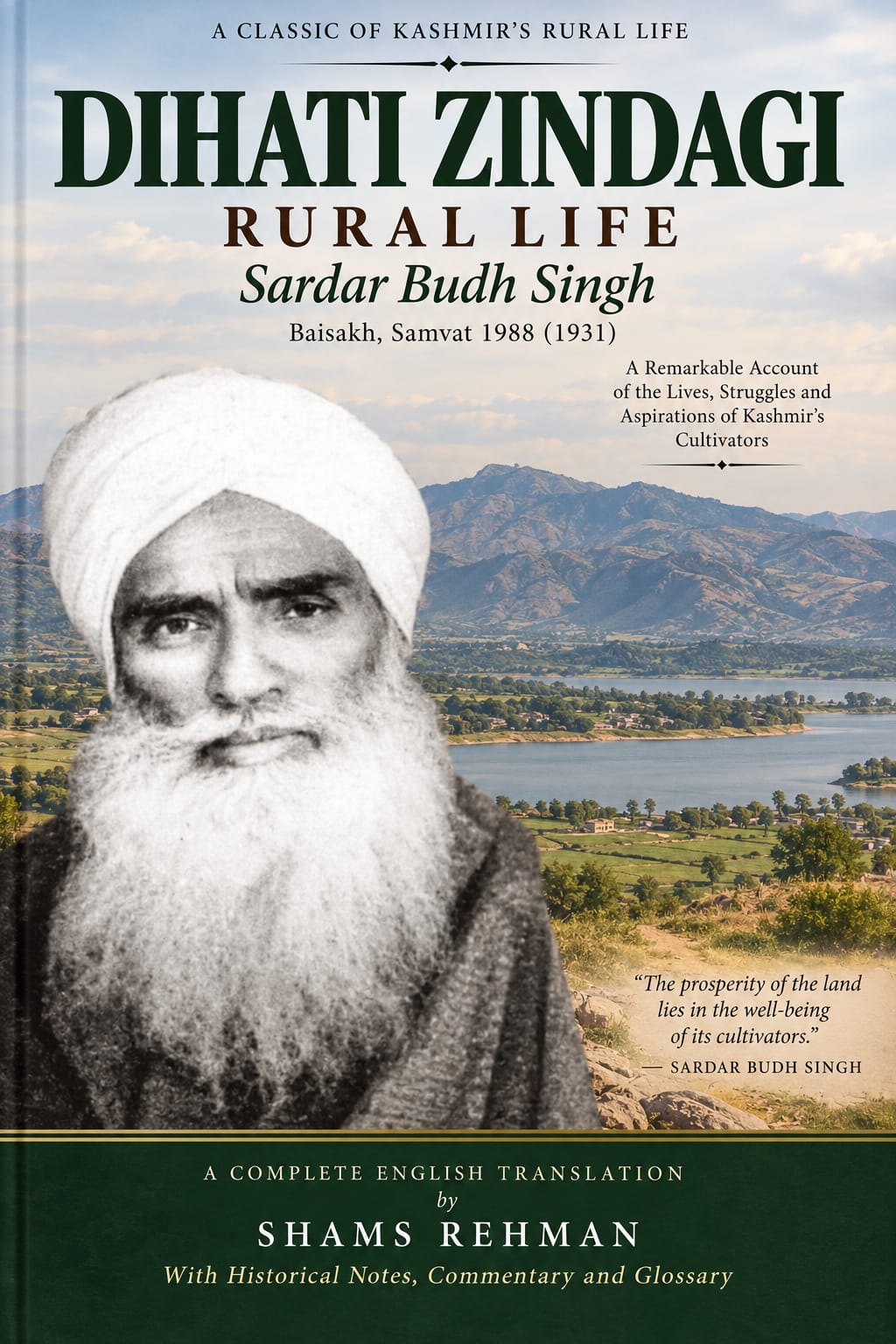
Comments (0)