

Three months after the government of Pakistan-administered Azad Jammu and Kashmir (AJK) banned the Joint Awami Action Committee (JAAC) under anti-terrorism laws, the confrontation that has left scores dead is entering a new phase — one fought less in the streets than over the story of what happened, and who bears responsibility for the dead.
Among the movement's supporters, a clear reading of the past three months has taken hold: that the state's messaging has not failed so much as evolved, moving through successive framings as each collapsed under its own weight. First the JAAC was branded a tool of Indian intelligence. Then it was proscribed and confronted with overwhelming force. Then it was designated a terrorist organisation and compared to the Tehreek-e-Taliban Pakistan. Now, activists and residents argue, a fourth phase has begun — a subtler campaign that no longer attacks the movement's legitimacy directly, but instead questions its strategy, asking whether the JAAC's own decisions caused the deaths of its supporters.
The events behind the argument
The factual backdrop is grim, and much of it is verifiable despite severe restrictions on reporting from the region.
On 5 June 2026, the AJK government proscribed the JAAC — a coalition of traders, lawyers, students and civil-society activists founded in Rawalakot in 2023 — under anti-terrorism legislation, citing intelligence about weapons acquisition and planned violence. The JAAC, which built its following on bread-and-butter grievances such as wheat subsidies and electricity tariffs before turning to the constitutional dispute over twelve assembly seats reserved for Kashmiri refugees settled elsewhere in Pakistan, denies the allegations and insists its struggle is peaceful.
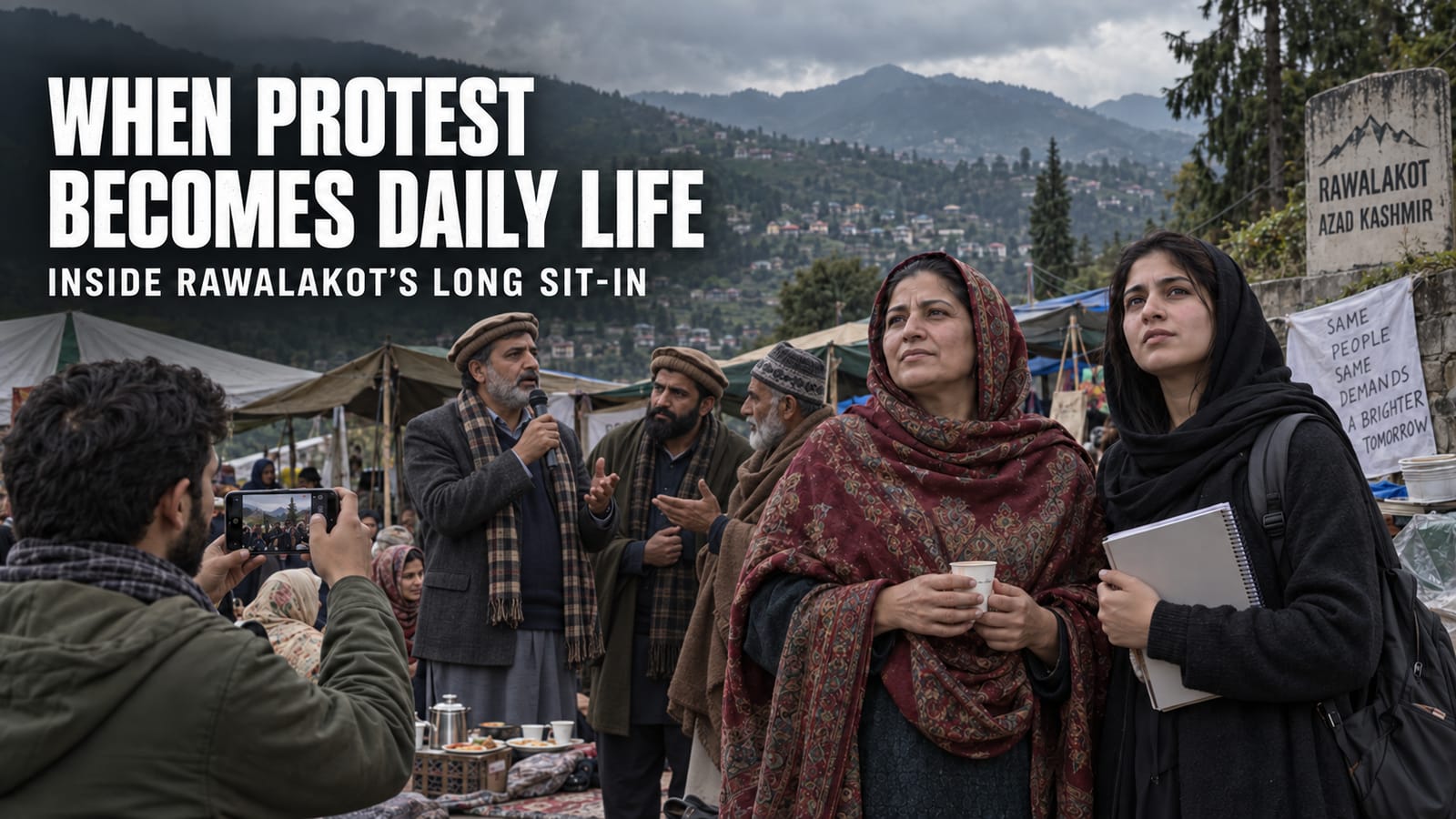
The night of the ban, Shahzaib Habib — a close associate of JAAC leader Sardar Umar Nazir — was shot dead near Rawalakot in what the movement describes as a botched raid targeting Nazir himself. Protesters took custody of Habib's body from the Combined Military Hospital and began a sit-in; an FIR subsequently registered against the dead man, declaring him a terrorist, inflamed the region further. Within days, clashes across Poonch and neighbouring districts had killed at least twenty people by an AFP tally of official figures. The movement's own count was higher from the start.
The confrontation escalated through the summer. The JAAC boycotted the legislative elections held from 27 July and launched a long march from Rawalakot towards Muzaffarabad. That day became the bloodiest of the crisis: local sources and the committee reported around twenty dead in Rawalakot alone, among them Usman Nazir, the JAAC leader's brother, while police declined to confirm fatalities pending post-mortems. Across the second phase of protests, credible compilations put protester deaths above fifty. Officials, for their part, have reported police and Rangers killed, weapons caches, and attacks on security convoys — a narrative of armed insurrection that the movement rejects wholesale.
The movement's cumulative count now approaches one hundred dead. Critically, neither the AJK government nor Islamabad has formally acknowledged that toll — and that gap of recognition has itself become a political fact. Prolonged internet and mobile-data shutdowns have made independent verification extraordinarily difficult, a pattern documented by international news agencies throughout June and July.
The anatomy of a narrative shift
The most consequential question circulating in AJK concerns timing. Why has criticism of the JAAC's strategy — was the long march wise? should the leadership have anticipated the crackdown? — surfaced only now, three months in, and largely from quarters that supported or excused the state's response?
The answer heard from movement circles is pre-emption. When the deaths are eventually acknowledged and investigated, the question "what were the informed people doing while this happened?" will be unavoidable — for officials, for allied AJK politicians, for civil servants and their relatives, and for the journalists who amplified each successive official framing. Shifting responsibility onto the movement's tactical choices before that reckoning arrives would allow those actors to escape it. On this reading, the sudden vogue for strategic critique is not analysis but anticipatory blame-laundering: an attempt to construct, in advance, an environment in which the dead can be laid at the Action Committee's door.
Legitimate strategic critique exists; movements that lead unarmed people into confrontations with security forces face genuine questions about risk, and not everyone raising them is a state proxy.
A fair-minded assessment should note what this framing risks foreclosing. Legitimate strategic critique exists; movements that lead unarmed people into confrontations with security forces face genuine questions about risk, and not everyone raising them is a state proxy. Yet even within the movement's harder line, a distinction is drawn — and it is a telling one. Long-standing critics of the JAAC who fell silent after 5 June, unwilling to defend brutality under the cover of political disagreement, are spoken of with respect; their silence is read as conscience. The contempt is reserved for what locals call the loudspeakers of the agencies and the government — those who continued broadcasting official lines as the bodies accumulated. The target, in other words, is not criticism as such, but criticism deployed as cover.
Attempts to shift public attention have also, by this account, repeatedly failed. Talking points pushed through the summer — tribal framings, the disruption of children's schooling, rising food prices, claims of mass departure from Rawalakot — did not take hold with a public that largely blamed the crackdown, not the protests, for its hardships. The pivot to questioning strategy is read as the next iteration in that sequence.
The social rupture
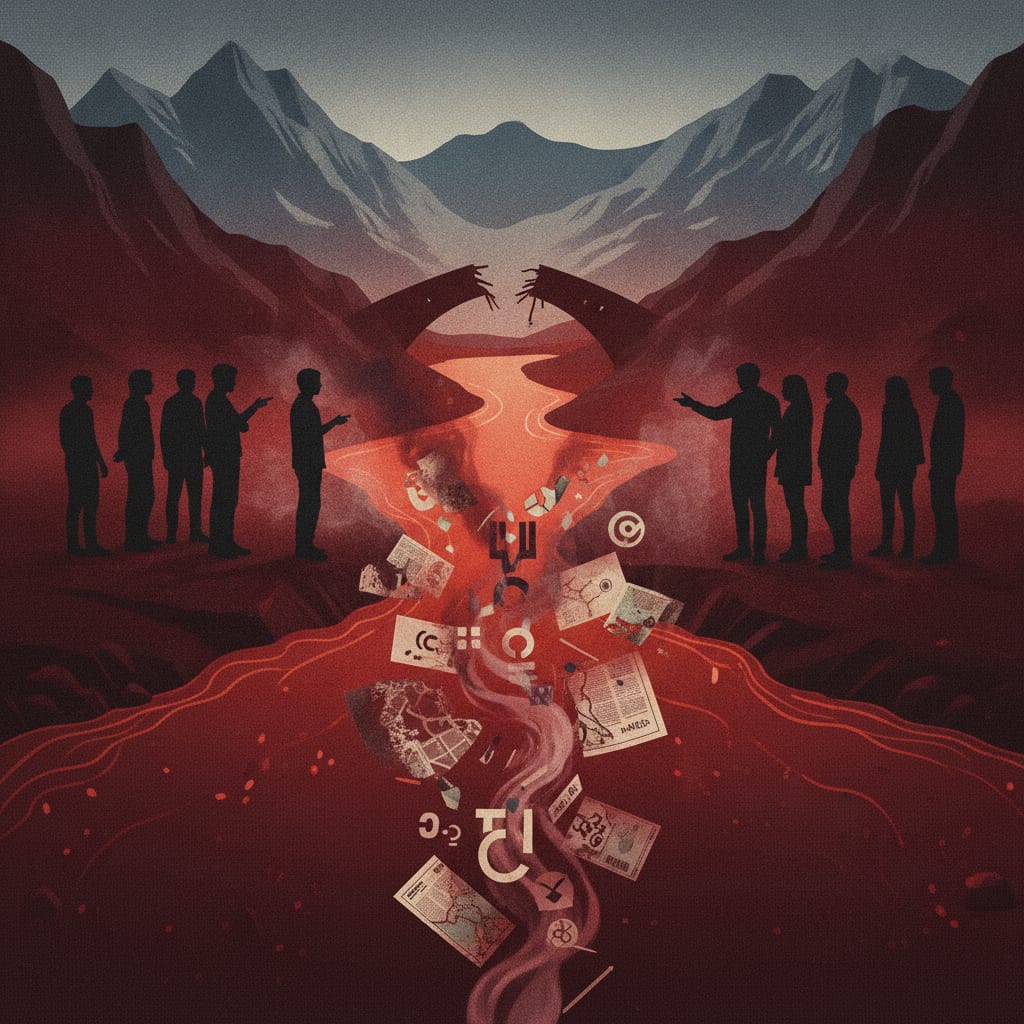
Perhaps the most significant development is not political but social. In a region as small and densely networked as AJK — where the dead named in local compilations span villages from Hajira to Tararkhel to Kotli, and virtually everyone in Poonch division knows a bereaved family — the killings have changed what is possible between people. The sentiment now widespread among the movement's base is stark: personal relationships and friendships cannot return to what they were; there is a river of blood between the two sides that cannot be crossed; the bodies will hang between them.
This deserves to be taken seriously as reportage on the region's mood, not merely as rhetoric. Those who defended the crackdown in even the smallest degree, who deflected attention from it, or who fed the public misleading information are increasingly regarded not as political opponents but as enemies of the people, with whom no reconciliation is conceivable. Comparable ruptures have followed state violence elsewhere in Pakistan's peripheries; they tend to be generational. Whether or not one endorses the maximalism, it describes — and arguably accelerates — a hardening of lines that will outlast the current confrontation.
What remains unverified, and what to watch
Under the communications blackout, several widely circulated claims remain difficult to confirm independently: the scale of military involvement, reports of significant displacement from Rawalakot, and the full extent of disruption to schooling and food supplies. They are plausible given the documented paramilitary deployments, curfews and blockades, but they remain contested. So too does the state's counter-narrative of an armed uprising, which the movement flatly denies and which no independent body has yet examined.
Three tests lie ahead. First, whether any independent investigation into the deaths materialises, and whether either government moves from non-acknowledgement to accounting — because once the record is established, the question of who enabled, excused or obscured the violence will be asked, and answered. Second, whether the assembly produced by an election the movement boycotted amid the bloodshed can claim legitimacy in Poonch division at all. Third, whether the JAAC's leadership can hold together a coalition now bound as much by grief as by its original 38-point charter.
What is already clear is that the summer's dead have become the central political fact of Pakistan-administered Kashmir. Blood unjustly spilled, runs the conviction now settling across the region, is never spilled in vain. When the dust settles, those who stood with the crackdown — actively or by artful deflection — will discover how deep the public's wound runs. The battle over responsibility for the dead has already begun; the attempt to pre-assign it is the surest sign that everyone involved knows a reckoning is coming.
Comments (0)