

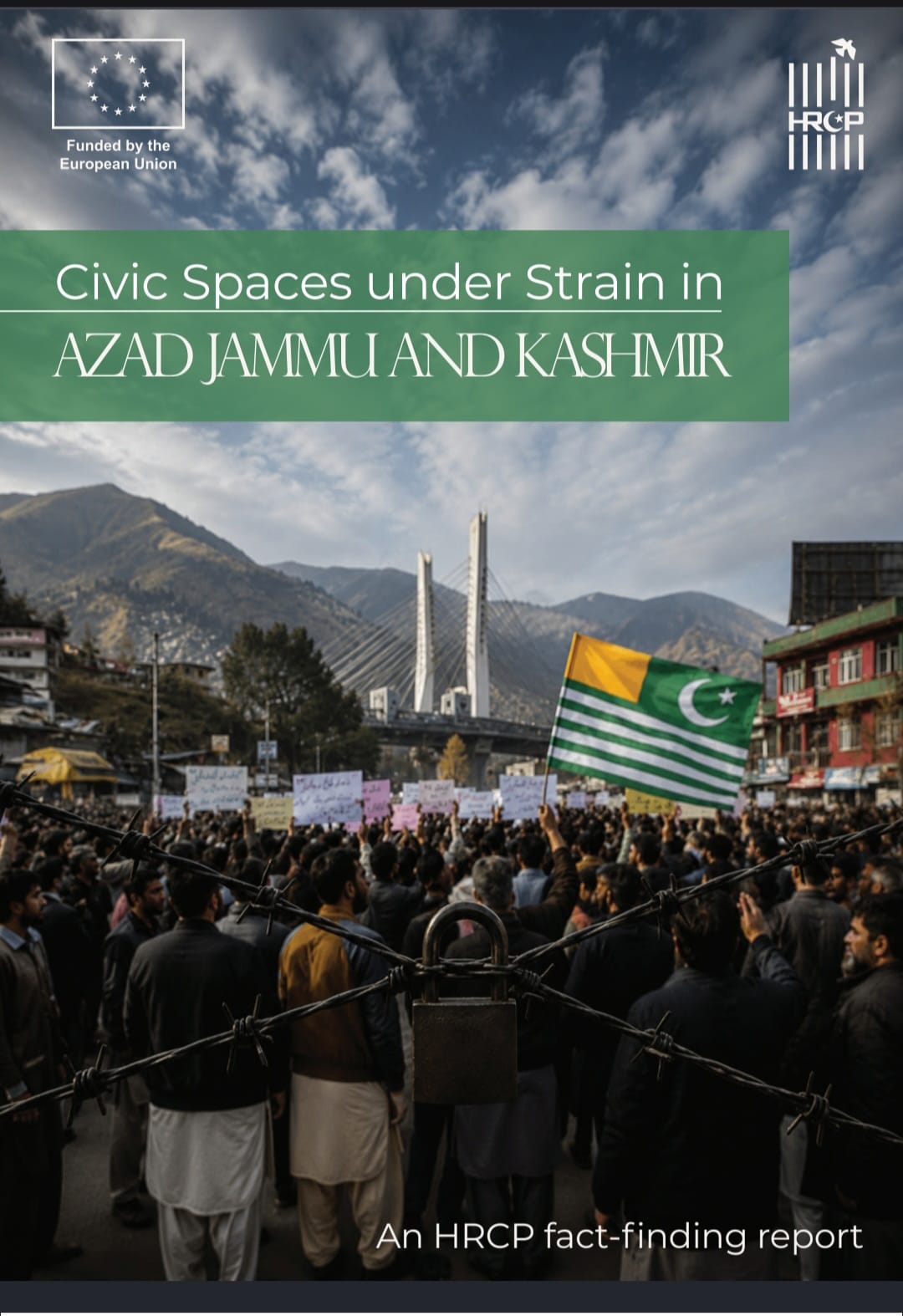
MUZAFFARABAD, AJK — Azad Jammu and Kashmir’s 2026 political crisis has exposed a widening gap between public demands for accountable government and the state’s increasingly security-driven response, according to a fact-finding report by the Human Rights Commission of Pakistan (HRCP).
The report, Civic Spaces under Strain in Azad Jammu and Kashmir, describes a region where economic grievances over electricity, flour, inflation and public services developed into a broader movement demanding constitutional reform, political representation and greater accountability. It warns that the government’s crackdown, prolonged communications shutdown and restrictions on civic activity have deepened public distrust rather than resolved the dispute.
At the centre of the crisis was the Jammu Kashmir Joint Awami Action Committee (JAAC), a coalition of traders, transporters, students, lawyers and political activists. After negotiations over an October 2025 agreement failed, the AJK government proscribed JAAC on 5 June 2026 under the AJK Anti-Terrorism Act, followed by arrests, movement restrictions and a suspension of mobile internet services across the region.[1]
From economic protest to constitutional confrontation
JAAC’s initial demands focused on electricity tariffs, wheat prices, inflation and public services. Over time, the agenda expanded to include governance, accountability, political privileges and the constitutional status of 12 seats reserved for Kashmiri refugees in Pakistan.
The AJK Supreme Court, in a 7 June advisory opinion, held that the refugee seats were constitutionally protected and could not be abolished through executive action or political agreement. Any change would require the formal constitutional amendment process.[1]
Although stakeholders disagreed over JAAC’s methods and the government’s security response, the HRCP mission found broad support for the principle that the dispute ultimately required a political solution.[1]
Conflicting accounts of violence
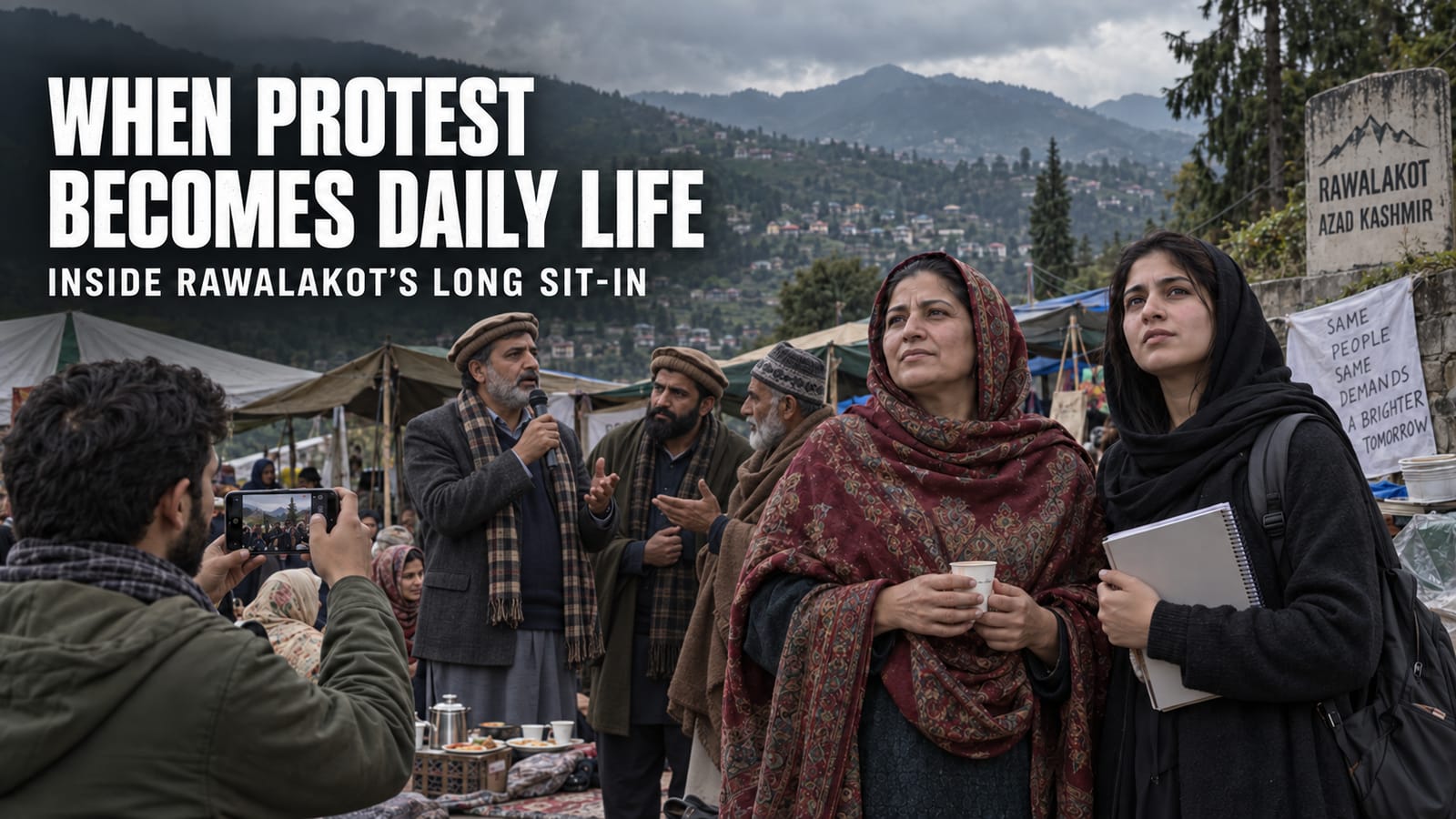
The most serious unresolved questions concern deaths, injuries and the alleged use of excessive force during clashes, particularly in Rawalakot.
AJK Inspector General of Police Liaquat Ali Malik told HRCP that approximately 38 security personnel had been killed and 742 injured since June, alleging that protesters possessed sophisticated weapons. JAAC supporters rejected that account, describing the unrest as a political uprising met with disproportionate force. Reports of civilian deaths varied widely, and the government disputed claims that hundreds of civilians had been killed.[1]
The HRCP mission was unable to independently establish the full scale or circumstances of the deaths. Its access to Rawalakot was blocked, limiting direct verification of allegations involving casualties, arrests and the conduct of security forces.
The report recommends an independent investigation into all major incidents since June, including alleged unlawful killings, excessive use of force and arbitrary detention. It stresses that accountability should apply to state officials and protesters wherever individual responsibility is established by evidence.[1]
Internet shutdown widened the crisis
The suspension of internet and mobile services disrupted banking, education, commerce, transport, journalism, public administration and access to emergency information.
The mayor of Bagh said banks remained closed for extended periods, residents struggled to access cash and the municipal corporation had been unable to pay more than 60 sanitation workers for approximately two months. Students faced postponed examinations, freelancers and businesses lost income, and journalists were forced to travel outside the region to file reports.
The report recommends an independent investigation into all major incidents since June, including alleged unlawful killings, excessive use of force and arbitrary detention.
Road closures and transport disruptions reportedly caused shortages of medicines in several districts and made it harder for patients to reach hospitals. The HRCP report questions whether the shutdown met the requirements of legality, necessity and proportionality, recommending that any future suspension have a clear legal basis, defined duration and independent oversight.[1]
Journalism caught between pressure and silence
HRCP documented reports of journalists being arrested, detained or subjected to legal proceedings in connection with their coverage of the unrest. Local reporters described difficulties securing access to affected districts and obtaining security passes. Some said they had been verbally instructed not to cover JAAC activities.
The communications shutdown made independent verification especially difficult. Reports of deaths, injuries, arrests and electoral irregularities could not easily be checked, while journalists were unable to communicate normally with sources or newsrooms.
HRCP has called for journalists to be allowed access to protest- and conflict-affected areas, subject only to narrow and lawful security restrictions, and for authorities to protect media workers from intimidation by state and non-state actors alike.
Election held under exceptional conditions
The 2026 legislative election was originally scheduled as a single-day poll for 27 July but was later divided into three phases because of security concerns. Seven constituencies were postponed, while voting went ahead in only four constituencies in Bagh and Haveli on 10 August.
The result was an incomplete electoral process: reserved-seat arrangements began while seven directly elected constituencies remained unfilled. By late August, the PML-N had secured 24 of the 34 decided seats, while the PPP held 10. The PTI and JAAC boycotted the election, citing alleged manipulation and unresolved political grievances.
The HRCP mission found that polling stations it visited generally functioned in an orderly manner, with low turnout in some areas reflecting a voluntary political boycott rather than systematic physical coercion. However, the report warns that a boycott by major political actors, the communications blackout, heavy security deployment, phased polling and postponed constituencies all shaped the conditions under which voters made their decisions.
What comes next?
The HRCP report’s central message is that the crisis cannot be resolved through arrests, bans and temporary security arrangements.
It recommends an inclusive political dialogue involving JAAC representatives, political parties, elected officials, lawyers, civil society and journalists. The agenda should include governance, public spending, political privileges, service delivery, accountability, representation and the relationship between AJK institutions and authorities outside the territory.
It also calls for independent investigations into deaths and alleged human-rights violations, prompt judicial review of arrests, a review of the use of anti-terrorism laws, protection for peaceful assembly and independent journalism, restoration of communications and movement, and a constitutional and inclusive process to address the 12 refugee seats.
The report concludes that AJK’s electoral process took place in an environment where political grievances remained unresolved, information was restricted, independent observation was limited and public trust had already been weakened.
The immediate political challenge for AJK’s new authorities is restoring the credibility of institutions sufficiently to persuade citizens that protest is not their only avenue for being heard. Without a credible investigation, meaningful dialogue and constitutional reform, the confrontation between public mobilisation and state coercion is likely to remain unresolved.
*This article is based on the Human Rights Commission of Pakistan’s August 2026 fact-finding report, “Civic Spaces under Strain in Azad Jammu and Kashmir.” Allegations described in the report are identified as such where they were not independently verified by the HRCP mission.
Comments (0)