

Azad Jammu and Kashmir’s People’s Rights Movement
From Civic Demands to Mass Resistance: Class, State Power, Impacts, Risks and the Road Ahead, May 2023–August 2026
VPaTH
Virtual Publishing and Translation House
All rights reserved by the author.
Author: Shams Rehman
Typesetting: Shams Rehman
Updated edition: 21 August 2026
Introduction
The People’s Rights Movement in Azad Kashmir — centred on the Joint Awami Action Committee (JAAC), ordinary citizens and political activists — has rightly kept its main attention on the People’s Charter, or Charter of Demands. Yet there are also ideological comrades who have spent decades struggling in Azad Kashmir under different banners: independence, accession to Pakistan, Nizam-e-Mustafa, democracy, socialism and Marxism. Whatever their differences, all of them have imagined a better Azad Kashmir according to their own political ideas, and many have dreamed of bringing about some form of social or political revolution.
When the present rights movement emerged, most of these activists joined it and began playing their part. At the same time, however, some have expressed disappointment — and sometimes anger — that the movement does not carry the particular ideological colour they would prefer.
I therefore felt it necessary to write this essay for those ideological friends, in the hope of clearing away some of the confusion and misunderstanding surrounding the movement. In particular, I want to look at class. But rather than begin with an abstract ideological debate, I want to ask a simpler and more concrete question: what did the class structure of Azad Kashmir look like when it came into being, and what does it look like now?
Only after understanding that basic reality can we test our ideological lenses against the actual geographical, administrative and political conditions of this region — and, where necessary, adjust the focus.
The Birth of Azad Kashmir
The birth of Azad Kashmir has, of course, a long history behind it, and that history matters. But if I went into all of it here, the discussion would travel far beyond the purpose of this booklet. It is enough for the present argument to say that the idea of “Azad Kashmir”, and later the government bearing that name, emerged from the modern politics of popular resistance in the State of Jammu and Kashmir.
The term was used by the All–Jammu and Kashmir Muslim Conference (AJKMC) in a pamphlet titled Azad Kashmir at its thirteenth annual convention, held at Poonch in 1945.[1] It is important to be clear that this was not the original Muslim Conference founded in 1932, as the maiden political party of the Jammu Kashmir history or perhaps any of the over five hundred princely states. The original Muslim Conference had become the National Conference in 1939. The Muslim Conference which used the term Azad Kashmir for the first time was the organisation re-established by Chaudhry Ghulam Abbas in 1942 after he left the National Conference. In May 1945, this Muslim Conference passed a resolution under the name of Azad Kashmir.
The idea appeared again at the inaugural convention of the Jammu and Kashmir Mazdoor Kisan Conference in 1946. The Mazdoor Kisan Conference had emerged through the coming together of Pandit Prem Nath Bazaz’s Socialist Party and Abdul Salam Yatoo’s Kisan Conference. Bazaz later discussed the idea in Azad Kashmir: A Socialist Republic. The proposal was for a socialist republic with internal autonomy after accession to Pakistan.
At that time the State of Jammu and Kashmir, ruled by Maharaja Hari Singh, was a semi-autonomous princely state within the British imperial order. Two months after the end of British rule and the creation of Pakistan and India, first forces from Pakistan and then India entered the state, each under different justifications. The state was divided under Indian and Pakistani control. Both countries later agreed at the United Nations that its future would be decided through a plebiscite, but that commitment has never been implemented.
When Azad Kashmir came into being in October 1947, the overwhelming basis of production — as it had been for centuries — was land and agriculture.
Agriculture had shaped life for thousands of years. The tools and methods of production had changed only gradually. The scale and kind of farming varied from district to district and from one locality to another, and social, cultural and political institutions had developed around those material conditions over centuries. There were local differences, of course, but in broad terms the society that existed at the birth of Azad Kashmir looked something like this.
The main source of livelihood and food was land. In that sense, agricultural produce itself functioned as a kind of currency. In the plains, grain and livestock were the main forms of wealth and exchange. In some areas fruit, fish and herbs also provided food and livelihood and could be used in exchange. But almost everything ultimately came from the land: food was cultivated or gathered from what nature produced.
This agricultural economy formed the basis of the class structure. Land occupied the central and dominant position. Overall, it was an agrarian society whose social organisation combined feudal and tribal relations. At first glance, particularly through a conventional Marxist lens, one might identify two broad classes: those who owned land and those who worked it.
But if we look more closely through the same lens, the picture becomes more complicated. The number of landowners who took no part in production was extremely small. Most landowners were themselves directly involved in cultivation. In many places they did not employ peasants to work for them: they farmed their own land. They were both landowners and peasants.
Those without land provided different skills and services to landowning families and received grain or other goods in return. Society was therefore divided between landholders and non-landholders, and there was certainly a class difference between them. Landholders enjoyed greater social influence because grain grown on their land was the main source of food for non-landholding skilled groups. Yet the landholder also depended upon the tailor and builder for clothes and houses, upon the blacksmith for agricultural tools, upon the potter for utensils, and upon the barber and other occupational groups for everyday services.
The division therefore did not produce the kind of sharp class confrontation associated with the capitalist-owner and wage-worker relationship, or with a classical landlord-tenant relationship. At this social level, in my present understanding, the economy of the region — and later of Azad Kashmir — was not dominated by a feudal organisation of production. It is more useful to describe its social structure as tribal, with blood relations and kinship occupying a central place.
The deeper economic contradiction was therefore not primarily between one tribe and another, or between tribes and the occupational groups who provided services in return for grain. It was between all these groups and the machinery of the state: the machinery that claimed ultimate ownership of the land and took a substantial share of production through land revenue and various taxes.
That state machinery was feudal. At its head stood the Maharaja, the ultimate owner of the land of the state. The modern popular politics that emerged in the 1930s was directed largely against this machinery. For a variety of other reasons, however, that movement took increasingly national and religious forms and, as it approached victory, lost its original direction. The result was a struggle among Hindu, Muslim, secular and socialist political currents and, ultimately, the division of the state. Those wider questions cannot be examined in detail here because the focus of this booklet is the class structure of Azad Kashmir.
At the time Azad Kashmir came into being, Mirpur was the only place that was called ‘city’, or at least something close to one. Elsewhere there were mainly small market settlements/towns. The difference between urban and rural society was therefore most visible in Mirpur, where a small working class also existed around machines producing khaddar cloth and traditional footwear in Mirpur city.
After the end of Maharaja rule, local Muslims entered government employment in greater numbers. Salaried employment began to become an important source of livelihood, and cash gradually gained greater importance alongside grain.
The Maharaja’s feudal rule had collapsed, but many of the productive and administrative ‘offices’ that had carried the old order remained. Some grew stronger. These included the zaildars, tribal chiefs, rajas, chaudhries and maliks of different localities. Senior officials and politicians from the same tribe/ baradari/ socio-economic groups, some of them already established under Maharaja rule, became central and leading part of the new governing structure.
What did not pass from the Maharaja to these local elites, however, was the position of the ultimate feudal authority. In my reading, that position passed through the Karachi Agreement and the Ministry of Kashmir Affairs to Pakistan’s ruling class. Local elites then helped carry the new “Maharaja system”, competing with one another to prove their loyalty and obedience and thereby establish their own claim to local authority.
From this point onwards, three major material changes began to transform the foundations of the old tribal economy:
- migration from Mirpur to Britain;
- the expansion of government employment; and
- the growth of trade and business, encouraged by the first two developments.
Before examining these in detail, I want to make two points clear.
First, the purpose of this booklet is not to instruct the People’s Movement to follow any particular ideology, nor to expect it to do so. My purpose is simply to offer, according to my own understanding, an outline of the historical development of the region’s class structure. Those who find the argument useful can then use their own political ideas to understand the material conditions and class relations of this society more honestly. That may help them do two basic things:
- carry out a realistic analysis of the local local conditions and connect their politics with realities on the ground; and
- stand with people where they actually live and struggle, while testing their own theories and political understanding against real life.
These are essential tasks because no modern political theory came down from the sky. Every modern political theory emerged from particular material conditions and later travelled into other societies. However deep or extensive our knowledge of those theories may be, if we do not use them to analyse our own conditions honestly — and if we do not test those theories against our own conditions — then knowledge remains knowledge for its own sake. We may hold impressive intellectual debates, but no real movement for change can be built on that alone.
My second point is that my own knowledge is limited. I do not know everything about every part of Azad Kashmir. I am writing from what I do know, and some of that information may be incomplete or mistaken. I therefore invite those who know more than I do to write, correct and improve the discussion, as Sardar Aftab and Comrade Tahir did in response to earlier instalments.
Azad Kashmir has many people with an impressive knowledge of global political theories. What has often been missing, however, is a material analysis of our own region using that knowledge. I have felt that absence for many years. I have written more extensively on Mirpur and on the social changes before and after 1947 elsewhere. Here I am giving only a short account of the economic and political development of Azad Kashmir after 1947.
From Land to Salary, Migration and Trade
The previous section offered a glimpse of the economic foundations of Azad Kashmir in 1947. We can now look at the changes that followed. Three developments were especially important:
- government employment;
- migration to Britain; and
- trade.
All three existed in some form before 1947. What changed afterwards was their scale, economic power and political influence. If we look at their effect on the social foundations of the region, the sequence is roughly this: first the expansion of government employment, then migration to Britain, and finally the rapid growth of trade generated by both.
After 1947, Maharaja rule ended and the non-Muslim population was either killed or displaced. Those who remained in the region now had to run their own systems of livelihood and administration. I will concentrate here on the major sources of livelihood rather than every aspect of social change.
Government Employment
After the end of Maharaja rule, government posts that had previously included relatively few Muslims came to be filled largely by local Muslims. The number of salaried employees increased substantially.
Under the Maharaja, salaries had come from a treasury financed partly through taxes on land and other goods. After 1947, salaries came increasingly from the Azad Kashmir budget, which in turn came through Pakistan, although I do not have figures for the proportion that came from locally raised taxes in the early years.
The growth in the number of local employees — apart from officers posted in from outside — produced a significant salaried layer. Every government post carried some degree of authority, so the social influence of this group also increased. Much of the influence previously held by non-Muslim officials under the Maharaja now passed to Muslim officials. Government employment therefore became an attractive route to livelihood and status.
I do not have statistical evidence for the period, but people of the generation that lived through it often told me that until the 1960s bribery and political recommendation were much less common in government employment and the professions linked to it — teaching, clerical work, the judiciary, medicine, law, engineering and administration. Many appointments were based more on qualification than on political loyalty. Recommendation and bribery may still have been used for unlawful purposes, but legitimate work could often be done without them. Bribery was socially disapproved of.
Many officials of that generation had also been educated in institutions that existed before 1947. Another possible reason for lower levels of corruption was that there were more vacancies and fewer qualified candidates, so competition was less intense. Tribal social relations may also have played a part: people often approached an official from their own clan or biraderi.
The important point is that, between the birth of Azad Kashmir and the 1960s, a salaried class emerged and expanded. It was now largely Muslim, but it had not yet transformed the material foundations of society. Land remained the main source of production and agriculture the main mode of livelihood. The society was still overwhelmingly agrarian.
Government employment nevertheless became an important second source of livelihood. It encouraged greater interest in education because education opened the door to attractive jobs and professions. Gradually, this began to reshape a class structure that had developed over centuries around a feudal and tribal economy.
Senior posts were still disproportionately occupied by the descendants of zaildars, rajas and chaudhries, by higher-status families displaced from Jammu or the Valley, and by already educated families. But by the 1960s, children — overwhelmingly boys at that stage — from some ordinary households were also receiving education and entering government employment. This can be seen as the first stage in the formation of a local ruling class.
Migration to Britain
Migration from Mirpur to Britain had begun around the start of the twentieth century, but it accelerated in the 1950s. There were several major reasons.
Britain needed labour after the Second World War. There were not enough workers willing or available to meet the demand in cotton mills, steel factories, brickworks, buses, railways and other industries. British workers had also developed stronger class consciousness and trade-union organisation and were less willing to accept the lowest wages. Employers therefore recruited workers from former colonies.
By then, a significant number of workers from Mirpur were already living in Britain. Following long-established patterns of chain migration, they began calling over relatives, neighbours and acquaintances.
The construction of Mangla Dam was another major factor. A widespread historical misunderstanding still exists that Mirpuris were “sent to Britain by the Pakistan government because of Mangla Dam”. The reality is different. Workers from Mirpur had begun travelling to Britain long before the dam. My own research suggests that, before Mangla, many early migrants came from Dadyal and surrounding villages and from villages around Mirpur city. Migration directly from Mirpur city increased sharply after the dam displaced the old city and surrounding communities. I have discussed this history in more detail elsewhere.
From the late 1970s, migration to Britain began transforming Mirpur’s economic structure at great speed. Institutions that were still in the process of developing increasingly became captured by individuals and networks rather than serving their public responsibilities.
The most important material change was that agriculture rapidly declined as the main source of livelihood, while money arriving from Britain took its place. Cash replaced grain. The flooding of fertile land under Mangla Dam also ended much of Mirpur’s earlier food self-sufficiency and accelerated its transformation into a market-dependent society.
Money now began to occupy the position once held by grain. Two major sources of this new “production” were government salaries and the money coming from Britain.
At the same time, bribery in public employment, government offices and ministries began to expand. Unlawful work could increasingly be obtained through payments, while even lawful work became harder to obtain without bribery or recommendation.
One reason was that as overseas money began to flow into the region, some of those receiving it did not understand the rules and institutions of government, while others quickly discovered that relationships and money could be used to bypass those rules. A triangular alliance developed among middlemen, government officials and politicians. Through collusion, they could earn money both from helping ordinary people obtain what they were lawfully entitled to and from arranging unlawful advantages for those with money and connections.
This, in my view, was the second stage in the formation of the local ruling class.
Traders and Trade
At the birth of Azad Kashmir, Mirpur was the only substantial commercial centre that could properly be called a city. In the united State of Jammu and Kashmir, Srinagar was the largest commercial centre, Jammu the second and Mirpur the third. Other districts and towns had smaller bazaars.
Some goods came from Punjab while others were locally produced. Salt and some grain may have come to Mirpur from Punjab, but much fruit, vegetables and pulses were produced locally, including around Chahngan. Villagers came into town in the morning to sell goats, eggs, ghee and milk, and returned with household goods. Traders brought salt from Punjab and spices from the areas around Jammu and Srinagar. Mirpur also produced khaddar and traditional footwear for sale across the river in what became Pakistan.
This remained broadly the pattern until the construction of Mangla Dam. When the old city was submerged, hundreds of villages that had been economically connected to it were also lost or cut off. The surviving settlements did not develop the same relationship with the new Mirpur. Increasingly, almost every commodity began to come from Pakistan.
By the late 1970s, the new Mirpur city had begun to establish itself. During the 1980s and 1990s, as purchasing power increased, markets expanded not only in the city but in surrounding towns. Shops selling construction materials opened rapidly. Mirpur had become a full market for goods arriving from Pakistan.
Attempts to establish small local factories usually failed, while industrial plants brought in from Pakistan often lasted only for the period in which tax concessions were available. From the late 1990s, and especially after 2000, there was a huge growth not only in construction-related businesses but also in clothing, decoration, furnishing and consumer goods.
Some older crafts disappeared. Pottery largely vanished and shoe repair declined. Tailoring and hairdressing, however, expanded and adopted new machinery, techniques and fashions, increasing the income available through those trades.
In Poonch and Muzaffarabad divisions, agriculture and government employment remained the main sources of income for longer, which partly explains why overseas migration initially developed more slowly. Later migration to the Middle East and then to Europe, North America and Britain produced rapid market growth there as well.
In Muzaffarabad, as the seat of government, salaries were a major source of purchasing power and trade grew around them. In Poonch, in my view, migration — whether to Pakistani cities, the Middle East or later European countries — played the larger role in expanding purchasing power.
Azad Kashmir as a whole therefore became an attractive market for Pakistani goods. As public purchasing power increased, trade expanded and the upper layer of the trading community accumulated wealth. This group joined the triangle already formed by politicians, officials and middlemen, becoming a fourth side of the emerging upper class.
Today, in broad terms, the upper class of Azad Kashmir appears to consist of four main groups.
First are senior government officials who have accumulated wealth through various forms of bribery, official power and privileges. Second are political families, many of whom have little independent business of their own but have accumulated large fortunes through the lawful and unlawful use of public authority. Over time, they may have become the richest part of the upper class.
Third is the upper layer of the trading class, enriched by rising public purchasing power and by its own commercial skills and ability to negotiate and make deals. Fourth are sections of the diaspora who accumulated wealth through business or political connections abroad and now conduct business both there and in Azad Kashmir, or whose relatives do so locally. These groups are part of transnational networks linking migrants with senior officials and politicians.
I do not know what percentage of the population this upper class represents. What is striking, however, is that it does not itself produce a commodity in the classical sense and then exploit those who physically produce it.
Under the old agrarian order, grain was the major product. Landowners and peasants produced it. A large share went upward through the state and the Maharaja’s system, and then through landlords, zaildars, moneylenders and other intermediaries. The landowning and peasant population was the largest class, while skilled workers and artisans were connected to it through the services they provided.
That is why, once peasants became conscious of their exploitation, Maharaja rule — built on controlling a politically weak population taught to accept its condition as fate — could not withstand organised agrarian resistance indefinitely. During the 1932 movement, Sardar Budh Singh told cultivators that the Maharaja’s rule stood on their ploughs: if they stopped the plough, the rule would fall. When cultivators stopped work in protest against land revenue, the old order was shaken at its foundations.
So what is the equivalent class in Azad Kashmir today — the class whose material interests are shared and whose collective action can move the economy?
At a broad level, almost everyone outside the upper class shares important common interests: lower-level government employees, small traders, mechanics, tailors, cobblers, barbers, shop workers, waiters in hotels and restaurants, and those trapped in or around the networks through which political corruption operates.
Resistance and alternative politics against what can broadly be called the exploitative or ruling class began to develop in Azad Kashmir as early as 1950 with the Jammu Kashmir Awami Conference. From this later emerged nationalist currents — or qaum-parwar, “people/nation-centred”, in the language of its founder Abdul Khaliq — including the Plebiscite Front and later the Liberation Front. Alongside them came the socialist National Students Federation and later the Marxist People’s National Party.
These organisations contributed greatly to political consciousness through ideas of the Kashmir dispute, liberation of the Valley, national independence, socialism and the creation of a classless society. Yet none succeeded in drawing the ordinary majority into a lasting mass organisation. They attracted those already politically conscious of nationalism, socialism or Marxism. At times alliances brought their supporters together for demonstrations, but no permanent movement emerged that could carry the struggles for freedom, revolution and everyday public rights together.
Maqbool Butt, in his court statement after the Ganga hijacking and in later speeches, famously located his rebellion not only against national oppression but against coercion, exploitation, nepotism and social backwardness. He drew attention to the other chains within society as well as the chain of national subjugation. Yet his principal struggle became armed resistance against Indian control in the Valley, and he gave his life in that struggle.
Before the present People’s Movement, all these currents made a fundamental contribution to political and social awareness. But none developed into a lasting popular organisation — revolutionary, independence-oriented or democratic-popular. Ideological disputes repeatedly divided an already conscious cadre, gradually separating it from the material realities of Azad Kashmir. In many ways, ordinary people moved ahead of the organisations that claimed to speak for them.
That leaves us with a set of basic questions.
What is the central “production” of Azad Kashmir today? Who produces it? Who owns it? How is it distributed? What is the economic character of present-day Azad Kashmiri society? It is clearly a class society, but is it capitalist in the usual sense? What kind of capitalism would that be? In productive terms, it is no longer primarily feudal or tribal either. Is it better understood as a commercial or bargaining society? Which classes have become most effective within it, and why? What can be learned from the history of resistance politics? What kind of politics might be effective if it begins from the actual material conditions of the region? What is the class character of the People’s Rights Movement itself? And is it really non-political and non-ideological?
Production, Ownership and Access
What does Azad Kashmir produce today? Who produces it? Who owns it? Who distributes it?
These are not questions of faith. They are questions of everyday life — of how we understand and live our economic and political existence. Political theories have emerged throughout human history as tools for making sense of such questions. They still exist in many forms today.
I am trying here to look at Azad Kashmiri society through the lens of historical materialism as I understand it. Nothing I write should be treated as the final word. This is an attempt to understand and to invite understanding. Anyone able to offer a stronger analysis should criticise it openly and put a better case before readers.
That is how the natural and social sciences develop. Intellectual criticism is the lifeblood of scientific knowledge. The condition is that an argument should be challenged by better knowledge and stronger reasoning — not by attacking the person who made it.
I mention this because, in an earlier instalment, I used a photograph of Shaukat Nawaz Mir sitting on the ground among participants at a gathering. Tahir Mujtaba jokingly asked why I had gone to so much trouble when I could simply have declared Shaukat Nawaz the leader of a revolution. The point of the picture was not to canonise anyone. There were also photographs of women activists larger than his. I used it to illustrate a style of leadership: he was sitting on the ground with everyone else. Leadership will be tested in the field, and that test will continue.
So let us return to the first question: what is Azad Kashmir’s central product today?
Before answering, we need to be clear about what I mean by “production” in this argument. I am using the term for the thing without which the whole structure of social life comes to a halt — political, social, economic, cultural and, ultimately, biological life as well.
Before 1947, that thing was food: grain, fruit, vegetables, fish, meat and other essentials, produced directly or indirectly from land. If food were not produced, society could not function. Institutions developed around producing it, storing it, distributing it and controlling access to it. Together, production, tools, labour, social relations and systems of ownership formed the material structure of society.
The pre-1947 order developed over centuries around producing, storing, distributing and gaining access to grain. I have discussed that in greater detail elsewhere. Here the question is what occupies that central place in post-1947 Azad Kashmir.
Grain is still produced in some places, often for household use. But grain no longer buys the other services of life. If somebody produces more than they need and sells it, they receive money, and it is money that buys the services they require. The majority who no longer produce grain must buy it. And to buy it, they need money.
This is why I argue that the central “product” of contemporary Azad Kashmir is money. The entire political and administrative structure is now organised around producing money, gaining access to it, using it and distributing it.
To understand Azad Kashmiri society today, therefore, we should follow the money: where does it come from, how is it distributed, and who is able to gain access to it?
There appear to be three major sources: government employment and the public budget, remittances sent by migrants, and trade and business.
The Budget
Government employees receive salaries in return for their service. Where does that money come from? From the annual budget of Azad Kashmir.
At the time of writing, I understand that the budget is around Rs310 billion, with roughly Rs261 billion going on salaries and Rs49 billion on development, although I am not an expert in public finance and these figures should be checked against official AJK Finance data. The number of government employees is often estimated at around 150,000.
Why does Pakistan provide or transfer this budget?
Following the United Nations resolutions and the Karachi Agreement, Pakistan assumed responsibility for the administration of Azad Kashmir and Gilgit-Baltistan — territories that are not provinces of Pakistan or constitutionally the same as Pakistan’s provinces, but parts of the wider State of Jammu and Kashmir under separate administration pending a settlement of the Kashmir dispute.
Where does the money come from?
There is a widespread misconception that Pakistan gives this budget as charity or aid. My argument is that it must instead be understood in relation to revenue raised in Azad Kashmir and the use of Azad Kashmir’s resources, including water, forests, minerals and the foreign exchange generated through migrant remittances.
A major share of the money circulating through the public budget also comes from taxes paid by ordinary people through purchases and taxable income. In return, healthcare, education and other basic services are not gifts from the government. They are rights.
I do not have precise figures for how much of the Rs310 billion budget is spent on privileges above reasonable need for senior officials, prime ministers, ministers and advisers, but it is clearly an area that deserves serious public scrutiny. The same applies to the development budget: how much is actually spent on public schemes, and how much is diverted through political commissions, patronage or corruption? These are questions requiring proper research.
My purpose here is not to pretend to be a budget specialist. It is to underline that the budget is one of the central channels through which money enters and is distributed in Azad Kashmir, and that an entire administrative and political machinery exists to manage it. If that machinery worked properly for the public, people would not repeatedly be forced onto the streets.
Migrant Money
The money sent by migrants — Azad Kashmiris working in Britain and many other countries — may now be one of the largest pillars of the region’s economy.
Migrants send money to their families, but that money is handled and circulated through large institutions, including the State Bank of Pakistan and commercial banks. It benefits not only individual households but the wider society, the AJK government and Pakistan.
When money is transferred through banks or digital apps, Pakistan receives the foreign currency. That foreign exchange is vital for international trade and the national economy. Money sent informally through hundi networks often also enters local banks and the wider financial system.
The global Azad Kashmiri diaspora has been estimated at close to two million people, although I do not have reliable figures for exactly how much they remit each year. The sheer number of Pakistani bank branches operating in Azad Kashmir suggests that very large sums flow through the region.
How much of this capital is reinvested in Azad Kashmir? How much do the banks return to local communities through their social responsibilities? I have not seen serious research answering these questions. The widespread impression is that very little of the capital is used for the long-term development of Azad Kashmir itself.
The Action Committee’s demand that the Bank of Jammu and Kashmir be granted scheduled-bank status should be understood partly in this context: as an attempt to give Azad Kashmir a stronger institutional share in the financial flows generated by its people.
Migrant money is not only a source of foreign exchange and investment for Pakistan. It also fuels trade in Azad Kashmir and, through gifts, favours and bribery, becomes a source of income for officials and politicians. Around it has grown a dense transnational network linking migrant communities abroad with political, administrative, economic, social and cultural life in Pakistan and Azad Kashmir.
These networks are woven around the production, movement, distribution, use, access and ownership of money.
Trade
Trade is the third major source of money in Azad Kashmir.
Local production is now very limited. Most goods come through Pakistani markets. Pakistan itself imports many of the goods it consumes, so the Pakistani economy is already strongly market-dependent. Azad Kashmir is even more dependent on markets — in effect, a market economy dependent upon another market economy.
Some people use this dependence to mock Azad Kashmir: “Everything you use comes from Pakistan. You cannot even make a teacup or a hoe.” What this ignores is that an Azad Kashmiri trader buys those goods, pays for them and pays taxes, just as a Pakistani trader imports goods from other countries. The trader then sells them for profit — producing money.
As purchasing power has grown, another change has taken place. It is no longer only goods that arrive from Pakistan. Pakistani brands and privately sold services have also entered Azad Kashmir. The region has therefore become a source of profit not only for local traders but for Pakistani commercial interests as well.
This brings us to two major political-economic questions: who ultimately controls this money, and who gets access to it?
If we look closely at the three major sources — the budget, remittances and trade — the ultimate financial system is controlled through Pakistan’s banking and state structures, particularly the State Bank of Pakistan. In that sense, the position once occupied by the Maharaja as the ultimate authority over the material resources of the state now rests, in practical terms, with the Pakistan state.
AJK governments have often described themselves symbolically as successors to the Maharaja’s government. But if we look at actual control over finance and authority, I would argue that the Pakistan state is the more direct successor to that position. The AJK government performs a role closer to the zaildars and local intermediaries of the earlier order: it channels resources upwards and receives a degree of local power in return.
That local power could have been used to build a better society and improve people’s lives. Instead, successive political and administrative elites have taken shares from the three major sources of money through bribery, recommendation, commissions and patronage. In doing so they have helped create an artificial upper or dominant class whose central philosophy is to move money into its own pockets, property and accounts — inside and outside the region.
For ordinary people, the main routes to money are government employment, overseas labour and migration, local labour, trade and small business. Access, however, is not equal. It requires qualifications, connections, bargaining power and often the ability to deal with institutions.
Politicians and government officials have access not only through salary but, depending on position and authority, through privileges, commissions and corruption. Traders gain access according to the scale of their business. Because opportunities are unequal, two broad class groupings have become increasingly visible.
On one side are senior officials and politicians, large traders and business owners, with some sections of the diaspora connected to each of them. On the other are lower-level employees, small traders, wage workers and those employed in commerce and private services such as health and education.
Outside both is another section with no secure employment and no relative abroad to support them. Their access to money may come through casual labour, religious institutions, patronage, serving upper-class networks or doing lawful and unlawful work for those networks. There are also religious and charitable institutions that provide their own routes to resources and influence, including the large networks of pir-murid relationships which, among other roles, often provide people with forms of psychological and emotional support.
The question then arises: are these capitalist classes, and is their exploitation capitalist exploitation in the classical sense?
Capitalist class relations are rooted in ownership of the means of industrial production and in workers selling their labour. In simple terms, an owner appropriates the value produced by workers and sells the resulting goods for more than the cost of their labour, generating profit.
Azad Kashmir does not fit neatly into that model. Its upper classes do not, by and large, own factories in which local workers produce commodities. Much production takes place elsewhere. Local traders buy and resell goods for profit, while politicians and bureaucrats use authority to appropriate a share of the money circulating through the system.
These are clearly exploitative relations, but in my view they should not automatically be described as classical capitalist class relations. Even Pakistan’s economy cannot simply be reduced to the textbook model of industrial capitalism.
This distinction matters because Marx developed his analysis of capital and labour by examining capitalist industrial production and the contradiction between owners and workers. From that material reality he theorised the revolutionary role of the proletariat.
Our task is first to understand what kind of economy actually exists in Azad Kashmir.
Is it a market economy? Yes, but it is not a market in which local workers mainly produce the goods being sold. Local traders are not generally mill and factory owners employing workers to manufacture those goods. Is it a consumer economy? In one sense, yes, because production is limited and most goods are brought in for consumption. But traders are not only consumers: when they buy goods in Pakistan they are buyers; when they bring them into Azad Kashmir, they become traders and merchants.
For that reason, I describe Azad Kashmir as a commercial or bargaining society — a society in which trade, brokerage, negotiation and access to money have become central organising forces.
This society is, of course, connected to global capitalism. It experiences the effects of imperial and neo-colonial structures and in some ways participates in them. But what are its own internal dynamics? Who exploits whom, how, when and why? Are we dealing with capitalist exploitation in the strict sense, or with forms of extraction, monopoly and organised plunder?
Can theories developed out of industrial capitalist exploitation simply be copied and pasted onto these conditions? Or should we use those theories as tools to develop a political language against monopoly and plunder that reflects local material realities — a language capable of raising the political and social consciousness of the people who actually live under this system and of building an alternative form of government and society?
This brings us to a Gramscian question: how is hegemony maintained, through what institutions and ideas, and why are people persuaded that they deserve no better? On what foundations can that hegemony be challenged?
The following sections look at the political development of Azad Kashmir and at its different traditions of ideological politics. That, I hope, will make it easier to understand the rapid growth of the Awami Action Committee, the tests and dangers it faces, and the opportunities before it — and to consider how the energy and aspirations running through this movement might be organised so that an outdated system is not merely broken, but replaced with something better.
To summarise the argument so far: until roughly the 1970s, Azad Kashmiri society was still substantially rooted in an agricultural economy. Land was the main means of production and grain the main product. Institutions were organised around producing grain and gaining access to it. The mode of production was agricultural, while social life retained tribal and feudal institutions and moral values.
After 1947, money gradually displaced grain as the central organising product. Salaried employment, overseas remittances, shopkeeping and business became the main routes to livelihood. Land itself became commercialised: instead of producing grain, it increasingly produced money through sale, construction and property dealing.
Under the old state, the Maharaja ultimately controlled the land and the officials, zaildars, numberdars and chowkidars helped administer and distribute the resulting resources. Today, the financial system and budget are controlled through Pakistan’s state and banking structures, while AJK officials, institutions and influential networks mediate access and distribution.
The key social skill in this new order is bargaining — the ability to make a deal. Bargaining is not confined to food, clothing, land and business. It enters educational admissions, government appointments, transfers, promotions, political influence and access to power. Even when money is paid as a bribe to gain authority, the purpose of gaining authority is often to make more money.
This is why I call it a bargaining or commercial society. Tribal and feudal moral values remain deeply present, but they are increasingly mixed with the ethics of deal-making. All available skills and resources are used in the bargaining process: remnants of biraderi and feudal culture, Pakistan’s institutional influence, and new skills and connections learned through migration and the diaspora.
Social media has greatly increased the speed and scale of communication, and with it the speed at which networks of money-making, legal and illegal, can grow. Written law and everyday practice often occupy overlapping worlds: what is lawful on paper and what is treated as permissible in practice may contradict one another while also feeding one another.
Yet the central engine remains money, and money now exists in sufficient quantities that Azad Kashmir could modernise its public institutions, private enterprise, services, transport, tourism and use of natural resources through contemporary knowledge and technology.
The first condition for doing so, however, is to free political and governing institutions from their present state of decay.
We must therefore turn to the development of government and politics in Azad Kashmir.
Government
The present AJK government traces its birth to an announcement made on 4 October 1947 in a hotel in Rawalpindi. It was then reorganised on 24 October 1924, as the manuscript states at this point.
Before following the development of that government, however, it is worth remembering what had happened to the government that existed before it.
The previous order was part of the Maharaja system. When popular protests for rights and responsible government began in the early 1930s, the first major modern political organisations of the State of Jammu and Kashmir emerged. The Muslim Conference was established in 1932. The manuscript also refers to the first modern assembly, with elected members, as having been established in 1924, with fewer than half its members elected and the franchise linked to payment of land revenue. A further election took place in 1938. In 1939, by majority decision of its members, the All Jammu and Kashmir Muslim Conference became the All Jammu and Kashmir National Conference.
The National Conference launched the Quit Kashmir movement in 1946. The same year also saw the formation of the Mazdoor Kisan Conference, the third major political organisation in the state. The last elections in the united state appear to have been held in early 1947; the National Conference boycotted them. A number of smaller parties also emerged, including one associated with former Prime Minister Ram Chandra Kak and, possibly, another linked to the Maharaja himself, though neither achieved substantial support.
By the time armed groups entered the state from areas that had become India and Pakistan in 1947, a constitutional and democratic political process had begun to take root. But the combination of internal political, social and personal interests with external intervention turned the state into a battlefield between India and Pakistan, and it was eventually divided between them.
In the areas that became Azad Kashmir, the All Jammu and Kashmir Muslim Conference enjoyed the support of a large majority. Again, this was not the Muslim Conference originally formed in 1932, but the organisation re-established by Chaudhry Ghulam Abbas in 1942 after his departure from the National Conference. There is little doubt that, at the birth of Azad Kashmir, this Muslim Conference was by far the largest and effectively the only major political party in these areas. Many of its leaders had already participated in popular politics since the 1930s or had grown politically under its influence.
Before discussing the AJK government further, it is useful to say something about government itself.
In the earliest forms of human society, collective order and administration were organised through kinship, elders, religious figures and custom. In very broad terms, early government rested on four institutions: clan leadership dealing with production and distribution; councils of elders settling disputes; religious figures organising worship and moral authority; and armed protection defending the community and its territory.
As the means, tools and scale of production developed, government also became a much larger and more complex institution. Today it is even moving into the age of electronic and digital government.
In the modern world, the central responsibilities of government are generally understood to include:
- managing the economy and distributing resources;
- providing people with essential goods and public services;
- maintaining public order and security;
- protecting rights and establishing institutions of accountability; and
- defence and foreign policy.
The evolution of government over human history is a vast and fascinating story. For our purposes, the important point is simply that modern government is the result of thousands of years of development. It carries responsibilities that go far beyond issuing orders and collecting revenue.
The Government of Azad Kashmir
The AJK government, too, was not born in its present form.
The government announced on 4 October 1947 in Rawalpindi consisted of a small number of people associated with the Muslim Conference. Ministries and departments were allocated among them, but in reality it was a government mainly on paper. It possessed the names of institutions, not the institutions themselves.
Its declared aim was to represent areas freed from the Maharaja’s authority and to work for the liberation of the rest of the state. This was why its president, Ghulam Nabi Gilkar, travelled to Srinagar only two days after the announcement in an attempt to persuade Sheikh Abdullah, leader of the National Conference — then the largest political party in the state — to become part of the new government.
Those who remained behind did not control the areas where ordinary people and former soldiers were already fighting the Maharaja’s forces. We therefore know little about the 4 October government beyond the announcement itself.
Two days after the tribal incursion from the Pakistan side began on 22 October, the government was reorganised on 24 October at Jangal Hill near Palandri.
Before tracing that government’s development, we should look again at the society over which it claimed authority.
Mirpur and Poonch, two of the principal areas that came under the new AJK administration, had been part of Jammu Province in the united state, while Muzaffarabad and the areas extending towards the Neelum Valley had been linked administratively to Kashmir Province.
The productive system had been built over centuries around agriculture and handicrafts. Cultivators — landholders and peasants — and artisans were the engine of the economy. Family, biraderi and tribe were central institutions formed through those relations of production.
Above them stood the state. At its head was the Maharaja, the ultimate owner of the state’s land, followed by his family and social order, local intermediaries such as zaildars and numberdars, and a bureaucracy responsible for communication, instruction, taxation, administration and distribution. By the 1930s, an assembly and political parties had also emerged.
Religious and class divisions often ran broadly parallel. The ruling class was disproportionately non-Muslim, while a large majority of the subordinate population was Muslim. But this structure did not begin with the Maharaja, nor was religion its fundamental cause. Its deeper roots lay in tribal, feudal and monarchical systems. Under earlier Muslim rulers, cultivators, peasants and artisans had also remained subordinate, even under rulers who shared their religion. That larger history deserves separate treatment.
The government that existed before the October 1947 declarations had evolved after the formation of the princely State of Jammu and Kashmir in 1846. Popular demands for rights and responsible government challenged it from the 1930s onwards. The Muslim Conference, National Conference and later Mazdoor Kisan Conference were all, in different ways, products of that struggle.
By 1947 a constitutional political process was developing, however limited and unequal. Internal conflict and external intervention broke that process apart and divided the state.
Politically, the Muslim Conference had overwhelming support in the areas that became Azad Kashmir. It had inherited leaders shaped by the rights politics of the 1930s. It is also important to remember that the Muslim Conference, National Conference and Mazdoor Kisan Conference had all emerged from struggles for public rights and responsible government. Their stated objectives ranged from reforming the Maharaja system to replacing it with democratic or socialist forms of rule.
These organisations were also shaped by modern political ideas coming from outside the state. Liberalism, democracy, socialism and communism had developed in Europe alongside the transition from agrarian and craft production to mechanised industrial capitalism. In those societies, popular movements had challenged monarchy, feudalism and the political authority of the church, although old social relations did not disappear overnight. Socialist and communist ideas later produced the Russian Revolution.
Through colonialism, education, military and civil employment, travel, political organisation and revolutionary networks, these ideas reached British India and then Jammu and Kashmir during the early twentieth century. Educated people, soldiers, civil servants, traders and those with access to political literature carried different levels of modern political awareness.
For ordinary people, however, the attraction was often much more practical: for the first time, organised politics was talking about rights they had been denied for generations and had often been taught to accept as fate.
Before the 1930s, healthcare and education were largely accessible to privileged groups. Ordinary people relied heavily on non-state institutions: madrasas, traditional healers, shrines, community networks and mutual support. The arrival of modern politics forced reforms into the Maharaja’s system. The state had begun moving, however unevenly, towards more modern forms of government when partition and war cut across that development.
As argued earlier, the rebellion against the Maharaja ended his rule in the areas that became Azad Kashmir, but it did not automatically transform the material foundations on which that rule had rested. Non-Muslim elites largely disappeared and Muslims took their places. Once the religious contradiction changed, other contradictions within society became more visible.
Under the Muslim Conference government, people no longer necessarily saw the same scenes of moneylenders and state agents physically lifting shares of produce from fields and threshing grounds. But peasants and landholders could still be trapped in private debt, interest and forms of mortgage.
More importantly, the new government did not make building a rights-based, socially progressive and people-friendly administration its first priority. Instead, the liberation of Indian-administered Kashmir remained the central political priority.
Yet under the Karachi Agreement, Pakistan had already assumed responsibility for foreign affairs, defence, communications and the international policy and propaganda relating to the Kashmir dispute. The formal role of the AJK government had therefore been narrowed largely to internal administration.
Despite this, local rulers continued to build their politics around the Kashmir dispute, accession to Pakistan, Islam, Nizam-e-Mustafa and other high ideological themes. These narratives helped maintain political support. Beneath them, however, access to employment, permits, contracts, licences and other opportunities increasingly became organised through existing social relations.
In the early years, the shortage of educated people meant that many who had acquired education and experience under the Maharaja system could find roles in the new administration. But as education expanded and more money entered society, the government — and at that stage the Muslim Conference and government were almost the same thing — increasingly relied not on strong democratic institutions but on family, biraderi and tribal networks.
Biraderi became stronger than party organisation. A revolution had taken place in name, but when it collided with entrenched tribal and feudal social relations, it retreated.
In the early AJK government, Kashmiri elites who had come from the Valley held important positions. At lower levels, however, biraderi became so influential that migrants from the Valley themselves came to be identified collectively as a “Kashmiri biraderi”. Government and administrative institutions increasingly operated through these social blocs.
The essential point is that after “freedom”, the governing structure of Azad Kashmir continued to develop on foundations that were centuries old. The titles of manifestos, speeches and declarations changed, but much of the underlying content remained the same.
A new hegemony was successfully built around Pakistan, religion and biraderi. But no hegemony is ever complete. Repression can silence voices, but where justice is absent and equal access to resources and opportunities is denied, new ideas continue to grow in people’s minds. Among those excluded by the dominant order, those ideas become dreams of alternative roads.
We therefore need to look at how alternative politics, alternative narratives and movements of resistance developed in Azad Kashmir.
The Development of Government and Alternative Politics in Azad Kashmir
I should make one thing clear at the outset. This booklet is not intended as a complete political history of Azad Kashmir. I am looking at aspects of class structure, government and alternative politics that, in my view, have often been neglected in existing writing.
Many people who participated directly in this political history — and many who worked closely with them — could write this story better than I can. Much of what I know comes from listening to those people and reading what has been published. I am offering a broad, preliminary interpretation.
My purpose is to place before those who want a dignified life for the people of this region — and those actively struggling for it — some features of local material conditions that may help make their politics more rooted in reality.
I am not a professional politician, so some of my observations may appear politically naive. But the purpose is straightforward: political debate and struggle should be built on the best possible understanding of concrete conditions.
The argument so far can be summarised in this way. After the Karachi Agreement, the government established on 24 October was largely confined to internal administration. It had an opportunity to build, within that limited sphere, a locally empowered and dignified system in which basic services, rights and opportunities came first.
Instead, it used high-sounding slogans and narratives of Pakistan and Islam to establish political and ideological hegemony, while relying in practice on biraderi networks to administer society.
After the first decade or two, the political and administrative system increasingly developed around access to money — through lawful and unlawful routes — and around making ordinary people ever more dependent upon political patrons and officials.
Rights became favours. Services became favours. Opportunities became favours.
The people of Azad Kashmir did not become citizens. They remained subjects.
The old skills learned under monarchical rule — obedience, submission, flattery and gratitude — remained useful skills for gaining access to money and power. Those who mastered them rose. The rest were left, as the old saying has it, watching the rajas eat while the poor could only look on.
A modern-looking administrative structure certainly developed. Today the region has departments, laws and officials covering almost every area needed to run public affairs. But that structure has become so deeply opposed to public interests that when people finally rose to demand long-neglected and denied necessities of life, the beneficiaries of the system lined up to defend their privileges against the people.
The public response has been equally clear. From remote, forgotten villages to the largest towns, people have rallied behind the Awami Action Committee’s Charter of Demands. In such a moment, it is essential to look honestly at the history of alternative, resistant and rights-based politics — to understand both its achievements and failures and to make better decisions for the future.
When the AJK government was announced on 4 October and reorganised on 24 October 1947, the Muslim Conference was the dominant political party and a large majority of people supported accession to Pakistan.
The accession formula adopted by the Muslim Conference on 19 July had, according to Yusuf Saraf, envisaged defence, foreign affairs and communications being handled by Pakistan, while the Maharaja remained a constitutional head and the state retained full internal autonomy.
The 24 October declaration expressed the hope that the new government had established authority over a significant part of the state and would soon free the remaining areas from Dogra rule. It spoke of friendly relations with neighbouring governments and of defending Jammu and Kashmir as a political unit with a right to political freedom.
On the state’s final future, it declared that accession to either neighbouring country should be decided by a plebiscite. The provisional government promised to arrange neutral observers so that the people’s choice could be seen to have been freely made.
In that sense, the declared political vision combined the unity and political identity of Jammu and Kashmir, internal autonomy and the prospect of accession to Pakistan through a popular vote. Six months later, the first United Nations Security Council resolution on the dispute used a broadly similar formula: India and Pakistan were to create conditions for a free and impartial plebiscite on accession. The official Pakistan-AJK political narrative on the state’s future has remained broadly within that framework.
But outside the Muslim Conference’s near-monopoly, a small political group in Mirpur began developing an alternative narrative. From this current emerged a tradition of resistant and rights-based politics that would evolve over the following decades.
Rather than giving a complete history of every party and personality, I want to concentrate on political narratives: how they changed, how they spread, what strategies they adopted and where they ran into problems.
The early Mirpur group included people shaped by the original Muslim Conference of 1932, by the Mirpur agitation against increased land revenue in the same period, and later by the politics of the National Conference. In that sense, they carried forward an older tradition of popular rights politics in Jammu and Kashmir.
One of the most important figures was Abdul Khaliq Ansari, who had been active as a student in movements against the Maharaja system. His politics drew on an inheritance associated with figures such as Sardar Budh Singh, Raja Akbar, Maulana Abdullah Siakhvi and Maulvi Wahabuddin.
When Sheikh Abdullah shifted the National Conference towards the Indian National Congress and accession to India in 1946, activists in Mirpur, including Raja Muhammad Akbar, broke away.
After 1947, when the Muslim Conference transferred major responsibility for the Kashmir dispute to Pakistan through the Karachi Agreement and concentrated less on local welfare than on grand claims and promises, some ideological workers from within its own ranks also moved towards the rights-centred politics represented by Abdul Khaliq Ansari and others such as Sufi Zaman.
The Jammu Kashmir Awami Conference emerged from this process. It sought public rights within the state and support for an independent Kashmir through a plebiscite.
From the beginning, it stood in both ideological and material tension with Muslim Conference politics and with biraderi politics. Its organising principle was public rights — including the right of national self-determination — rather than kinship loyalty.
By the time the Plebiscite Front was formed in 1965, this alternative politics had expanded beyond Mirpur, helped by its participation in campaigns around public rights and opposition to the construction of Mangla Dam.
After the Plebiscite Front, however, the centre of gravity gradually shifted away from everyday rights towards independence through plebiscite. The material contradiction with Muslim Conference rule weakened, while the ideological contradiction became stronger.
This current later produced the National Liberation Front and the Jammu Kashmir Liberation Front. Through them the politics of an independent Kashmir moved from Azad Kashmir into the Valley. Today that politics is heavily restricted and imprisoned there.
As rights politics moved towards a more exclusively national question, a space opened in Azad Kashmir. The Jammu Kashmir National Students Federation partly filled it, combining ideas of independence and socialist revolution.
Yet the socialism that reached the NSF was not necessarily rooted in the local progressive tradition that had grown out of material struggles in Mirpur. Much of the ideological current arrived through students at Punjab University.
A fascinating link in that history is Khalid Mahmood from Jammu, one of the early socialist organisers at Punjab University and the elder brother of Arif Kamal, one of the founders of the NSF in Mirpur. Their family had migrated from Jammu after 1947. Khalid Mahmood, together with Professor Azizuddin Ahmad in Lahore, was among those associated with spreading socialist ideas at the university.
The NSF also contained political seeds that challenged biraderi politics. By the 1970s, the activities of the Plebiscite Front, National Liberation Front — particularly Maqbool Butt — and the NSF had created a substantial political alternative to the Muslim Conference narrative.
Yet the focus remained largely on plebiscite, independence and socialism. Maqbool Butt, more than many others, linked national freedom with chains inside society: poverty, exploitation, social backwardness and nepotism. But much of the wider movement continued to concentrate on the larger ideological destinations of independence and revolution.
Alternative politics therefore became increasingly ideological. The strategy became to turn people into nationalists or socialists, win them to the programme, and then achieve independence or revolution.
When the Pakistan People’s Party established itself in Azad Kashmir, many former NSF leaders joined it after completing their education rather than building a local progressive party. The PPP itself then carried a progressive image.
The JKLF, by contrast, largely remained outside what it regarded as an illegitimate political order and continued to campaign for independence.
Later, Barrister Qurban Hussain returned from Britain and established the Jammu Kashmir People’s National Party, bringing together a number of educated activists around explicitly Marxist and Leninist politics. Marx, Lenin and Stalin became central reference points. Revolutionary debate became more theoretically developed, and some activists began treating both Pakistan and religion as sources of social backwardness or false consciousness.
Other currents followed, including the National Awami Party and the United Kashmir People’s National Party. Their broad objective combined an independent Jammu and Kashmir with socialist transformation.
This history also included serious internal disputes. Shaukat Ali Kashmiri, then general secretary of the JKPNP, developed the argument — influenced by left and nationalist politics in Pakistan and by his time at Karachi University — that the main struggle in Azad Kashmir and Gilgit-Baltistan was against Pakistan rather than India. After internal controversy, including unanswered questions around alleged visits to Bangladesh, he was removed from the party and later established the UKPNP.
A majority of left organisations and leaders within alternative politics opposed the armed movement launched in the Valley under the JKLF from 1987. Their argument was that Indian-administered Kashmir could not be genuinely liberated through Pakistani state support because Pakistan’s ruling classes wanted not to free Kashmir, but to acquire it.
The mass mood, however, was strongly with the uprising in the Valley. I myself was active in Britain from 1989 to 1992 as a member of the Jammu Kashmir Liberation Front supporting that movement. When Amanullah Khan later broke up the UK organisation of the Front, I, like many others, stepped away from JKLF politics.
My attention then shifted towards campaigning for recognition of Kashmiri identity in Britain, developing literacy in the Pahari language, helping establish and run Kashmiri television in Britain, and trying to understand Azad Kashmiri society through progressive politics and historical materialism.
The arguments in this booklet are the product of roughly three decades of that learning.
My present view is that alternative politics made an enormous contribution to the ideological awareness of younger generations in Azad Kashmir. There are people with impressive knowledge of the Russian, Chinese and Cuban revolutions and of Marx, Lenin, Mao, Castro, Che Guevara and many other major figures in revolutionary history.
But ideological knowledge can become so powerful a pair of spectacles that the society immediately in front of us disappears from view.
Questions such as “What actually exists here? Why does it exist in this form? How did it develop, and how can it be improved through scientific understanding?” are too often raised only briefly before being swept away into the great oceans of abstract theory.
That theoretical knowledge is a great asset, but too often it has become knowledge for its own sake.
People speak constantly of scientific politics and scientific socialism while neglecting the most basic scientific questions about local material reality: what is this society, how does it work, and why?
The result has been that the corruption, exploitation and administrative monopoly of AJK rulers have often been interpreted through only one answer: socialist revolution. Or, from the Liberation Front perspective, the restoration of a united and independent state.
Too many activists did not step outside those ideological dreams to sit with ordinary people living every day through corruption, repression, exploitation, humiliation and denial. Instead, teaching Marx to those excluded from rights, services and opportunities became, at times, the central political method — with the promise that revolution would eventually grow out of ideological education.
Rather than helping people organise around immediate problems created by rulers, their helplessness was sometimes soothed with the promise of a grand future. For many revolutionaries, the main struggle remained challenging the ruling narrative of religion and accession rather than building institutions capable of solving everyday problems.
The consciousness spread by these movements undoubtedly helped awaken students, teachers, traders, transport workers, women and others frustrated with backward government. But much of that awakening remained, to borrow the old philosophical metaphor, standing on its head rather than its feet. Beneath the layers of theory, the ordinary majority continued fighting daily for survival, far from the attractive alternatives offered by intellectuals.
It is also true that progressive and nationalist activists raised public-rights issues for years before the sit-ins associated with Umar Nazir, Sardar Qadeer and others. They organised demonstrations and dharnas, challenged rulers and spoke about denied rights. But because the wider political objective remained independence or revolution — ideas not shared or fully understood by the majority — ordinary people did not join them on the scale later seen around the Action Committee.
This brings us to the present political field.
At the time of writing, five broad political forces can be identified in Azad Kashmir:
- the parties of government and state power;
- independence-oriented parties;
- progressive and revolutionary parties;
- religious political parties; and
- the Joint Awami Action Committee.
These are broad descriptions, shaped by their aims and political traditions. Let us look briefly at their theory, practice and political interests in the present situation.
The Parties of Power
I call the mainstream parties “parties of power” because these are the organisations normally allowed to compete for government in Azad Jammu and Kashmir.
Under the existing constitutional arrangement, usually referred to as the 1974 Act or Interim Constitution, participation in electoral politics requires formal loyalty to the idea of accession of Jammu and Kashmir to Pakistan.
The principal parties are now branches or subordinate organisations of political parties based in Pakistan, and at the time of writing all of the main ones are represented within the governing structure. Other organisations, including the Jammu Kashmir Liberation League, Jamaat-e-Islami and Tehreek-e-Labbaik, are also permitted to contest elections, although they may not hold seats in the current assembly.
Before the People’s Rights Movement began, these parties dominated what was called mainstream politics. Their common formal position on the future of the state was accession to Pakistan.
In practice, however, the picture has been more complicated.
Senior independence activists often argue that before Pakistan-based parties established their own branches in Azad Kashmir, local pro-accession leaders — many of them raised under the Maharaja system — used the threat of “independence supporters” to bargain with Pakistan’s ruling establishment while preserving a degree of local autonomy. They did not have to pay Pakistani party structures for tickets and ministries in the way that is widely alleged today.
Even after the PPP arrived, this commercialisation of tickets and ministerial positions did not immediately become dominant. Over time, however, party structures in Pakistan changed, and diaspora Kashmiris — particularly first-generation migrants and their descendants from Mirpur Division — were drawn into networks around local politicians for small favours, photo opportunities, status competition and personal matters.
In a society increasingly organised around money and bargaining, political power itself became one of the most expensive commodities because it was also one of the most powerful routes to money.
Tickets for assembly elections, ministries, Kashmir Council membership and diaspora representation increasingly came to be discussed in terms of bids, deals and financial influence. After the PPP, the Muslim League adopted similar methods, and later the PTI did as well. Pakistani party leaderships developed their own intermediaries for dealing with their AJK branches. The names of such intermediaries and the stories surrounding these dealings are widely discussed among the public.
The manifestos of these parties are, of course, full of promises: services, rights, opportunities and the creation of a welfare-oriented Azad Kashmir.
But according to widespread public experience and the observations of journalists who follow constituency politics, MLAs frequently use appointments, transfers, promotions, permits, licences, contracts and other public matters according to political and financial interest rather than party manifestos or constitutional responsibility.
Similar allegations surround ministers and prime ministers. I am not aware of serious academic research measuring the scale of this corruption, but ordinary people frequently point to the rapid increase in the assets of politicians after they enter power as evidence of what they believe is happening.
The common perception is that the first priority is to make money by every available lawful and unlawful route, and that political activity is organised around that purpose.
Whenever people raise uncomfortable questions, protest or criticise government, these parties have traditionally shifted the discussion towards loyalty to Pakistan, the ideology of Pakistan, accession to Pakistan, national security and the argument that “the enemy India will benefit”.
Yet in another sense their politics is also popular politics: they always try to read the public mood because they need the public to keep voting for them. Until recently, they could often maintain support through speeches and promises, attending funerals and sickbeds, arranging jobs, transfers, promotions and political adjustments, completing long-delayed local schemes immediately before elections, and, in some places, distributing cash.
The present People’s Movement exposed the limits of that model.
At first, mainstream politicians did not understand that public attitudes were changing. They mocked the movement, then threatened it, then entered negotiations largely to buy time. After the first great mobilisation and the intervention of Pakistani institutions in negotiations, followed by acceptance of major demands, their tone changed.
They can now see that the public mood has shifted. The problem for them is that it has shifted much further than they expected.
For leaders raised in feudal and tribal political practice, and rarely subjected to genuine public accountability, it is difficult to deal with a new generation shaped outside the old patronage system — a generation that asks questions, criticises, debates and does not automatically accept status or authority.
The demand to end elite privileges has become a particularly powerful point of unity. Because the Action Committee has won such broad support, it is now seen as a direct challenge to the status quo.
Instead of answering basic public demands on their merits, ruling circles therefore repeatedly present them through the language of threats to Pakistan, the Pakistan Army, state institutions and national security, or as opportunities for India.
At government-organised meetings in Rawalakot, Bagh and Kotli, the public were not shown which specific demands of the Action Committee were supposedly against public, AJK or Pakistani interests. Speeches concentrated instead on accusations, attempts to minimise the movement and old inherited warnings about disloyalty.
This was a missed opportunity. The government could have said plainly that it accepted every legitimate public demand and would implement them.
At the time these lines were first written, two developments from Pakistan were unfolding with potentially far-reaching consequences. On one hand, the PML-N government was sending the minister responsible for Kashmir Affairs, together with another federal minister, to Muzaffarabad to help facilitate negotiations. On the other, reports were circulating that around five thousand regular and auxiliary police personnel were being sent from Islamabad.
Given Pakistan’s own political crisis and the questions surrounding the independence of its government, it was difficult to know whether these represented one coherent civilian policy or different strategies for managing the situation in Azad Kashmir.
Independence-Oriented Parties
The central objective of these organisations is the unity and independence of the State of Jammu and Kashmir.
From the Plebiscite Front to the Liberation Front, their politics has revolved around national identity, national liberation, independence and sovereignty.
The most widely respected figure in this tradition is Muhammad Maqbool Butt, executed by the Indian government in Delhi’s Tihar Jail on 11 February 1984. Even before his execution, his underground activities, escape from prison and the politics surrounding the Ganga hijacking had helped give the independence movement significant support in Azad Kashmir and among the diaspora. His execution made him still more influential among young people.
I myself was a committed supporter of accession to Pakistan until 11 February 1984, when I was beaten and humiliated by Pakistani police in Karachi. Until then I had regarded accession to Pakistan as the natural political position for Kashmir.
A few years later, when protests against alleged electoral manipulation and the exclusion of the Muslim United Front in the Valley turned into an armed uprising, the attention of independence activists in Azad Kashmir and Britain shifted sharply towards Indian-administered Kashmir.
Under Amanullah Khan, and with what many JKLF leaders themselves described as Pakistani backing, the Liberation Front expanded into the Valley. This greatly increased its popularity across the divided state and in the diaspora.
Later, for many reasons, the JKLF split into multiple factions, while the movement in Indian-administered Kashmir also fragmented between accessionist and independence currents and between secular and Islamist politics.
In 2019, India’s Hindu nationalist government removed the internal autonomous status and statehood of the territory under its control and imposed direct rule. Thousands of young people connected with anti-occupation politics were detained. Elections were later held for a politically weakened arrangement with limited power.
The movement may appear suppressed, but opposition to Indian control remains alive in different forms. In my view, politics demanding at least meaningful internal autonomy will continue there and may yet win broader support.
In Azad Kashmir, it was mainly nationalist groups that protested against India’s 2019 measures as open violations of earlier laws, United Nations commitments, India’s own constitutional framework and democratic principles.
Thousands marched towards the Line of Control under one JKLF group led by Sardar Sagheer, while another group led by Dr Tauqeer Gilani held a prolonged sit-in towards Chakothi. Large protests were also organised by diaspora Kashmiris, including Kashmiris from the Valley living in the United States.
These protests later subsided after Pakistan, under Imran Khan, argued that marches towards the Line of Control could harm Kashmiris in the Valley and promised instead to raise the issue internationally.
Progressive and revolutionary organisations in Azad Kashmir had, from the beginning, opposed the Pakistan-backed armed strategy of the JKLF in the Valley. Barrister Qurban Hussain produced extensive arguments against it. These arguments were initially dismissed but were later privately acknowledged by some nationalist leaders as serious warnings. A former head of Pakistan’s intelligence establishment also later discussed aspects of this history in a published dialogue with a former Indian intelligence chief.
Over time, independence activists in Azad Kashmir increasingly turned their attention towards the lack of power of the AJK government and towards corruption and maladministration within the region itself. JKLF factions remained, but among many activists the narrowest forms of nationalism began to loosen.
Progressive and Revolutionary Parties
Modern organised progressive and revolutionary politics in Azad Jammu and Kashmir can be traced in a formal sense to the establishment of the National Students Federation in 1966.
Progressive, socialist and even communist ideas had reached the wider State of Jammu and Kashmir much earlier, from the 1930s onwards, and socialist and communist parties also existed. In the areas that became Azad Kashmir, however, such ideas remained limited outside Mirpur.
In Mirpur, Krishan Dev Sethi was clearly associated with communist and socialist politics. His teachers and predecessors, including Raja Muhammad Akbar, were progressive but not necessarily ideological communists or socialists. Sardar Budh Singh was more clearly socialist and may have been familiar with Marx and Lenin.
What matters in the local context is that their progressivism was not a rejection of people or everyday life. It was a rejection of oppression and exploitation. They opposed state injustice regardless of religion, region or biraderi.
Abdul Khaliq Ansari and Sufi Zaman belonged to this tradition. Both were personally practising Muslims, yet they did not use religion as an instrument in their politics of public rights and national freedom. The dividing line was oppression, not faith.
The socialist current that later shaped the NSF, however, came more directly through Soviet-influenced Marxist traditions. Its stated aims included ending class society, free education and healthcare, employment, anti-imperialism and — in the Kashmiri context — national self-determination.
By 1970 the NSF had become a significant student organisation. It played an important role in protests around Maqbool Butt’s detention after his escape from prison, the imprisonment of NLF leaders following the Ganga hijacking, and resistance to Zulfikar Ali Bhutto’s proposals affecting the constitutional status of Azad Kashmir.
After the PPP established itself in AJK, many former NSF leaders joined it rather than building an independent progressive political organisation, partly because the PPP itself carried a progressive identity.
More explicitly “scientific” Marxist-Leninist politics developed when Barrister Qurban Hussain returned from Britain and helped establish the Jammu Kashmir People’s National Party. The party brought together former NSF organisers and educated progressive activists from different professions and areas, taking Marx, Lenin and Stalin as major ideological reference points.
Later came other organisations, including NAP and UKPNP. Their politics combined state independence with socialist revolution.
Their theory of change generally held that ideological education would gradually bring people into the movement and ultimately produce revolution. Public problems were discussed, but their full solution was often said to lie only in revolutionary transformation. At rallies about local issues, revolutionary leaders would therefore frequently use the platform to deliver class education and ideological speeches. Study circles concentrated heavily on global progressive theory.
The People’s National Alliance under Raja Zulfiqar was one of the larger attempts to unite revolutionary politics around local issues and governance. It did not last. Smaller Maoist currents and groups influenced by Maulana Ubaidullah Sindhi also appeared.
Gradually, local issues gained more prominence across progressive politics. But mobilisation often stopped at presenting demands. Because much of the language remained ideological and difficult for ordinary people to relate to, these organisations did not develop into sustained mass movements.
This raises the obvious question: why did the Awami Action Committee become popular where so many others had struggled to build a mass base? How did it become a real social movement? And what happens when political negotiators arrive from Pakistan while thousands of police personnel arrive behind them?
Both countries later agreed at the United Nations that its future would be decided through a plebiscite, but that commitment has never been implemented.
Before answering that, we should briefly look at religious political parties.
Religious Political Parties
The two most visible religious political organisations at the time of writing are Jamaat-e-Islami and Tehreek-e-Labbaik.
As their names and programmes suggest, religion occupies a central place in their politics.
Jamaat-e-Islami, like the revolutionary and independence organisations, is an explicitly ideological party. It bases its politics on Islam and seeks an Islamic political system according to its own interpretation, in which it believes the major problems of society can be resolved. It also draws from modern political ideas, sometimes presenting them as subordinate to Islam and at other times criticising them as incompatible with it. Like other ideological organisations, it hopes to win the public to its worldview and eventually reach its preferred form of political transformation.
Tehreek-e-Labbaik emerged primarily around the defence of the honour of the Prophet Muhammad (peace be upon him), opposing any perceived insult and resisting changes to blasphemy laws.
It soon also became a political voice for sections of society in Pakistan and Azad Kashmir who felt excluded from political and economic representation and from access to resources. It now possesses significant electoral and social strength in many constituencies, and sections of the elite have also joined it, arguing that it remains necessary for the defence of the Prophet’s honour.
Workers from both Jamaat-e-Islami and Tehreek-e-Labbaik have supported the People’s Rights Movement in Azad Kashmir. Although reports at one stage suggested representation at a particular conference, Tehreek-e-Labbaik later denied that it had participated.
Among election-oriented parties, PTI, the Liberation League and Tehreek-e-Labbaik have at various points remained outside the governing alliance’s direct campaign against the movement.
The Limits of Ideological Politics
If we look at Azad Kashmir’s governing, electoral, resistant and alternative political parties as a whole, one thing stands out: they are all ideological parties.
Each has its own doctrine. Whether those doctrines are right or wrong, and whether individual parties genuinely practise what they preach, is a separate question. But ideology is central to their political identity, and ideological conflict runs through the whole political field.
In my view, this has also become one of their greatest collective weaknesses.
Each organisation places great value on demonstrating ideological purity and loyalty to its own doctrine.
The governing and accession-oriented parties built their narratives around the “base camp”, accession to Pakistan, Pakistan and Islam. Alternative politics built its narratives around independence and revolution.
Within almost every party, committed ideological activists are publicly honoured. But from the beginning there has been a contradiction between ideological templates and the real practice of politics, because those templates were not necessarily distilled from the local material conditions demanding a different kind of political practice.
As a result, apart from a small number of deeply committed activists and leaders, most people cannot live according to ideological demands even when they remain emotionally loyal to them.
Ideology may tell them to remain absolutely faithful and to sacrifice everything. A person with secure family income can sometimes afford to do that. But somebody facing the basic needs of a household every day must deal with life as it actually exists.
Such people may then carry a sense of guilt because practical life forces them to compromise with realities that do not fit the ideals they have been taught. That gap can produce alienation and confusion. They dream of an ideal society while being crushed by the frightening realities of the existing one.
This does not mean, God forbid, that Islamic political thought, socialism, liberalism, democracy or other modern traditions do not speak about human and public rights. They do. The point is that the problems of actual life are not solved by sincerity of belief alone.
Every major political theory originally emerged from attempts to understand and solve the real problems of the society in which it was born. Because those theories offered persuasive explanations and could organise people around them, they spread beyond their places of origin and inspired millions.
But wherever political ideas failed to adapt to changing material conditions, new generations gradually moved away from them. Where they evolved with reality, they remained relevant.
The question, therefore, is not whether political theory matters. It does. There is no politics without ideas.
The question is whether theory is to be memorised and mechanically imposed, or used as a mental tool to understand our own society honestly, as it is — and from that understanding to develop a politics that is practical, achievable and rooted in local reality.
In my view, the dominant tradition in Azad Kashmir has been to teach ideology, demand loyalty to it and hope that commitment and passion will eventually impose it upon society.
The consequence has been that everyday life, everyday problems and the practical routes to solving those problems remained too often outside the centre of politics.
A growing distance developed between politics — of every ideological colour — and the life of the ordinary majority.
The energy of ideological movements was spent trying to attach people suffering real problems to a larger doctrine by promising that one day an ideological revolution would make life better.
Some people joined every political current in the hope it offered. But no organisation succeeded in building the practical institutions capable of solving the society’s everyday problems at scale.
Jamaat-e-Islami could perhaps be described as the most organisationally developed of these parties. Yet even there, the greatest comfort often went to relatively secure middle-class supporters, while poorer people were offered patience, contentment and hope that better days would eventually come — whether in this world or the next.
Across the spectrum, politics became centred on mobilising people for Islamic revolution, socialist revolution, national independence or other grand destinations.
Meanwhile, within almost every organisation, some individuals learned how to use the opportunities of real life to rise materially while the rest continued raising their ideals and their slogans.
This was the political and social setting in which the People’s Rights Movement emerged: shaped by the political consciousness spread by older resistant traditions, but also by a growing rejection of the authoritarian and patronage-based politics of power.
From Ideological Politics to Everyday Struggle
If we look at the two years of politics around the Awami Action Committee, the first thing that stands out is that either by deliberate choice or through the pressure of circumstances, it found a path out of the ideological forest surrounding it.
To understand how, we would need to look closely at its beginnings. Did Umar Nazir move away from older ideological alternative politics because of a developed political understanding? Did personal experiences play a role? If it was a political break, what experiences and observations produced it? Or did conditions themselves push him and his colleagues onto the path that the majority of people, far away from ideological noise, were already walking through self-help and everyday struggle?
That path is the struggle of daily life.
It is the struggle to improve life here and now — to secure those basic rights without which daily existence becomes a chain of deprivation and helplessness.
By standing with people on that ground, the Action Committee described itself as non-party, non-ideological and non-political. Instead of placing itself above people as a traditional leadership, it tried to build a relationship of companionship and shared struggle.
How far is it really non-political or non-ideological? Has it genuinely escaped the kind of abstract ideological consciousness that is cut off from material conditions and real politics — a consciousness that dreams of ideal worlds while looking at reality upside down?
These are questions worth considering seriously.
Is the Action Committee Really Non-Political and Non-Ideological?
It is already clear that the Action Committee is not a party platform. It contains active, semi-active and inactive supporters and members from almost every political party. In reality, it is a multi-party forum.
Is It Non-Ideological?
It is non-ideological only in the sense that no single ideology has been formally adopted by the forum. It does not stand for one party’s Islamic system, for socialism, for nationalism or for any other single doctrine.
But because activists and leaders from all these ideological traditions participate in it, the committee cannot really be called ideology-free. It is better understood as a multi-ideological platform.
Is It Non-Political?
It is non-political only in the limited sense that it does not conduct the politics of one party or one ideology. That does not make it apolitical.
When its leaders call it non-political, I believe this is what they mean. They need to say it because a large majority of people in Azad Kashmir have become deeply tired of the established meaning of “politics”.
Whatever its ideological colour, mainstream politics has made everyday life harder rather than easier for many people.
Biraderi politics, ideological politics, regional politics and sectarian politics have created routes to jobs, power, status and position for some, but they have made the ordinary person’s life increasingly difficult.
For many people, “politics” in Azad Kashmir has come to mean manipulation, dishonesty, broken promises, corruption, using people and exploiting them — because that is what they have repeatedly experienced.
The leadership of the Action Committee did not emerge from the highest layers of the ruling elite. It came largely from lower and middle social layers and from resistant or alternative politics. For them, politics as traditionally practised is part of the problem, not the solution.
But in the real meaning of politics, this is not a non-political movement at all.
It is a fully political movement whose final political form is still being created.
It can be given many labels, just as different political theories around the world have been given different names according to how they understand public problems. But at this stage the politics of the Awami Action Committee is, above all, people’s politics.
It is not giving the people a political line from above. It is taking its political line from the people.
Its foundation is the struggle for public rights.
That is why, in only a short period, such large numbers joined it. It has grown beyond a conventional political campaign into a broad social movement and, in practice, into one of the main forms of alternative politics in Azad Kashmir.
The Charter of Demands: A People’s Charter
If we look at the development of the Action Committee’s Charter of Demands, almost every demand — with the important exception of the demand concerning the twelve refugee seats — is directly connected to public rights.
The original demands for cheaper electricity and flour were immediate questions of daily life. The demand to end excessive privileges was directly connected to the class divide between ordinary people and the ruling elite.
Most of the demands added later concern basic rights that any government is constitutionally and legally obliged to provide. These are the duties for which ministers and officials receive salaries and take oaths of office.
The problem is that ordinary people have spent their lives watching rulers themselves break constitutional and legal rules. This is why official lectures about the constitution and law no longer persuade them; they often make people angrier.
People have experienced humiliation directly and indirectly at the hands of politicians and officials. It is therefore not surprising that, at times, the language of protest also becomes unparliamentary.
None of the Action Committee’s central public demands, in my reading, is against the constitution or law. Yet from the beginning AJK rulers have repeatedly described the movement as anti-Pakistan or as serving Indian interests.
The purpose of this old tactic is to avoid performing the constitutional and legal duties for which rulers are paid, while continuing a personalised style of rule and asking Pakistani institutions to manage the public when resistance grows.
This is not new. From the early years, AJK rulers have repeatedly used “independence supporters” as a threat in their dealings with Pakistan and presented resistant politics as rebellion against Pakistan.
There is no doubt that the idea of an independent state has long existed within alternative politics. Repression carried out in the name of accession to Pakistan has also produced slogans that can sound hostile to Pakistan.
But it is equally important to be precise. I do not know of any significant Kashmiri current in Azad Kashmir that has campaigned for accession to India. Even organisations frequently accused by official or pro-Pakistan circles of being “pro-India” do not campaign for union with India.
Within independence and revolutionary politics, direct hostility towards the people of Pakistan is relatively rare. There has, however, been strong anger towards Pakistan’s Kashmir policies and towards the use of accessionist politicians to suppress or distort pro-independence voices.
When political space for disagreement becomes too narrow, anger can circle within closed groups and harden into narrowness. Repression and violence feed such emotions. Open political space, dialogue and argument allow those ideas to be tested in the public arena, where many extreme positions lose support.
The People’s Movement is a powerful example of what happens when real rights — previously buried under competing ideological claims of nationalism, revolution and accession — are taken out of ideological captivity and made the direct centre of politics.
At that point, rulers attack the Action Committee as an Indian conspiracy, while some advocates of independence or revolution accuse it of facilitating Pakistan.
Most grassroots activists, however, have joined because they see their own everyday concerns in the movement.
Alongside public rights, two wider political ideas are becoming visible within the movement: a stronger Kashmiri identity, and the demand for an AJK government that is genuinely empowered, dignified and accountable.
The Twelve Refugee Seats
In my view, the question of the twelve refugee seats does not sit comfortably within the original foundation and scope of the Action Committee’s movement. I do not know whether the issue was fully debated and decided by the thirty-one-member Core Committee, but at this stage I regard it as a demand that goes beyond the immediate field in which the movement began.
Whether we accept it or not, and whatever we may think about whether the present constitutional structure extends into Pakistan, the political reality is that the question of the refugee seats is tied to the wider Kashmir dispute. The simple fact that those elected to these seats, or their forebears, came from Jammu and the Valley gives the issue a direct political connection with the Kashmir question.
That does not mean the present arrangements should be left untouched. The number of seats, the electoral process, fraudulent State Subject certificates, the use of development funds and the role of these members in voting inside the AJK Assembly all require serious discussion. Corruption and abuse surrounding these seats should be removed through an agreed and transparent process.
The difficulty is trust. During the past two years, AJK rulers have broken so many promises and agreements that neither the Action Committee leadership nor ordinary people have much confidence left in them.
Police arriving from Pakistan, negotiations failing, and the possibilities ahead … perhaps by the time the next part appears, some of those possibilities will already have become reality.
Azad Kashmir During the Strike and Communications Blackout: Some Personal Observations
I had been publishing this discussion of Azad Kashmir’s class structure, government and politics in instalments on Facebook. At midday on 28 September 2025, that series suddenly stopped because the authorities imposed a communications blackout.
The ninth instalment had ended with these words:
“Police arriving from Pakistan, the failure of negotiations and the possibilities ahead … in the next instalment. Who knows—by then some of those possibilities may already have become reality.”
And that is what happened. What had seemed like possibilities became reality, and then part of history. It will take time before we fully understand what happened. Before attempting a wider analysis, however, I want to record some of what I personally experienced during those days.
After negotiations failed between the Action Committee and government representatives who had arrived from Pakistan—including Tariq Fazal and Amir Muqam, who was also the federal minister responsible for Kashmir Affairs—the situation became much more tense. According to reports at the time, at least five thousand police, constabulary and Rangers personnel had entered Azad Kashmir and were deployed across Muzaffarabad, Poonch and Mirpur divisions.
At the same time, social-media accounts blindly hostile to the Action Committee began pushing a familiar line: the institutions had prepared a complete and effective plan to defeat the Action Committee’s “conspiracy”; lists had been prepared; a major crackdown was coming. Some people argued that movements always begin in the name of rights—as, they said, in Baloch and Pashtun areas—but that the “real agenda” is something else.
My question then was the same as it is now. If the authorities really believe there is some hidden agenda, why not defeat it by granting legitimate rights? Why adopt policies that deny people their rights and thereby strengthen the very forces that are supposedly exploiting public anger?
By then, it seemed that circumstances had pushed the Action Committee leadership into a position from which perhaps they would not be seen again. Four civilians and a police officer had been killed during the previous Long March. How many would die this time? I could feel a blanket of fear closing in around me.
A few minutes before midday on 28 September, I sent a message to a group of AJK academics and researchers in Britain saying that a crackdown might be only minutes away. At exactly twelve, my mobile internet disappeared. I went to another part of the house to check the home connection. That too had gone. I tried to make a mobile call. There was no service.
A complete communications blackout.
From Sunday 28 September until Saturday 4 October 2025, those six days were among the most mentally stressful of my life. Once the flow of information and news had been cut off, it felt as though high walls had risen around us and turned our surroundings into a deep well from which no voice could enter or escape.
On the evening of 29 September, Pakistan’s Dunya News reported that the Action Committee’s strike call in Azad Kashmir had “failed badly”, after which “armed miscreants” belonging to the committee had allegedly attacked a peace march organised by a local party, leaving one person dead and dozens injured, while security forces were carrying out operations to restore law and order.
I was stunned.
I had always understood that private television channels leaned towards particular centres of power or political narratives. But in the age of social media, could a channel that presented itself as a serious news organisation still tell such an enormous falsehood so confidently?
My own measure of the strike and public participation was my home town of Kalgarh, Islamgarh. After travelling around AJK and meeting people from different social and political backgrounds, I had come to think of Kalgarh as one of the weaker places in terms of support for the Action Committee.
Yet when I went there during the day with my friend Karim Nawaz, every large and small shop in the central Raja Muhammad Shaheed Bazaar was closed apart from pharmacies, government banks and the NADRA office. Hundreds of people had gathered in the open space along the bridge road. Alongside Action Committee activists, local leaders of the Pakistan People’s Party and the PML-N were speaking against the government formed by their own parties and in support of the People’s Rights Movement.
There was anxiety, certainly, but I saw no panic and no atmosphere of chaos.
A pharmacy opposite the gathering was open. My friend went in to buy water, but the shopkeeper refused, saying that only medicines could be sold because a protest meeting was taking place outside. My friend came back disappointed. I wondered whether the Action Committee had actually issued such an instruction, or whether the shopkeeper had simply concluded on his own that selling water would amount to breaking the strike.
We then went to a government bore-water point at Kalyal to fill bottles, but that too was locked. A few hundred yards further up, near the mosque in New City, another bore was open.
Over the next five days, little changed. From the third day onwards, a few shops towards Kalyal and around Pir Gali Cross began opening for a couple of hours in the evening. At one or two places, people could buy small amounts of food discreetly from the back door.
At the same time, traders—including some of these shopkeepers—and a number of people who had returned from Britain provided lunch and evening meals for participants in the protest and for Pakistani labourers living nearby throughout the six days.
Then reports began coming in of clashes with police, deaths and injuries.
On the evening of 30 September, a friend told me he had travelled with a convoy heading towards the Dadyal–Dhan Gali entry point as far as Palak. Police had fired tear gas to stop protesters and clashes had followed. He said a number of police officers had been badly beaten and that the local Assistant Commissioner had also been caught up in the confrontation. Some protesters, he said, had stripped officers of their uniforms and possibly taken weapons from them.
I remember thinking: this is not a good sign.
The next day I heard that protesters at Palak had lifted containers placed by the authorities to block the road and thrown them into the river. There were reports that protesters and police had been killed. Someone even said people had been thrown into the river.
Rumour after rumour circulated.
I kept asking myself what purpose the internet shutdown was serving. Yes, it might make coordination difficult for the Action Committee, but in the absence of social media it also handed the field over to rumours. And what about Kashmiris living around the world? Perhaps only one or two per cent of them had previously known what was happening inside Azad Kashmir. Once the internet was shut down, every one of them would understand that something very serious must be happening.
Would people not remember what India had done in August 2019? Would it not strengthen the view that Pakistan was behaving in the same way? Was the blackout intended to prepare the ground for a major operation against protesters?
These questions and fears kept circling in my mind.
On 2 October, my sister told me that a young man from a neighbouring village had come with news that our aunt, Fazal, had died in Derby, England. The young man had been asked to deliver the message by his brother-in-law, Javed Tariq, who runs the Islamgarh Facebook group from Britain.
I wondered how the message had reached us at all.
We then learned that services were blocked only inside “Azad Kashmir”. In some houses close to the Pakistan-side border, and occasionally on rooftops, phones could pick up boosters located across the administrative boundary. The previous evening, somebody at our friend Sarfraz’s petrol station at Pir Gali Cross had also said that service could sometimes be found higher up towards Pir Gali.
The following day some friends and I went there to check. We found no signal. On the way back, however, we noticed that the Al-Khaliq Hotel near the cross was open.
That evening, while I was on the roof searching for a signal, our neighbour Zameer called over:
“I am higher up than you, but there is no service here either. You can get it at the Rathoa Haryam bridge.”
The following evening, Sadiq and I went to the bridge.
Dozens of people were wandering around holding their phones, almost like people walking in the dark or in their sleep, looking for a signal. Some young men were sitting in bushes at known “service points”. The glow of phone screens among the bushes created a strange scene in the darkness. A few families were managing to speak to relatives.
My Zong phone occasionally showed one bar, then two. Some WhatsApp messages that had been waiting began to arrive, but my replies would not go through.
It reminded me of my days at Karachi University, when some technically minded students had connected phones to telephone wires hanging near trees. Groups of students would stand under those trees from evening until late at night waiting for a chance to make a call.
During the day we went to the home of Aunt Fazal’s grandchildren for the condolence gathering. Relatives had come from many different areas and everyone was discussing the situation in their own village or town. Relatives from Mirpur city described distressing incidents outside the hospital. We also heard more about the confrontation between protesters and police at Palak.
What struck me was that I could not identify a single person expressing support for the government or the governing parties.
Some said that if the government had accepted the demands earlier, matters would never have reached this point. Others argued that if thirty-six demands had already been accepted, the Action Committee should have withdrawn the strike. Someone else replied that the government had not truly accepted them at all; it was merely saying so, while refusing even to discuss the central questions of elite privileges and the twelve seats.
On one point everyone seemed to agree: the markets were completely closed, and there was no evidence that shopkeepers had been forced to shut. They had closed voluntarily.
By the third day of the strike, other Pakistani television channels had also begun reporting the situation. News tickers said the Prime Minister of Pakistan had expressed concern and that a delegation of senior PML-N and PPP politicians from the federal coalition was travelling to Muzaffarabad for negotiations.
That evening several of us went to the Al-Khaliq Hotel. Tariq Sahib, a local councillor from a neighbouring village, joined us. The place was crowded and everyone was looking at the television screen. Yet the channels were full of reports about Gaza.
Someone remarked: “They show us news from the whole world except Azad Kashmir.”
At that moment a large convoy of Rangers vehicles came down the road from the direction of Pir Gali and passed towards the cross. According to what we had heard, Rangers were supposed to be deployed only in Muzaffarabad, Islamabad Police in Mirpur Division, and AJK Police in Poonch Division. People were therefore alarmed to see Rangers here.
Everyone had a different theory about where they were going. Some thought they were heading towards Palak. Others said they were being sent to control the situation in Mirpur. Someone else suggested that perhaps, because the crowds in Muzaffarabad had become so large, these units were now being returned to Islamabad. A man working at the local council office then arrived and said the convoy had gone towards Mirpur.
Later, Sadiq said that the next day he would travel to Jhelum to visit his daughter because the lack of contact was causing worry. I too was concerned because all my online work had stopped. He suggested that I travel with him, work from there during the day and return in the evening.
I told him that the next day was Aunt Fazal’s qul, so I could not go. We agreed that if communications had not been restored by then, we would go into Pakistan the following day.
The next morning, while travelling through the market on the way to the qul, we saw that the shops were still closed, but the mood at the protest gathering had become almost celebratory. Someone said the negotiations had succeeded and the committee’s demands had been accepted. The gathering, however, would continue until the internet was restored.
Relatives from different areas were also present at the condolence gathering. Those from Mirpur said the situation there had returned to something close to normal. Thousands of protesters were sitting in the stadium, while police remained deployed around Chowk Shaheedan, the courts and the hospital.
Most people sounded hopeful about the negotiations. Some said an agreement had already been reached and the strike would soon be called off. Others remained cautious: until the internet returned, they said, nothing could be trusted because Pakistani media were giving one-sided coverage and were not even showing Action Committee representatives sitting at the negotiating table.
That afternoon, on the way back from the qul, I stopped at a petrol station. One of the workers said that a police officer serving in Palandri had been there a short while earlier and had told them the negotiations really had succeeded. The demands had been accepted. Mobile phone services would return by the evening, while full internet might take two or three days.
But only fifteen or twenty minutes later, as we entered Kalgarh, messages began arriving on our phones.
The internet was back.
Then came the flood of social-media posts, explanations, the text of the agreement, arguments and reactions.
Criticism Must Clarify, Not Destroy
Whatever the political situation, any writer who enters this difficult field with the purpose of improving matters in a positive and healthy direction has a responsibility to base criticism and analysis on facts.
I have tried to examine the agreement with the Joint Awami Action Committee in that spirit.
A movement of this breadth and complexity, and an agreement covering so many issues, will naturally produce as many interpretations as there are political forces. Individual vloggers, Pakistani journalists, social-media reporters, academics and researchers will also offer criticism according to their information, politics and purposes. Each has an audience, large or small. Public opinion is often formed, changed and sometimes distorted through these channels.
What should happen is simple: people should begin with basic facts, ask questions, and criticise through evidence and argument. The information and political understanding reaching the public should be as close to reality as possible. Nobody should need to inflate public emotion, circulate fake or unverified claims or spread hatred simply to make their own narrative popular. At the very least, people should become better able to distinguish the genuine from the fake.
In practice, however, people often interpret events in whatever way strengthens their existing political position. Criticism—which should be constructive—can then become destructive, sometimes knowingly and sometimes without intention.
I think of criticism like weeding a crop of millet or maize. The purpose is to remove the weeds and clear the ground around the crop, not to destroy the crop itself.
In the following review, I begin with the brief background of the Action Committee and then examine the main issues included in the agreement before offering my own analysis.
My view is not, and cannot be, the final word. No human being possesses complete knowledge. Where this analysis deserves criticism, it should be criticised.
The Awami Action Committee’s People’s Charter, Negotiations and Agreement
The present People’s Rights Movement began in May 2023 at the flour-supply depot outside Officers Colony in Rawalakot.
According to Umar Nazir, one of the founders of the local Awami Action Committee, the immediate spark came after flour prices were increased and depot officials insisted on selling old stocks at the new, higher price.
At first, only a small number of shopkeepers joined the protest. Participation then grew, and further demands were added: the removal of what Umar Nazir described as irrelevant and unlawful taxes from electricity bills, and an end to the excessive privileges enjoyed by the elite.
As the sit-in developed into a movement and spread across Poonch and Mirpur divisions, the stage at the first consultative jirga of Awami Action Committees in Kotli carried a banner showing these three central demands.
After the consultation announced a boycott of electricity bills, the campaign gradually became a movement of ordinary people and spread into Muzaffarabad Division as well.
On 16 and 17 September 2023, a Grand Consultation in Muzaffarabad brought together the Awami Action Committees then operating in different parts of AJK. The united body was named the Jammu Kashmir Joint Awami Action Committee. It was agreed that a thirty-member Core Committee would be formed, with three representatives from each district.
The list of demands was also expanded. Alongside the removal of taxes from electricity bills, an end to the artificial shortage of flour and the reduction of unjustified privileges of the ruling classes, the committee demanded that AJK be exempt from electricity load-shedding, that the Lohar Tunnel be built, that the Kohala Road be improved and that a Greater Water Supply scheme be launched for the capital.
The manuscript records that a strike and protest were called for 31 August if the demands were not accepted, and that the response showed that Azad Kashmir was awakening.
Several rounds of negotiations followed between the AJK government and the committee.
Although demands were accepted in principle, implementation did not follow. In March 2023, the first People’s Strike and Long March was announced for 11 May 2024.
During the two months after the march was announced, the AJK government, instead of trying to prevent the situation from deteriorating through constructive engagement, adopted an aggressive and threatening attitude.
I still remember the Prime Minister saying words to the effect that roads and bridges are not closed on Facebook—you have to come out onto the streets to do that.
Before 11 May 2023, Rangers and police contingents from Pakistan were also brought in for Muzaffarabad.
Even after a letter requesting these forces was circulated on social media, the AJK government later denied having made such a request.
In any case, the largest march in AJK’s history up to that point took place. Pakistan’s government and institutions intervened, and the three major demands were accepted.
But other commitments remained unfulfilled. According to Action Committee leaders, the AJK government did not implement promises concerning jobs for the families of those killed in the rights movement or the withdrawal of false cases against protesters.
After the committee’s first major victory—particularly the reduction of electricity and flour prices—the movement expanded in both breadth and depth, and its list of demands grew.
Further negotiations followed. The government accepted roughly a dozen demands and issued service-related notifications, but implementation again failed.
Instead, a Presidential Ordinance was introduced which, in effect, attempted to establish that only political parties could speak on public rights. Protests began again, and the ordinance was eventually withdrawn.
When the Action Committee called a public strike in January 2025 over failure to implement accepted demands, the government asked for more time. The committee gave it six months.
Yet instead of using that period either to implement the commitments or to sit with the committee and explain what was possible, what was not, and how long implementation would take, the government again moved towards confrontation.
At a major public gathering in May 2025, held in memory of those killed in the struggle for rights, the committee announced a thirty-eight-point Charter of Demands and formally submitted it to the government.
No meaningful response followed.
The Action Committee therefore announced a strike for 29 September. The call was made around a month and a half in advance, and the government was given until 20 September to reopen negotiations and settle the issues through dialogue.
The threatening approach continued.
Eventually the Government of Pakistan intervened again. After the committee’s demands were accepted either wholly or in part, one of the biggest general strikes, public processions and protest mobilisations in AJK’s history came to an end.
Because communications remained blocked, rumours also spread about the agreement itself. Some claimed no demands had really been accepted and the committee had simply been fobbed off. Others claimed that the AJK Board of Intermediate and Secondary Education in Mirpur had been deliberately dismantled and divided between Muzaffarabad and Poonch as part of a conspiracy.
Once communications were restored, speeches and explanations by committee leaders began circulating on social media, along with the text of the agreement.
The truth is that for several days I did not have the mental capacity even to study it carefully. There was so much information to absorb and process that my mind simply felt full.
The Agreement
According to the manuscript, representatives of the governments of Pakistan and Azad Kashmir, serving on a negotiating committee constituted by Pakistan’s Prime Minister, Shehbaz Sharif, and headed by former Prime Minister Raja Pervaiz Ashraf, held negotiations with the Joint Awami Action Committee on 3 October.
Photographs of the negotiations show a larger number of people present, but according to the English-language copy of the agreement, the formal negotiating sides included seven representatives of the Government of Pakistan—senior PML-N and PPP figures and ministers—two representatives of the AJK government and three representatives of the Joint Awami Action Committee.
Following detailed discussion and debate, and after Shaukat Nawaz Mir travelled to Kohala to consult other members of the Action Committee, decisions were reached on the Charter of Demands, additional points, the violence that had taken place during the march, deaths and injuries, compensation and employment for affected families.
Among the decisions recorded were:
- the establishment of two additional education boards in AJK;
- possession or land-related measures for subsidiary families affected by Mangla Dam;
- implementation of the court decision concerning elected local-government representatives;
- restoration or introduction of the health card;
- phased provision of CT scanners and MRI machines in sub-district hospitals;
- improvement of the electricity system across AJK;
- a reduction in the number of ministers and secretaries;
- merger or restructuring of the Accountability Bureau and Anti-Corruption institutions;
- construction of tunnels; and
- establishment of a high-level committee of constitutional and legal experts.
In addition to these decisions, the agreement contained thirteen further points.
Violent incidents between 21 September and 2 October were to be referred to a High Court judge. A timeline for the proposed Mirpur International Airport was to be issued within one year. Other points included reducing tax on land transfers, implementing the 2019 court decisions relating to hydropower projects, examining Greater Water Supply schemes for all ten districts, providing operating theatres and neonatal nurseries in district hospitals, constructing bridges, reducing advance taxes, introducing open-merit admissions to educational institutions, providing electricity and proprietary rights to two colonies in Dadyal, and releasing Kashmiris arrested in Rawalpindi and Islamabad on 2 and 3 October.
The agreement also incorporated demands that the AJK government had approved on 12 August 2024.
These included withdrawal of all FIRs registered against Action Committee activists and members of the public between 9 May 2023 and 4 October 2025; reinstatement of employees suspended for participating in Action Committee gatherings; employment for the brother of Azhar, who had been killed; cancellation of electricity bills relating to properties submerged by Mangla Dam; road construction; e-tendering for electricity meters; improvements in flour quality and telephone services; waste-management plants in sub-districts; preparation of a code for the restoration of student organisations; and reduced electricity tariffs for local private colleges, schools and commercial establishments.
As I have written several times before—and as some politicians and journalists from Pakistan also acknowledged—almost none of these demands lay outside the constitutional framework.
Apart from the questions of elite privileges and the refugee seats in the AJK Legislative Assembly, most of the demands were simply matters that should already form part of the basic duties of any elected government and the basic rights of its people.
Healthcare, education, transport, electricity and water, provided according to the resources available to the state, are not acts of charity. They are basic governmental responsibilities.
If most people were receiving these basic rights, some might still criticise the pomp and privileges of government, but it is unlikely that public anger would reach the point where people were prepared to come onto the streets without regard for their own lives and property.
Competing Narratives Around the Agreement
One line of criticism claims that people were fooled in the name of rights and that the real objective was to “consolidate the occupation of Azad Kashmir”.
At the opposite extreme, another claim is that rights were merely an excuse for “ending Pakistan’s occupation”.
At local level I even came across the slogan: “Rights were only the excuse; the Mirpur Board was the real target.”
Another criticism directed at the committee was that thirty-six demands had already been accepted during talks with two Pakistani ministers on 28 September, with only two requiring further discussion. Why, then, did the Action Committee refuse to agree at that stage?
After those talks, the ministers involved said that the remaining demands had been accepted but that they could not themselves decide two issues because those involved changes in constitutional or legal arrangements. They suggested they did not know on whose advice the committee was refusing to accept that position.
The Action Committee’s response was that everything in those talks had remained verbal. There was no written responsibility, no implementation mechanism and no timetable for the demands said to have been accepted. Nor, in the committee’s view, had there been a serious effort to find a path forward on elite privileges or the refugee seats.
It appears that some in government expected public participation to collapse at that point. They may have assumed that people would say: thirty-six demands have been accepted; ordinary citizens will not come out merely over refugee seats and elite privileges—especially now that Rangers and police contingents have arrived from Pakistan.
That expectation proved wrong.
People came out from every city, town and village, in numbers without precedent in AJK’s history.
In my view, the main reason was that public trust in the AJK government and its politicians had fallen close to zero. There was also a visible lack of confidence in the PML-N ministers who had come from Pakistan.
There was another important difference from May 2024. At that time, the Action Committee was still little more than a name, and large numbers responded to a call circulated largely through social media because two of the three central demands directly affected daily life. Electricity bills in particular had made life unbearable for poor and lower-middle-income households.
By September 2025, however, Action Committees had been created village by village. Public confidence in their leadership had become extraordinarily strong.
There is the ordinary person—and then there is the person who is even more completely outside politics, the person nobody normally notices. Even that person now appeared connected to the committee.
It remains deeply tragic that violence occurred in several places, costing ten human lives and leaving hundreds injured.
The question now is what may follow this extraordinary strike, march and agreement—and, as an observer, what I think should happen next.
The Education Board Controversy
It is necessary to begin with the education board issue because it has created uncertainty not only among Action Committee leaders in Mirpur but has also provided an opening for electoral politicians whom many had assumed had lost much of their public support.
Before discussing the issue itself, however, two things must be kept in mind.
First, one disputed issue should not be allowed to erase the wider achievements of the movement: the written and principled acceptance of its other demands, the unprecedented spread of public-rights consciousness, and the discipline with which the Action Committee has maintained a largely peaceful movement.
Could anyone in AJK have imagined two years earlier that people would come together for their rights across biraderi, regional, party and ideological divisions in this way?
During these two years, AJK society—and the AJK diaspora in relation to it—has undergone a genuine change in political consciousness.
Those who oppose the committee will naturally try to make people view everything through a conspiratorial lens. Supporters, however, should be able to criticise particular decisions without forgetting the movement’s wider achievements.
The main concerns expressed so far about the education boards are these.
The biggest objection is straightforward: if this demand was not part of the thirty-eight-point Charter of Demands, and had not previously appeared in a rally, public statement or social-media post, how and why did it suddenly become one of the points accepted in the agreement?
Until now AJK has had one central education board, based in Mirpur. If the agreement is implemented, there will be three: the AJK Board in Mirpur, and additional boards for Poonch and Muzaffarabad.
Figures circulating on social media suggested that around forty-eight thousand students and employees would effectively be divided among the three divisions. Critics feared that fees would rise and educational standards would fall because each board might be tempted to award higher marks in order to secure a larger share of quota-based university places in Pakistan.
Some Mirpur social-media influencers described the proposal as a conspiracy against Mirpur and blamed Core Committee members from Mirpur for failing to protect the district’s interests.
The question of how a demand that was not in the Charter came to be accepted is legitimate and deserves an answer. The people best placed to provide it are the Core Committee members, particularly those directly involved in the negotiations.
The information that reached me through Amjad Sahib was that by the time he joined the negotiations, agreement had already been reached on most of these issues, while discussions continued over elite privileges and the refugee seats. His understanding was that because those two questions could not be implemented exactly as demanded, additional concessions were accepted, including the education boards and perhaps matters relating to subsidiary Mangla Dam families and the Dadyal colonies.
I hope Shaukat Nawaz Mir will address this criticism openly and clear up the concerns.
As for the likely educational effects of creating additional boards, the most reliable answers should come from people who understand educational administration and examination systems.
The comparison should perhaps be made with the growth from three districts to ten, and from one university to three or four. What benefits did decentralisation bring, and what problems did it create?
Like individual human life, every aspect of society changes. As circumstances and needs grow, the methods, tools, resources and skills used to manage them must also change.
The problem, in my view, is not simply whether there should be more education boards. The real issue is the way decisions are made.
Indeed, the entire People’s Rights Movement is partly the product of an administrative and governmental culture that refuses to respond to changing conditions and public needs, relying instead on silencing, delay and temporary fixes.
In Mirpur—and perhaps in other districts as well—people are also asking why other major local issues were not included in the Charter of Demands.
There is no doubt that every district contains citizens who are more experienced, technically informed and professionally accomplished than individual Core Committee members. Many have spent their lives serving society and now carry decades of knowledge into retirement.
Yet many of these people never developed a relationship with the Action Committee. Its demands, and perhaps its style, felt unfamiliar to them. That is understandable: those who built and led the Action Committee often came from social circles quite separate from the established professional and civic elite.
But this is exactly the moment when both sides should sit together.
Action Committee leadership in every town should make a deliberate effort to engage experienced local citizens and draw on their knowledge. Senior citizens, for their part, should listen beyond the accents, vocabulary and style of younger grassroots activists, understand what they are actually trying to say, and help guide them in a better direction.
The objective is not mysterious. It is to make the existing system and institutions actually perform the duties for which officials take oaths and receive salaries.
Local administrative and governmental institutions, experienced citizens and Action Committee representatives should sit together, identify the real problems of their own areas, identify the resources and actions required to solve them, and work to make every town and settlement clean, fair and prosperous for everyone who lives there without discrimination.
I do not believe good results will come either from crushing this movement by force or from trying to force some preconceived “revolution” out of the public unity it has created.
For the people themselves, this unity is already a revolution.
The task now is to manage and deepen it. That requires understanding the system in full and pursuing peaceful people’s politics.
Implementation of the agreement is the most immediate route towards improving the situation. The Action Committee must think about how it can play a positive, constructive and healthy role, and those who hold power must also ask how they can act constructively rather than defensively.
The final question, then, is what should come next.
What Should We Do? The Roads Ahead
On the night of 4 October 2025, one room inside the Pearl Continental Hotel in Muzaffarabad presented an unusual and potentially historic scene.
Ministers and senior politicians from Pakistan’s governing parties, two ministers from the AJK government, a former president, and three apparently ordinary men sat around a large polished brown table discussing the thirty-eight demands presented by the Jammu Kashmir Joint Awami Action Committee.
Outside that five-star negotiating room, the scene was even more historic.
A huge crowd filled the city, chanting for its demands and singing movement songs. Many times that number had travelled from different parts of AJK and gathered for miles around Kohala.
Across Azad Jammu and Kashmir, internet, mobile-phone and landline services were completely suspended.
I was in my small village of Mohrra Loharan, in Kalgarh in Mirpur district, and like hundreds of thousands of other citizens I had no reliable access to what was actually happening. I had to depend on Pakistani television channels—and often had to infer the truth from the obvious distortions in their coverage.
The three “ordinary” men at the Pearl Continental were Shaukat Nawaz Mir, Raja Amjad Ali Advocate and Anjum Zaman Awan, members of the Joint Awami Action Committee Core Committee. All three came from Muzaffarabad Division.
The other twenty-eight Core Committee members were organising and leading public protests in different parts of AJK.
The latest phase of mobilisation had begun on 29 September 2025 with a complete general strike across Azad Kashmir. The Action Committee had announced the date about a month and a half earlier. Its position was that the AJK government had repeatedly broken agreements and had not even acknowledged receipt of the latest Charter of Demands after it was formally submitted.
In the run-up to the strike, representatives of the AJK government repeatedly issued statements saying that nobody would be allowed to challenge the “writ of the state”; that decisions about public needs belonged to elected representatives, not “illegal groups”; that a thousand anti-riot personnel had been prepared; that Rangers and police could also be brought in from Pakistan; that no “Indian agenda” would be allowed; and that peaceful protest might be tolerated, but any obstruction of state business would be dealt with “with an iron hand”.
The Action Committee repeatedly answered that all its demands concerned improving the lives of people living inside Azad Jammu and Kashmir. It said it was not against Pakistan, not against the Pakistan Army, and had no quarrel with the people of Pakistan.
Its dispute, it said, was with the AJK government, its style of rule and its bureaucracy—people who take salaries and privileges while making ordinary lives harder rather than better.
It was in this atmosphere that the historic strike of 29 September took place.
Shops closed on the Action Committee’s call. The internet and phones were shut by the authorities.
Many people said the AJK government itself did not possess the power to impose such a communications blackout and that it could not have happened without Pakistani institutions.
Rumours and fears spread rapidly. By the evening of 29 September, many people believed the authorities were preparing a narrative of “Indian interference” and “anti-Pakistan activity”, after which the Action Committee would be labelled terrorist or a threat to national security, large-scale bloodshed would follow, and the existing AJK setup might then be dissolved in favour of direct civilian or military rule.
I even heard bureaucrats and journalists in Mirpur say that AJK was smaller than Rawalpindi and might not even be made a province; instead, they speculated, it could be broken up and parts attached to Punjab and Khyber Pakhtunkhwa.
These were fears and rumours circulating at the time, not established facts. But they show the level of public mistrust created by the confrontation.
In my own town of Kalgarh, however, the public gathering showed neither fear nor panic.
For five days, people remained gathered under large tents in an open space on the edge of the town. I did not play an active organising role, but I passed through once or twice each day and in the evenings often sat for a while outside shops, on raised platforms or handcarts normally used for goods, listening to the day’s “news”—most of which we treated as rumour—and to people’s discussions.
The speakers were not famous political leaders.
Second-rank local figures from the PPP and PML-N remained present throughout. Drawing on their own experience inside party politics and government, they criticised the AJK government, administration and their own political parties, while also advising the comparatively new and less experienced Action Committee organisers.
What I could see very clearly was the emergence of a new political force in Azad Kashmir.
It is different, distinctive and in some ways unique. It is made up of citizens who, since the creation of AJK in 1947, have gradually been kept outside the real machinery of government and administration.
At the centre of this new force are traders and shopkeepers, who during this movement have demonstrated that they are among the most effective organised social groups in the region.
Some Marxist commentators argue that nothing good can be expected from traders because they have too much to lose and therefore “sell out” before a revolution.
At the other end of that argument is the familiar claim that only the working class can make a revolution because workers have nothing to lose and the whole world to gain.
But one crucial part of Marx’s original argument is often left out. During the industrial revolution, factory workers really did possess very little—but the mills and factories ran on their labour. Their labour was the fuel of the economy. Without it, production stopped.
That raises a concrete question for Azad Kashmir: where is the industrial working class capable of running and stopping this economy?
During the present movement, traders have shown that they are not standing with the state and ruling elite against the interests of workers and other ordinary people. They have stood with the public.
Some revolutionary friends use the label “traders’ committee” as an insult for the Awami Action Committee. But the demands advanced by this so-called traders’ committee are not demands for traders alone. They concern people across social classes and communities.
The movement has become a broad popular force containing representation from many of the economic, political, social and cultural circles of society.
If this force is developed in a positive, healthy, constructive—in other words, genuinely progressive—direction, it could offer Azad Kashmir an example of peaceful social transformation: free from empty ideological labels and built around the real principle of people’s rights and people’s unity.
What stronger foundation could there be for defeating an unaccountable ruling order and building a genuinely popular alternative?
But there are dangers too.
If this movement is pushed into abstract revolutionary romanticism, narrow nationalism or some other form of emotional and ideological impatience, the consequences could become similar to what unfolded in the Kashmir Valley after 1987 in the name of independence and Islamic revolution.
It is true—and deeply tragic—that the use of state force against the Action Committee’s two Long Marches has already cost more than a dozen lives.
Those in authority must think seriously about what happens when peaceful movements are treated in this way. If every peaceful route is closed, eventually people will conclude that no peaceful route exists. If that happens, nobody will remain safe.
The Action Committee leadership also has responsibilities. If it begins making decisions “at the top”, cut off from public consultation, the consequences will not be good either.
At its latest meeting in Dadyal, the committee announced the creation of several new bodies, including an Advisory Council.
This is a very welcome step.
There are many people inside AJK and throughout the diaspora with expertise in different fields who can provide useful advice to the Core Committee.
Some Core Committee members now need to concentrate on ensuring that accepted demands are implemented at senior government level. At the same time, particular attention must be given to guiding, educating and training Action Committees at every level and helping them understand the problems and opportunities in their own areas.
Since the second Long March, I have not been able to visit many other parts of AJK, but I have continued meeting activists and local leaders around Kalgarh.
From the beginning, this has been a peaceful movement centred on securing for people the services, facilities and opportunities that belong to them as human, legal, constitutional, religious and moral rights.
Whenever demands have been accepted, the committee has called off protests, and people have shown remarkable discipline in restoring normal public life.
The same happened after the latest Long March. Despite more than a dozen deaths and hundreds of injuries, once demands were accepted and an agreement signed, the committee asked people to end their protests. Convoys returned home. I am not aware of incidents on the journey or after their return in which people began taking the law into their own hands.
That matters.
It demonstrates that the Action Committee is not inherently lawless, violent or committed to destroying the authority of the state.
In fact, the opposite argument can be made: by refusing legitimate demands, making baseless accusations and repeatedly failing to honour agreements, those exercising government authority in AJK have themselves weakened respect for constitutional and legal authority.
Even now, despite the Action Committee leadership not exploiting public grief and mobilisation for destructive purposes, there is a widespread fear that forces whose dominance and hegemony have been shaken by this movement will look for ways to divide, weaken or neutralise it.
The reason is obvious. If a popular movement of this kind succeeds in one region, it may encourage similar struggles elsewhere.
There is no doubt that what has happened in Azad Kashmir amounts to a genuine change at popular level, with the younger generation playing a central role.
But after a mobilisation of this scale, organisation is essential at every level.
Each local organisation must understand the issues affecting its own village, town, tehsil and district. It must also understand how local officials and political representatives can be held accountable for carrying out the duties for which they are responsible.
From my own experiences over the past two years—both in personal matters and in observing political and social life—I have come to think that one of the greatest problems in AJK, perhaps the mother of many other problems, lies in the powers and practices of Members of the Legislative Assembly.
People need to understand exactly what legal powers an MLA possesses and what an MLA actually does in practice.
At present the MLA has effectively become the “Maharaja” of the constituency.
Officials and employees across departments are expected to behave like bound servants of the local political ruler. Many appointments are political, made by the MLA or through the MLA’s influence. Whether the issue is a business licence, a road, a drain or even a telephone pole, very little seems able to move without the MLA’s approval.
Officials and institutions are therefore prevented from functioning impartially according to law, rules and merit. Every institution becomes dependent on the local political patron and is forced into obedience. Middlemen exist to arrange rates and shares in bribery.
This is not government in the proper sense. It is a system of organised and largely silent plunder.
Even officials who genuinely want to perform their duties honestly and according to rules often cannot do so.
From electricity to health and education, political appointments and the monopoly of MLAs over administration may be among the greatest barriers to building a government and administrative system that actually serves the people.
Movement, Organisation or Political Party?
Once the accepted demands have been implemented, I see two possible roads before the Joint Awami Action Committee.
The first is to announce its own dissolution. Its original purpose, after all, was to win acceptance and implementation of public demands.
The second road is to enter the political process with a programme for public development, welfare and improvement of the system of government in Azad Kashmir.
It may not be possible to transform the committee into a fully organised political party before the coming election. Perhaps Core Committee members themselves should not immediately contest seats.
But the movement could support one candidate in each constituency.
This would not be easy. Because local Action Committees have grown with considerable independence from the centre, reaching agreement on one candidate in every constituency would be extremely difficult. Yet in the present political atmosphere, where agreement can be reached around a credible candidate, an Action Committee-backed candidate may have a real prospect of winning.
By the following election, the committee should consider organising and registering itself as a formal political party.
In practical terms, it is already beginning to function like one. What it still lacks is a formal political name, democratically elected leadership and a clearly defined distribution of responsibility.
A large part of the people of Azad Kashmir—particularly the younger generation—are ready to build a new AJK that is people-centred, developmental and welfare-oriented.
The material resources exist. Knowledge and skills exist. Human capability exists.
The central question is how to organise those resources, skills, ideas and people into effective public action.
That process could begin with the coming election and, by the election after that, lead to the building of a genuine people’s party: one capable not only of holding present political and administrative office-holders to account, but of educating and organising the public; constructing a real alternative political and administrative system in Azad Kashmir; and leading relations with Pakistan on the basis of mutual interests rather than dependency and patronage.
Finally, after spending seven months in Azad Kashmir and returning to England, I have noticed something else both inside my family and outside it.
Young people born here in Britain may, perhaps for the first time, be learning about the realities of Azad Kashmir through the Awami Action Committee and the People’s Rights Movement.
That too creates a positive opportunity for learning, sharing knowledge and developing practical skills.
Used well, this moment could help free people both there and here from negative, destructive and self-interested networks, and connect them instead through relationships of constructive development and healthy solidarity.
PART TWO
FROM AGREEMENT TO PROLONGED CONFRONTATION
October 2025 - 21 August 2026
A Note on This Updated Edition
The first part of this book was written from within a rapidly developing movement. It traced the historical and class foundations of the People's Rights Movement, examined the Joint Awami Action Committee's demands and political character, and considered the roads that appeared open after the agreement of October 2025. This second part brings that discussion forward to 21 August 2026.
It does not rewrite the earlier chapters with the benefit of hindsight. Those chapters record what could reasonably be seen and hoped at the time. The purpose here is to ask what happened next: why the agreement failed to produce a stable settlement; how an economic and civic movement became the centre of a constitutional, electoral and security crisis; what effects the movement has produced inside Azad Jammu and Kashmir and beyond it; what dangers now confront the JAAC, the public and the governing authorities; and what peaceful courses remain available.
The factual record is unusually difficult. Communications blackouts, restrictions on journalists and sharply conflicting official and movement accounts have made independent verification hard. Casualty figures are therefore attributed rather than treated as settled facts. Where Reuters, Amnesty International, the United Nations, parliamentary records or other credible sources have independently reported a development, that is stated. Where a figure or allegation comes from the JAAC or the authorities, the source is made clear. This is not a minor editorial caution. Control over information has itself become one of the central political issues of the crisis.
1. The Movement in Four Phases
The movement that began in May 2023 can now be understood in four broad phases. The first was the phase of material grievance and local organisation. Rising flour prices, electricity tariffs, taxes and the everyday failures of administration gave people a shared language that was more immediate than the older ideological divisions of accession, independence, nationalism, socialism or religious politics. Traders' bodies, lawyers, transporters, students, political workers and ordinary households began to coordinate through local action committees.
The second phase was the phase of public victory. The May 2024 mobilisation and long march forced the governments of Pakistan and AJK to announce a package of about Rs23 billion, reduce flour prices and electricity tariffs, and address elite privileges through a judicial process. The importance of this victory cannot be measured only in rupees. It gave a large part of the population the experience that disciplined collective action could change the conditions of daily life. Cheap flour and electricity were not small or merely reformist demands to families carrying the burden every month. They were a first practical taste of freedom from an avoidable economic weight.
The third phase was the expansion from economic relief to accountability and institutional reform. The controversy over the Peaceful Assembly and Public Order Ordinance in late 2024, its suspension by the AJK Supreme Court and its eventual withdrawal after a general strike strengthened the belief that the movement could defend civic space as well as win price relief. By 2025 the Charter of Demands had widened to include health, education, communications, transport, administrative reform, elite privileges, the electoral structure and the twelve refugee constituencies. The general strike beginning on 29 September 2025, the deaths and injuries that followed, and the negotiated agreement of early October showed both the movement's exceptional reach and the government's continuing reliance on coercion, shutdowns and last-minute federal intervention.
The fourth phase began when implementation of the October agreement stalled and the dispute became concentrated around constitutional representation and the twelve refugee seats. By June 2026, the conflict was no longer simply over whether particular services would be delivered. It had become a struggle over who could legitimately define the political system of AJK, who counted as its electorate, whether a popular civic alliance could be criminalised under anti-terror law, and whether an election conducted under blackout, arrests, boycotts and postponed voting could restore authority. This fourth phase is still unfolding.
2. From the October Agreement to the Breakdown of May 2026
The October 2025 agreement created an opportunity for de-escalation, but it also contained the seeds of the next confrontation. The parties did not establish a sufficiently transparent implementation mechanism with agreed deadlines, named responsible departments, published evidence of completion and an independent method for resolving disputes. The government could therefore point to administrative steps and claim substantial compliance, while the JAAC could point to continued delay or partial execution and claim betrayal. Both descriptions could appear plausible to their respective audiences.
The question of the twelve refugee seats was particularly difficult because it could not be settled as if it were only a tariff or departmental order. Those seats are embedded in the constitutional and historical structure through which Pakistan-administered AJK presents itself as part of the unresolved State of Jammu and Kashmir. The JAAC argued that seats elected outside AJK dilute the political voice of residents and permit federal parties to influence the formation of the AJK government. Opponents argued that abolishing them would weaken the claim of displaced Kashmiris and alter the constitutional character of the territory. The AJK Supreme Court's position that the seats were constitutionally protected made clear that a lawful solution required constitutional rather than merely executive action.
The immediate political failure was not that the issue was difficult. It was that neither side constructed a credible transitional solution. A serious process might have examined updated electoral rolls, genuine refugee status, residency requirements, term limits, transparent verification, alternative non-territorial representation and a timetable for constitutional consultation. Instead, the issue became a test of strength. The JAAC treated it as proof that elected government in AJK could be manufactured from outside; the authorities treated resistance to the seats as a threat to the Kashmir policy and the state itself.
Talks at the end of May 2026 failed. The JAAC had set 31 May as a deadline and announced action for 9 June. On 3 June it addressed the AJK prime minister after an All Parties Conference and asked the government to implement the 14 October 2025 agreement and move towards a settlement. On 5 June the AJK authorities proscribed the JAAC under the AJK Anti-Terrorism Act 2014. Communications were suspended, movement was restricted, security forces were deployed and arrests followed. A negotiation dispute had been converted into a security operation.
3. Proscription, Violence and the Rawalakot-Poonch Sit-in
The proscription was a decisive turning point. Amnesty International described the terrorism designation as disproportionate and unlawful and called it a violation of freedom of association. It reported mass arrests, the sealing of the JAAC office, communications restrictions and deadly force. The authorities, by contrast, argued that violent elements had attacked officials, blocked convoys, seized or attempted to seize state material and endangered public order. Police and paramilitary personnel were also killed and injured. Any honest account must recognise every death while refusing to allow the deaths of officials to erase the state's higher legal duty of restraint, necessity, proportionality and independent investigation.
On 7 June, violence around Rawalakot and the Combined Military Hospital followed the death of JAAC activist Shahzeb Habib. Amnesty reported that police confirmed at least eight protesters and four police officers were killed in the clashes, with many more injured. Reuters later reported that by 19 June at least twenty-four people - twenty civilians and four police officers - had died over two weeks, according to available accounts, and that more than five hundred people had been detained. Further clashes in July produced additional deaths. By late July Amnesty cited media reports of at least forty deaths, including thirty-four protesters and six police or paramilitary personnel. The JAAC later claimed still higher civilian losses around Rawalakot; Reuters expressly said it could not independently verify the movement's total. The absence of a trusted official ledger and independent access has left families, the public and history without a commonly accepted account.
Thousands of supporters gathered around Rawalakot, and the protest developed into a prolonged sit-in whose political centre lay in Poonch Division. By 21 August it had continued for roughly seventy-five days. Businesses, schools, offices and transport were repeatedly or continuously closed in affected areas. Roads were blocked or restricted. Internet and mobile services were interrupted for long periods. Banking, ATMs, fuel supply, medicines, tourism and ordinary trade were damaged. The dharna became at once a symbol of refusal, a community of resistance and a severe burden on the population sustaining it.
This contradiction must be faced directly. A shutdown demonstrates consent only while the public experiences it as its own chosen sacrifice. Over time the costs fall unequally. Salaried households may survive longer than day labourers, taxi drivers, small shopkeepers, private-school employees, patients and families dependent on remittances or daily cash. Reuters recorded workers in Muzaffarabad saying they had earned nothing since the strike began. A movement founded on everyday economic rights cannot be indifferent to the everyday economic pain produced by its own tactic, even when the state's roadblocks and blackouts greatly increase that pain.
At the same time, the durability of the sit-in shows that proscription did not eliminate the political problem. It displaced normal politics. The attempt to remove the JAAC from lawful civic life made the dharna the main available public institution through which anger, grief, demands and solidarity could be expressed. A security measure designed to reduce the movement's legitimacy therefore strengthened its claim that ordinary constitutional channels were closed.
4. The 2026 Election and the Crisis of Representation
The regional election was announced for 27 July 2026 in the same period in which the JAAC was banned and communications were suspended. The election was divided into phases because of security concerns. The JAAC called for a boycott. The Pakistan Tehreek-e-Insaf also boycotted on allegations of electoral fraud, although for its own party-political reasons. Violence, road closures and restrictions accompanied the polling.
The Pakistan Muslim League-Nawaz won most of the seats contested in the first phases and was on course to form the next government. Reuters reported that by 12 August it had secured twenty-five seats in the fifty-three-member assembly. The Pakistan Peoples Party alleged rigging; the PML-N rejected the allegation. Voting in seven constituencies in Poonch and Sudhnuti was postponed without a settled date, and irregularities led to reruns at polling stations in two constituencies. The areas in which voting could not proceed were precisely those where the JAAC's social strength and the intensity of the confrontation were greatest.
A legal election and a legitimate settlement are not the same thing. An assembly may be constituted under the existing rules while a significant geographical region remains politically unrepresented or rejects the conditions under which the vote occurred. Conversely, a boycott does not automatically prove that every resident supports the JAAC or that the movement possesses an unlimited mandate. Boycotts can reveal alienation, but they also surrender institutional space and make it harder to measure support accurately.
The most likely outcome is therefore a dual legitimacy crisis. The incoming government may possess formal seats but lack social authority in Poonch. The JAAC may possess street authority and moral standing among large numbers of people but lack a transparent electoral mandate, constitutional office and formal mechanisms of internal accountability. If either side claims exclusive legitimacy, the conflict will harden. The task is to connect these two forms of authority through negotiation, lawful representation and verifiable public consent.
5. What the Movement Has Already Changed Inside AJK
The first and clearest impact has been material. The 2024 concessions on flour and electricity changed household budgets and established a public expectation that resources generated in or allocated to AJK should serve its residents. Even where implementation has been uneven, these victories altered the political meaning of utility bills, subsidies and fiscal policy. They are no longer treated only as technical decisions handed down from above.
The second impact has been organisational. The movement created networks across towns, markets, districts and divisions that did not depend entirely on the established parties. Traders supplied an existing organisational infrastructure, but the movement's reach extended to lawyers, transport workers, students, public employees, professionals, political activists and households. It turned the market shutdown, the bill boycott, the long march and the local camp into instruments of mass politics.
The third impact has been a shift from ideological identity to material citizenship. Earlier politics often asked whether a person favoured accession, independence, socialism, Islamism or one of Pakistan's governing parties. The movement asked whether electricity should be priced fairly, flour should be affordable, hospitals and schools should work, communications should remain open, representatives should be accountable and residents should control their political institutions. This did not abolish ideology. It created a new common ground on which ideological traditions had to prove their relevance to ordinary life.
The fourth impact has been the exposure of the relationship between the AJK government and Pakistan's federal and security institutions. Every major crisis has required federal money, federal negotiators, federal forces or federal approval. The result is a growing public belief that the AJK government bears responsibility without possessing full authority. The movement has therefore turned administrative grievances into questions about autonomy, constitutional power and the meaning of self-government.
The fifth impact has been generational. Young people who had little trust in the established parties gained political experience through logistics, communications, speeches, marches, relief work and neighbourhood organisation. Women have carried the economic burden and participated in support networks, although they remain under-represented in visible leadership. The movement has created political capacity, but capacity can be lost if it is not converted into democratic education, local institutions and accountable leadership.
The sixth impact has been the creation of a new memory of both victory and loss. May 2024 is remembered as proof that unity can win. September-October 2025 and June-August 2026 are remembered through funerals, injuries, arrests and blackout. These memories will shape AJK politics for a generation. Whether they nourish democratic organisation or bitterness and revenge depends on what happens next.
6. Diaspora, Pakistan, India and the Wider Kashmir Question
The movement has reconnected the diaspora with daily political life in AJK. British Kashmiris organised demonstrations, public meetings, fundraising, lobbying and social-media campaigns in London, Bradford, Birmingham, Manchester, Luton and other towns. Activists also mobilised in parts of continental Europe, including Brussels. For many younger members of the diaspora, the movement provided a concrete connection to AJK beyond family visits, property, remittances and inherited nationalist narratives.
The crisis entered the British Parliament. An Early Day Motion tabled on 8 June expressed concern about the blackout, arrests, medical access, due process and the breakdown of dialogue. A Westminster Hall debate on human rights in Kashmir on 7 July discussed the JAAC crisis alongside conditions in Indian-administered Kashmir and called for restoration of communications, restraint and talks. Petitions and constituency lobbying made the issue visible to MPs representing large Kashmiri-origin populations. These interventions did not create an international enforcement mechanism, but they raised the reputational cost of continued blackout and violence.
International human-rights organisations added a second layer of scrutiny. Amnesty International repeatedly called for the ban to be lifted, communications restored and killings independently investigated. The Office of the UN High Commissioner for Human Rights called for impartial investigations, due process, restoration of internet access and meaningful dialogue. The Human Rights Commission of Pakistan criticised the use of anti-terror measures against a civic movement. The practical power of these statements is limited, but they have made it harder to describe the crisis as a purely internal law-and-order matter.
Inside Pakistan, the movement has complicated the official Kashmir narrative. Pakistan has long criticised restrictions, blackouts and coercion in Indian-administered Kashmir. Similar measures in AJK expose it to charges of double standards. Pakistani journalists, parliamentarians, lawyers and rights activists have debated the ban, the refugee seats and the use of force. Federal intervention in negotiations has confirmed the centrality of Islamabad, while the refusal to assume transparent responsibility has deepened mistrust.
In Indian-administered Kashmir, political leaders and media outlets have commented on the unrest and called for peace or dialogue. Indian media have often folded the protests into an anti-Pakistan narrative, just as Pakistani official discourse has sometimes alleged an Indian agenda behind the JAAC. Both states therefore risk appropriating a local rights movement for their interstate propaganda. The existence of media attention or expressions of solidarity should not be confused with evidence of an organised JAAC branch or formal political structure across the Line of Control. No such conclusion should be asserted without proof.
The movement's most important wider impact may be conceptual. It has insisted that the unresolved international status of Jammu and Kashmir cannot be used to postpone the rights of people living under the present administrations. National self-determination and immediate social, economic, civil and democratic rights are not alternatives. Any credible future politics must address both.
7. The Risks Now Looming Over the JAAC and the Public
The first risk is exhaustion. A seventy-five-day sit-in and prolonged closure can turn heroic sacrifice into physical, emotional and financial depletion. If there is no visible path to achievement, attendance may decline, local committees may act independently and frustration may be directed at the leadership. The state may calculate that time will defeat the movement more cheaply than open repression.
The second risk is uneven class pain. The movement began by reducing the burdens on ordinary households. Prolonged closure can reverse that relationship. Daily-wage workers, small traders, patients, students and private-sector employees pay immediately, while senior officials and secure salary groups may continue to be paid. If essential services, food distribution and limited economic activity are not protected, opponents will portray the dharna as punishing the same people whose rights it claims to defend.
The third risk is geographical isolation. If the movement becomes identified only with Rawalakot or Poonch, authorities can portray it as a regional revolt rather than an AJK-wide civic movement. Different experiences in Mirpur, Muzaffarabad, Kotli and the diaspora can also produce strategic disagreement. Maintaining a common programme requires listening to regions that may support the objectives but not indefinite shutdown.
The fourth risk is organisational fragmentation. The JAAC is a coalition, not yet a fully constitutional organisation with publicly clear membership rules, elections, finances, disciplinary procedures and mechanisms for resolving disputes. Proscription makes internal democracy harder and secretive decision-making more likely. Personal rivalries, ideological capture, infiltration, misinformation or unilateral local actions could fracture the coalition.
The fifth risk is militarisation of language or practice. When peaceful protesters are killed and leaders are criminalised, some people will inevitably argue that peaceful methods have failed. That conclusion would be disastrous. Any armed turn, even by a small splinter, would allow the authorities to recast the entire movement as a security threat, divide public support, close international civic space and expose AJK to prolonged violence. The leadership must oppose unlawful force by the state while maintaining an unambiguous prohibition on weapons, revenge attacks and dehumanising language within the movement.
The sixth risk is an information war. Blackouts allow rumours, recycled videos, inflated or concealed casualty claims and communal accusations to circulate without correction. Diaspora activists far from the immediate consequences may unintentionally reward maximalist rhetoric. Official media may erase legitimate grievances or repeat allegations of foreign sponsorship without evidence. A movement that loses control of factual standards may retain anger but lose credibility.
The seventh risk is a humanitarian and educational crisis. Interrupted schooling, delayed examinations, closed clinics, medicine shortages, lost tourism seasons, blocked remittances and damaged small businesses accumulate quietly. Children and poorer families carry costs that may not be visible at the protest platform. These harms can outlast the political crisis and deepen migration from the region.
The eighth risk is permanent securitisation. If anti-terror law, communications shutdowns, mass warrants and paramilitary deployment become normal tools of AJK governance, every later social movement will face a lower threshold for repression. This would not strengthen Pakistan's position in Kashmir. It would weaken the credibility of its claim that the aspirations and rights of Kashmiris distinguish its approach from India's.
The ninth risk is a settlement that saves face but solves nothing. A vague promise, temporary opening of roads or selective release of detainees could end the immediate sit-in while leaving the ban, the constitutional dispute and implementation failures untouched. Such an outcome would prepare the ground for a still more bitter confrontation.
8. Strategic Choices for the JAAC
The JAAC's central objective should be to preserve the movement as a peaceful, democratic and socially broad instrument of public power. That requires more than courage. It requires institutional discipline.
First, the leadership should publish a short emergency programme distinguishing immediate, negotiable and long-term demands. Immediate demands should include restoration of communications and roads, medical access, production of detainees before courts, release of those not charged with recognisable offences, an end to collective punishment, withdrawal of bounties and an independent inquiry into every death. Negotiable implementation demands should be tied to the October agreement through dates, budgets, responsible departments and public reports. Constitutional questions, including refugee representation, require a separate time-bound dialogue rather than an ultimatum that pretends an executive order can lawfully settle them.
Second, the JAAC should offer conditional and reversible de-escalation. It could suspend total closures in stages when the government meets verified steps, while maintaining rallies, rotating vigils, consumer boycotts or limited strike days if compliance stops. This would demonstrate strength without making indefinite economic paralysis the only measure of commitment.
Third, the movement should establish an essential-services code. Hospitals, ambulances, medicine supply, water, food transport, examinations, emergency banking and access for journalists and human-rights observers should be protected. Local committees should publish opening windows and relief arrangements. Protecting daily life is not a retreat; it is evidence that the movement is capable of governing its own tactics responsibly.
Fourth, the JAAC should democratise itself. It needs a written constitution, a verifiable membership system, elected district and divisional bodies, term limits, transparent accounts, conflict-of-interest rules, a disciplinary and appeal process, and guaranteed representation for women, youth, workers, professionals and marginalised areas. The Core Committee should publish minutes or communiques explaining major decisions. Secrecy may be necessary for personal safety, but it must not become permanent unaccountable leadership.
Fifth, the movement should create a documentation and legal unit. It should maintain a verified register of the dead, injured, detained, missing and damaged property; preserve medical records, witness testimony and videos with dates and locations; correct false claims from its own supporters; and support strategic litigation. The demand for truth must include discipline about the movement's own evidence.
Sixth, the diaspora should be given a defined supporting role, not command over tactics inside AJK. It can lobby parliaments, support legal defence and medical relief, translate documents, engage media and preserve evidence. Decisions that expose people on the ground to arrest or hunger must remain accountable to those people.
Seventh, the JAAC should avoid an immediate transformation into a conventional political party while it is banned and while its civic coalition remains under pressure. A party and a rights movement perform different functions. Individuals may later contest elections, and the movement may eventually create or endorse a political vehicle, but the civic organisation should first build democratic rules and consult its membership. Otherwise electoral ambition may divide the coalition before it has secured lawful space.
Eighth, on the twelve seats, the JAAC should advance a positive constitutional alternative. It should not allow opponents to portray the demand as hostility to refugees or to the unity of Jammu and Kashmir. Options could include independently verified refugee rolls, direct election only by genuine displaced communities, removal of party-government control over nominations, conversion of some seats into non-voting consultative representation, or a negotiated chamber or council representing all displaced regions. The principle should be both resident democracy and recognition of the wider disputed state's people.
9. Strategic Choices for Islamabad and the AJK Authorities
The Pakistani establishment and the governments operating under its decisive influence face a choice between coercive management and political settlement. The first has not restored normal authority. It has produced deaths, a prolonged sit-in, international criticism, postponed voting and deeper public alienation.
The first necessary step is to return the dispute to a civilian and constitutional framework. Communications should be fully restored; roads reopened; hospitals, schools, markets and banks enabled to function; media and independent observers admitted; and security deployments reduced in a verifiable sequence. Force should be governed by law and used only where strictly necessary to protect life.
Second, the proscription should be suspended and reviewed by an independent legal process. A broad civic coalition cannot be made politically nonexistent by placing its name in a schedule. If individuals are alleged to have committed recognisable criminal offences, they should be charged on evidence, produced before ordinary courts and given due process. Collective guilt is both unjust and strategically self-defeating.
Third, an independent commission should investigate deaths and injuries from May 2024, September-October 2025 and June-August 2026. It should include credible retired judges, forensic expertise, representatives acceptable to victims' families and access for human-rights observers. It must examine the conduct of protesters and officials alike, publish findings and recommend prosecutions or compensation. Without truth and accountability, every negotiated document will rest on unresolved grief.
Fourth, the October 2025 agreement should be converted into a public implementation matrix. Each commitment should have a legal instrument, budget, responsible authority, milestone and completion evidence. A joint monitoring body should include government, JAAC and independent technical members. Disputes should go to mediation rather than returning automatically to shutdown and force.
Fifth, Islamabad must recognise that the refugee-seat dispute cannot be solved through denial or police power. It requires a constitutional conference involving AJK residents, genuine refugee representatives, legal experts, political parties, the JAAC, women and youth. The conference should examine democratic equality, the historic Kashmir claim, federal influence and transitional arrangements. Its recommendations should be published and, where necessary, tested through the courts or a clearly defined democratic process.
Sixth, the incoming AJK government must be given meaningful room to govern. Islamabad cannot continue to exercise decisive power in crisis while presenting every failure as the responsibility of Muzaffarabad. Fiscal transparency, control over local administration, hydropower revenue, appointments, public services and negotiated relations with Pakistan are essential if AJK institutions are to earn authority rather than merely transmit it.
Seventh, the authorities should stop relying on the allegation of an Indian or foreign agenda as a substitute for evidence. Foreign states and media will inevitably exploit the crisis. The strongest answer is not collective accusation but visible justice: open communications, functioning courts, accountable police, credible elections and negotiated reform.
10. A Negotiated Roadmap
A workable settlement can be organised in four stages. None requires either side to surrender its central principles at the beginning.
Stage one - humanitarian normalisation, within seventy-two hours of agreement: full restoration of internet and mobile services; reopening of roads; protected access for ambulances, food, fuel and medicines; publication of detainee lists; access for lawyers and families; and a JAAC commitment to protect essential services and suspend total closure while these measures remain in force.
Stage two - legal and security de-escalation, within two weeks: suspension and independent review of the proscription; release of uncharged detainees; ordinary-court process for specific alleged offences; withdrawal of extraordinary bounties and collective cases; phased reduction of external security deployments; and agreement on an independent commission of inquiry.
Stage three - implementation, within ninety days: publication of the October agreement matrix; verification of flour, electricity, health, education, transport and administrative commitments; budget disclosure; fortnightly public reports; and mediation of disputes by an agreed neutral panel.
Stage four - constitutional dialogue, within six months: a representative conference on the twelve seats, electoral equality, the status and powers of AJK institutions, relations with Pakistan and protection of the rights of displaced Kashmiris. Any final proposal should be published in full before legislative action. The public must be allowed to understand the alternatives, not simply mobilised behind slogans.
The sequencing matters. The government fears that de-escalation will be presented as defeat. The JAAC fears that ending the dharna will remove its leverage and permit another broken promise. Reversible, verified steps answer both fears. Each concession by one side is matched by a practical step from the other, and non-compliance restores the previous peaceful pressure rather than triggering immediate violence.
11. Movement, Organisation and Political Power - Reconsidered
The earlier chapter proposed two roads: dissolution after implementation, or movement towards electoral politics. Events have closed the first road for the present. The demands have not been fully implemented, the organisation has been banned and the constitutional dispute has intensified. Dissolution would now look less like completion than surrender.
The road to becoming a party is also more complicated than it appeared in October 2025. The 2026 election has taken place unevenly, with the JAAC calling for boycott and voting postponed in parts of its strongest region. Immediate conversion into a party could reward a small leadership circle, split traders from workers and professionals, and reduce a broad rights coalition to another electoral machine.
A third road is therefore more appropriate: build the JAAC first as a democratic civic federation. Its local committees can monitor services, budgets, utilities, schools, hospitals and representatives; organise public hearings; educate citizens about law and administration; and maintain the ability to mobilise peacefully. It can develop a People's Charter into a continuing programme rather than a list activated only at moments of crisis.
Such a federation would not be apolitical. It would exercise political power by making institutions answerable to the public. But it need not immediately seek government office. Later, after internal elections and public consultation, it could endorse candidates under transparent conditions, support independent civic platforms, or establish a separate electoral party whose finances and leadership do not control the movement itself.
The test is not the label. It is whether ordinary members can choose leaders, question decisions, see accounts, change policy and remove those who misuse authority. A movement demanding accountable government must embody accountability in its own organisation.
12. Conclusion: Rights, Grief and the Possibility of Politics
From May 2023 to August 2026, the People's Rights Movement has travelled from electricity bills and flour prices to the deepest questions of political authority in AJK. This does not mean the original demands were a disguise for a hidden agenda. It means that when governments refuse ordinary rights, delay implementation and answer civic organisation with coercion, everyday grievances reveal the structure of power behind them.
The movement's achievements are real. It won material concessions. It created an AJK-wide language of rights. It organised people beyond the established parties. It reconnected sections of the diaspora. It forced debate in Pakistan, Britain and international human-rights institutions. It exposed the contradiction between formal self-government and decisive external control.
Its dangers are equally real. Prolonged closure can exhaust the public. Regional concentration can narrow the movement. weak internal rules can turn collective leadership into personal authority. Grief can feed revenge. Diaspora enthusiasm can become detached from consequences on the ground. A state that treats civic dissent as terrorism can make violent futures more likely, while a movement that abandons non-violence can destroy the moral and social breadth that made it powerful.
The responsibility is therefore shared but not equal. The state possesses the law, prisons, communications infrastructure, public money and armed force. It carries the greater duty to create the conditions for peaceful politics. The JAAC possesses public trust, organisational reach and the power to mobilise. It carries the duty to use that power democratically, truthfully and with care for the most vulnerable.
There is still a road away from confrontation. It begins with communications, medical access, due process and an end to collective punishment. It continues through verified implementation, independent investigation and constitutional dialogue. It requires the JAAC to replace indefinite emergency mobilisation with durable democratic organisation, and it requires Islamabad to replace control through security and patronage with a relationship based on consent and mutual interest.
The movement began by insisting that rights must be experienced in daily life. That principle remains the best guide. A movement is successful not merely when it fills a road, closes a market or wins a document, but when people can live with greater dignity, security, equality and power over the institutions that govern them. The future of the JAAC - and perhaps of AJK's political order - will depend on whether both the movement and the authorities can return to that measure.
Chronology: May 2023 - 21 August 2026
- May 2023: Local mobilisation develops around flour prices, electricity tariffs and governance failures, especially in Rawalakot and Poonch.
- 2023-early 2024: Local action committees coordinate bill boycotts, market closures and an expanding People's Charter.
- May 2024: Long march and shutdown; deaths and injuries; federal package of about Rs23 billion and major flour/electricity concessions.
- December 2024: AJK Supreme Court suspends the Peaceful Assembly and Public Order Ordinance; the ordinance is subsequently withdrawn after mobilisation.
- 29 September-4 October 2025: General strike, communications blackout, clashes and deaths; federal-AJK-JAAC negotiations produce a written agreement.
- October 2025-May 2026: Dispute grows over incomplete implementation and the constitutional issue of twelve refugee seats.
- 30 May-3 June 2026: Talks and an All Parties Conference fail to produce a settlement; JAAC seeks implementation and announces action.
- 5 June 2026: JAAC is proscribed under AJK anti-terror law; communications shutdown, deployments and arrests intensify.
- 7-9 June 2026: Deadly clashes around Rawalakot; region-wide strike; prolonged protest camps and sit-in develop.
- June-August 2026: Shutdowns, road restrictions, communications disruption, arrests and repeated clashes; casualty totals remain contested.
- 27 July-August 2026: Election held in phases amid boycott and violence; voting postponed in seven Poonch/Sudhnuti constituencies; PML-N leads the declared results.
- 21 August 2026: Rawalakot/Poonch sit-in reaches roughly seventy-five days; no comprehensive negotiated settlement has been achieved.
Selected Documentary Sources
- Reuters, 'Pakistani Kashmir faces shutdown as protests leave more than 20 dead', 19 June 2026
- Reuters, 'Nine killed in Pakistan-administered Kashmir clashes', 14 July 2026
- Reuters, 'Final vote delayed in parts of Pakistan-administered Kashmir over security fears', 10 August 2026
- Reuters, 'Pakistan's ruling party poised to win Kashmir elections amid deadly clashes', 12 August 2026
- Amnesty International, 'Terrorism designation of protest movement marks dangerous escalation', 9 June 2026
- Amnesty International, 'Authorities must lift communications blackout', 28 July 2026
- UK Parliament, Early Day Motion 310, 'Communications blackout and human rights in Azad Jammu and Kashmir', 8 June 2026
- UK Parliament, Westminster Hall debate, 'Human Rights in Kashmir', 7 July 2026
- Al Jazeera, 'Pakistan-administered Kashmir elections and protests - all you need to know', 3 August 2026
Behera, Demystifying Kashmir (2007), p. 20. ↑
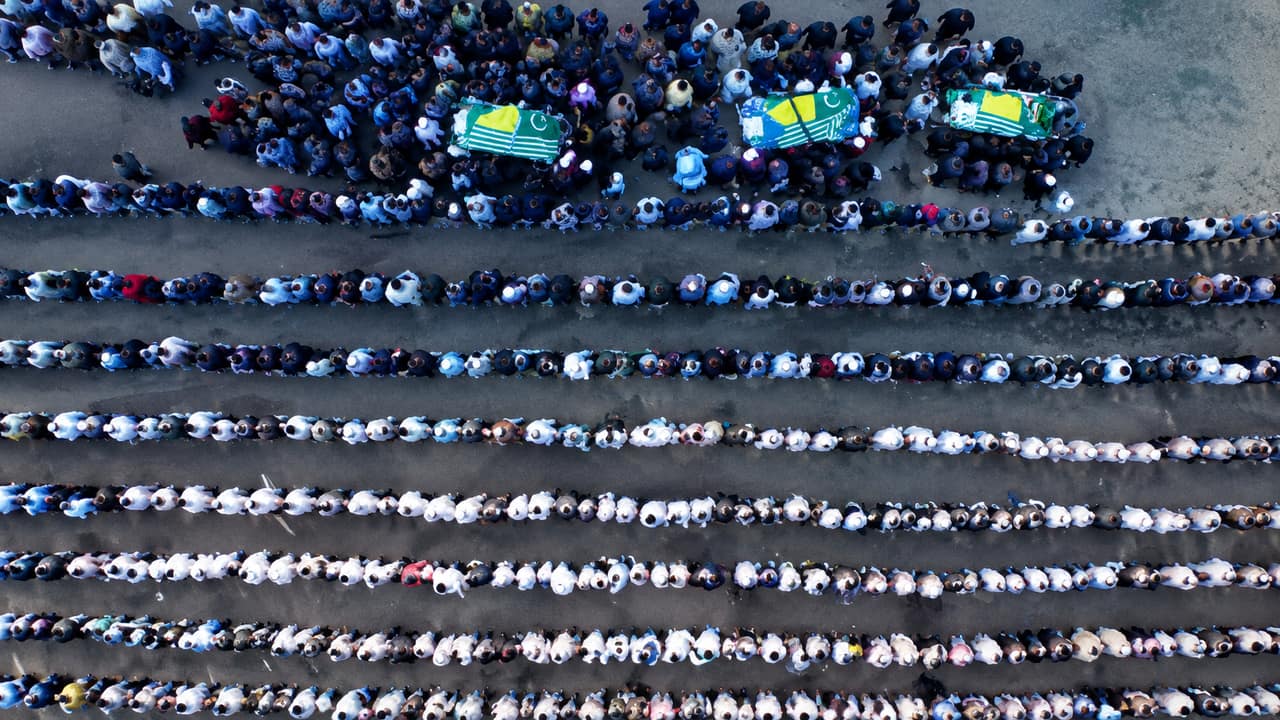
Comments (0)