
The People’s Rights Movement in Azad Jammu and Kashmir: Its Impact, Risks and Possible Futures
Introduction: a movement at the crossroads
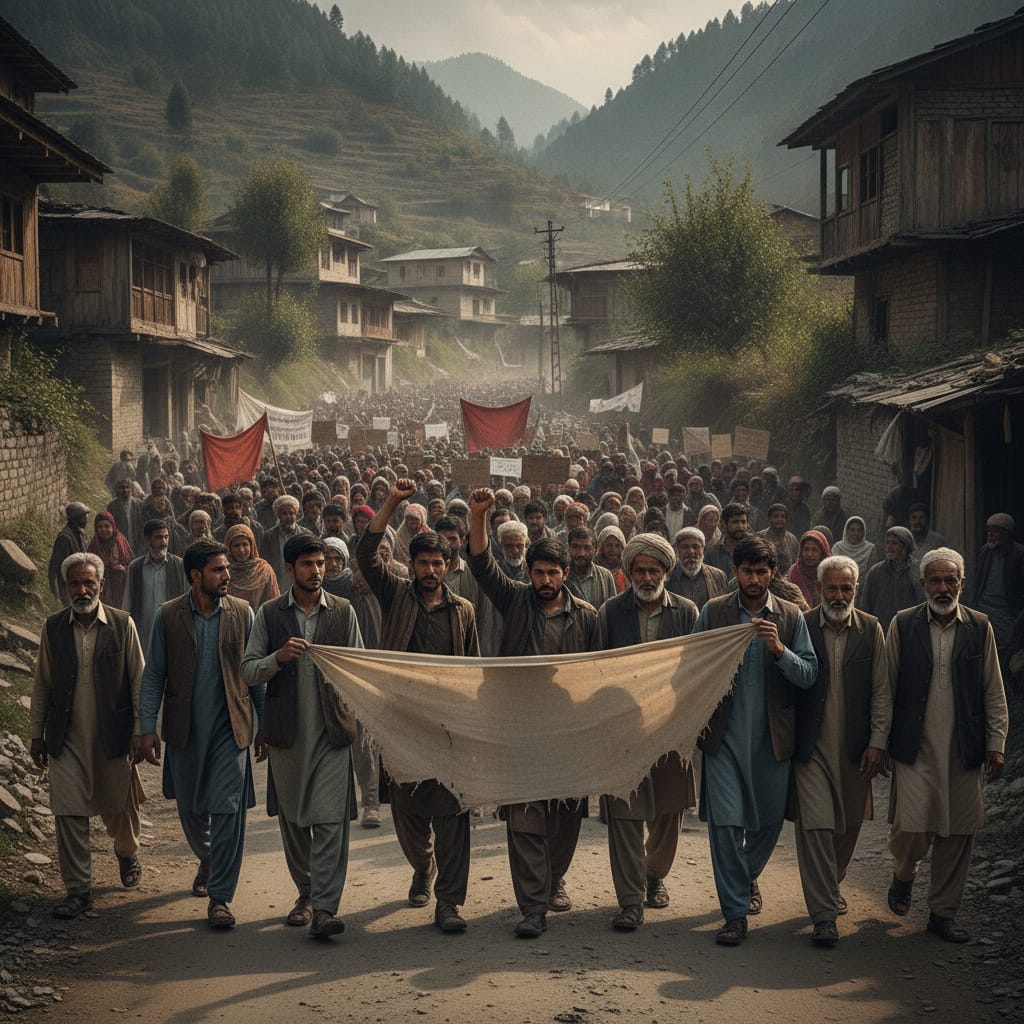
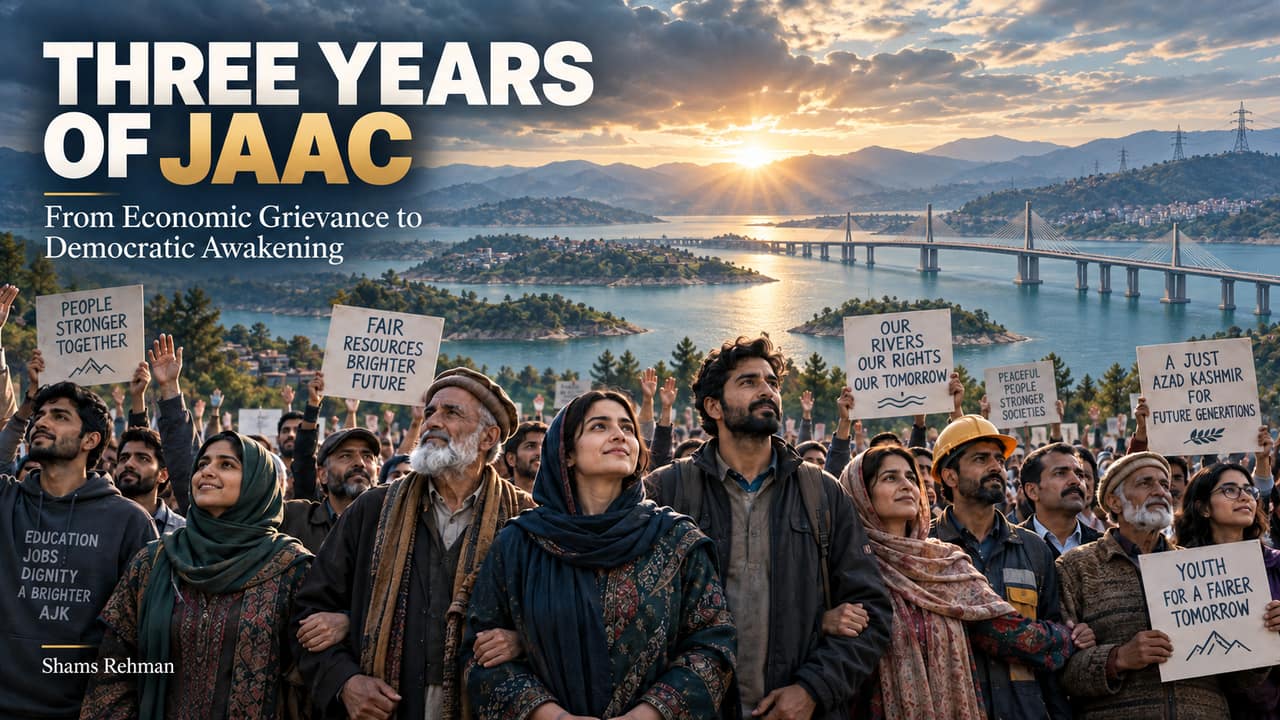
The People’s Rights Movement in Azad Jammu and Kashmir began in May 2023 with demands that were immediate, comprehensible and rooted in everyday life: affordable flour and electricity. More than three years later, it has developed into the most significant popular challenge to the region’s political and administrative order in decades.
The transformation is remarkable. A protest outside a flour depot in Rawalakot developed into electricity-bill boycotts, local action committees, general strikes, long marches and negotiations involving the governments of Azad Jammu and Kashmir and Pakistan. It secured substantial economic concessions, expanded its programme into a comprehensive People’s Charter and raised previously marginal questions concerning elite privileges, resource ownership, constitutional authority and democratic representation.
By August 2026, however, the movement had entered an altogether different phase. JAAC had been proscribed under anti-terrorism legislation; its leaders and supporters faced arrests and criminal cases; communications had been restricted; additional security forces had been deployed; businesses, schools and public offices had remained closed for prolonged periods; and Rawalakot and the wider Poonch division had become the centre of a sustained sit-in and political confrontation.
The crisis is no longer simply about whether the remaining demands will be accepted. It has become a struggle over political legitimacy and authority. The Government claims the constitutional right to govern and enforce order. JAAC claims the democratic legitimacy derived from mass participation and the Government’s repeated failure to honour negotiated agreements. Neither side has been able to impose a sustainable settlement.
The Pakistani establishment occupies the decisive position within this confrontation. Formally, AJK possesses an elected government, legislature, judiciary and administrative structure. In practice, however, the repeated involvement of Pakistan’s federal ministers, financial institutions, security agencies and military and paramilitary forces demonstrates that the major limits within which the AJK Government can negotiate are determined elsewhere. The movement has exposed not only the weaknesses of individual AJK governments but the structural limits of the political order itself.
JAAC has succeeded in demonstrating that the old system cannot continue without resistance. It has not yet demonstrated how popular resistance can be converted into durable democratic power. That is now the central historical question.
1. The material origins of the movement
The movement did not arise primarily from constitutional theory, nationalist ideology or competition among political parties. It arose from the material pressures experienced by ordinary households.
By 2023, people faced rising flour prices, shortages of subsidised wheat, expensive electricity, inflation, unemployment and declining purchasing power. These pressures existed alongside visible privileges enjoyed by ministers, legislators, senior officials and other powerful groups.
The electricity question carried a particularly powerful contradiction. AJK contributes substantially to hydropower generation, yet its residents paid electricity tariffs determined within a wider Pakistani system. The demand for electricity at the cost of local generation therefore combined household economics with a political claim: if electricity is generated from the region’s rivers and infrastructure, what rights do its people possess over that resource?
Flour and electricity became successful mobilising demands because they crossed party, ideological, regional and biradari divisions. A family did not need to understand Marxism, constitutional law or the history of the Kashmir dispute to understand an unaffordable electricity bill or the price of a bag of flour.
The movement’s original strength came from this simplicity. It linked politics to the reproduction of everyday life.
2. From isolated grievances to collective organisation
Before JAAC, dissatisfaction existed across AJK, but much of it was fragmented. Traders protested separately, transporters pursued their own concerns, lawyers raised constitutional questions, political activists worked under different ideological banners and individual citizens approached politicians for personal assistance.
JAAC brought many of these constituencies into a common organisational framework. Traders’ bodies, transport organisations, lawyers, students, political activists and local civic committees were able to work together without first resolving their ideological differences.
This organisational form was particularly suited to AJK. The established parties were closely connected to Pakistan’s major political parties and deeply embedded in patronage networks. Independence-oriented and progressive organisations possessed committed cadres but remained comparatively small and divided. JAAC did not require people to abandon their existing beliefs. It asked them to cooperate around a shared charter.
This was both its greatest strength and a source of future difficulty. Its ideological flexibility allowed rapid expansion, but it postponed difficult questions concerning internal democracy, representation, class interests, constitutional objectives and the ultimate destination of the movement.
3. The May 2024 victory and the collapse of political fear
The movement’s first decisive achievement came during the May 2024 mobilisation. Attempts to prevent the long march through arrests, roadblocks and security deployment intensified rather than contained public anger. After deadly confrontations and a general shutdown, Pakistan’s federal government approved an immediate PKR 23 billion package. Electricity and flour prices were reduced. Dawn
The direct economic effect was important, but its political and psychological consequences were more profound.
For perhaps the first time in their lives, many people experienced a clear sequence:
- ordinary people organised;
- the Government resisted;
- the public remained mobilised;
- higher authorities intervened;
- material concessions followed.
This experience weakened the culture of political dependency. People who had traditionally approached politicians as petitioners began to imagine themselves as rights-bearing citizens.
The movement’s legitimacy after May 2024 was therefore not constructed only through speeches. It was reinforced every time a household purchased cheaper flour or received a lower electricity bill. The material concession became daily evidence that collective struggle worked.
This explains why people continued responding to subsequent JAAC calls even when they did not fully understand or agree with every new demand. Many felt indebted to the organisation that had delivered concrete relief when established political parties had failed.
4. From economic relief to a People’s Charter
Having secured concessions on flour and electricity, JAAC expanded its programme. The wider charter included demands concerning:
- healthcare and education;
- roads and communications;
- employment and recruitment policies;
- local government;
- the Bank of Azad Jammu and Kashmir;
- the Accountability Bureau;
- Mangla Dam affectees;
- reductions in elite privileges;
- public-sector reform;
- constitutional and electoral arrangements;
- the twelve legislative seats reserved for refugees settled in Pakistan.
This expansion was historically understandable. The success of the original movement brought previously suppressed grievances to the surface. Every social group wanted its unresolved problem included.
The result was a transition from a bread-and-butter campaign to a movement for administrative, political and constitutional restructuring.
That transition expanded JAAC’s historical significance, but it also changed the nature of the confrontation. Flour and electricity could be addressed through subsidies and fiscal transfers. Questions concerning the refugee seats, political representation, constitutional authority and the formation of AJK governments directly affected the structure of power.
The Pakistani state could concede money more easily than it could concede political control.
5. The October 2025 agreement and the problem of implementation
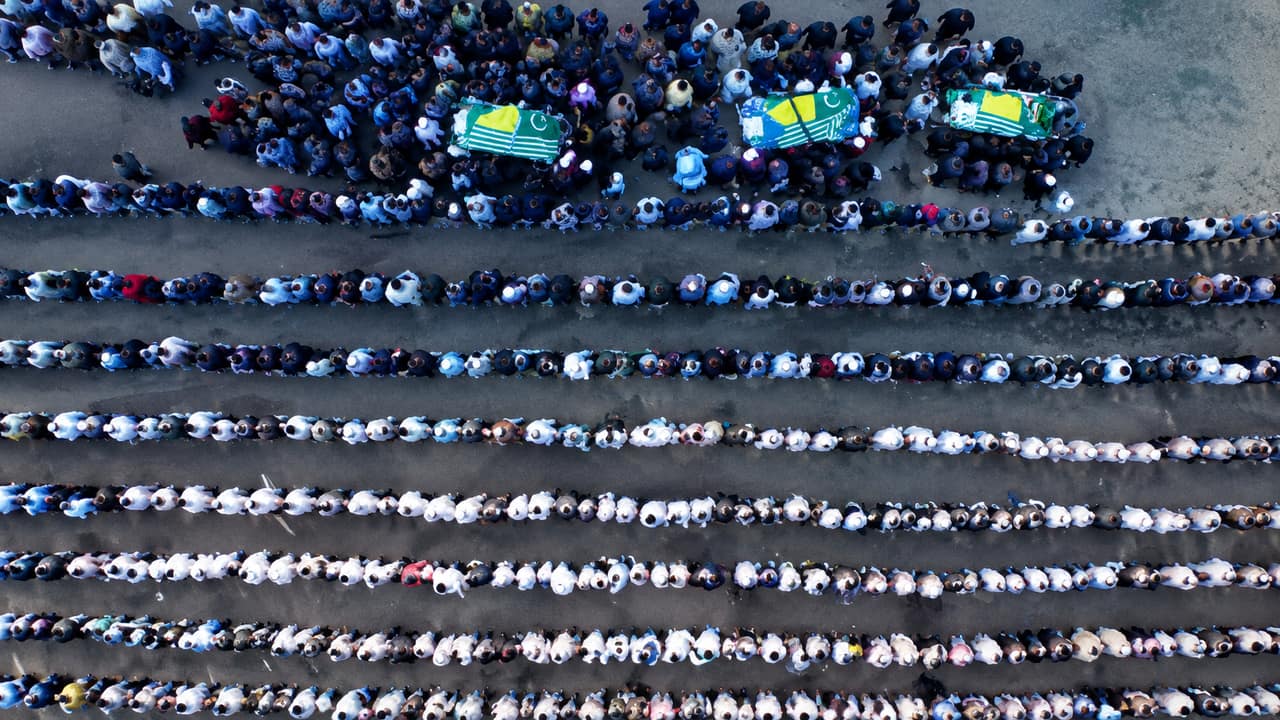
The September–October 2025 mobilisation demonstrated that JAAC retained the capacity to paralyse much of AJK. The confrontation resulted in deaths and injuries, but it also produced high-level negotiations involving representatives of JAAC, the AJK Government and Pakistan’s federal government.
The resulting agreement covered a large part of the movement’s charter. It represented another major recognition of JAAC as a legitimate negotiating party. The Government later claimed that a substantial majority of the demands had been accepted or implemented. JAAC argued that many commitments remained incomplete, delayed or implemented only in form rather than substance. Associated Press, Associated Press of Pakistan
This disagreement exposed a recurring weakness in settlements between social movements and governments. An agreement without:
- precise deadlines;
- independent monitoring;
- published progress reports;
- enforceable remedies;
- clear financial allocations;
- consequences for non-compliance
can temporarily end a protest without resolving the underlying conflict.
For JAAC, delayed implementation confirmed that pressure had to be maintained. For the Government, repeated protests after accepting many demands appeared to demonstrate that JAAC would never be satisfied. Each side increasingly interpreted the other’s conduct as evidence of bad faith.
6. The refugee seats and the struggle over political power
The demand concerning the twelve refugee seats marked the movement’s most important political transition.
These seats were established to represent Kashmiris displaced from Indian-administered Jammu and Kashmir and settled elsewhere in Pakistan. Their defenders regard them as part of the historical and constitutional architecture of the unresolved Kashmir dispute.
JAAC and other critics argue that the arrangement allows voters who do not reside in AJK to determine the composition of its legislature and influence the formation of its government. Pakistani political parties can win refugee constituencies situated within Pakistan and use those seats to shape parliamentary majorities in Muzaffarabad.
The issue contains several separate questions that have too often been collapsed into one:
- Do refugees possess a legitimate right to political representation?
- Should that representation take place within the AJK legislature?
- Should voters living outside AJK help determine its government?
- Can the AJK Assembly effectively represent constituencies under Pakistan’s territorial administration?
- How should refugees living inside AJK be represented?
- Could a separate representative institution protect refugee rights without distorting territorial government?
JAAC succeeded in making these questions part of mass political debate. But the abolition demand also enabled the Government to portray the movement as threatening the constitutional basis of the Kashmir cause and the rights of displaced people.
A more politically sophisticated position would separate the refugees’ right to representation from the mechanism through which Pakistan-based seats influence the government of AJK.
7. The post-5 June transformation
The proscription of JAAC on 5 June 2026 fundamentally changed the conflict.
Before that date, JAAC was a recognised negotiating party. Its representatives had participated in formal talks and monitoring arrangements. After 5 June, the same organisation was placed within the legal framework of terrorism and national security.
This transformation allowed the authorities to:
- arrest leaders and supporters;
- restrict association;
- disrupt financial and organisational networks;
- justify communications shutdowns;
- restrict media access;
- deploy additional forces;
- portray participation as a security offence rather than political activity.
Amnesty International described the proscription as disproportionate and unlawful, stating that anti-terrorism legislation was being used against a grassroots movement advocating economic and political rights. Amnesty International
The state’s objective appears to have been to change the terrain of the conflict. A movement confident in its capacity for mass mobilisation was to be isolated, criminalised and deprived of communications before it could disrupt the electoral process.
Instead, the proscription deepened the confrontation. It gave JAAC a new demand—its own legal restoration—and turned the defence of civic space into part of the struggle.
8. Rawalakot, the prolonged sit-in and the politics of endurance
The continuing sit-ins in Rawalakot and the wider Poonch division demonstrate exceptional political determination. They have prevented the Government from declaring the movement defeated and transformed Rawalakot into a symbol of resistance.
But endurance is not the same as strategic progress.
A sit-in is a political instrument. It should create pressure that leads towards negotiations, concessions, institutional change or wider organisation. If it becomes indefinite without a mechanism for moving towards those objectives, it can begin consuming the movement’s own social base.
After approximately seventy-five days, the burden of closure is distributed unequally. Salaried officials may continue receiving income. Wealthier households and remittance-supported families possess savings. Daily-wage workers, small traders, transport workers, private employees and families without overseas support face far greater hardship.
This creates a central class danger: a movement founded on the needs of ordinary people could unintentionally impose its greatest costs upon those same people.
The Government may be relying on precisely this contradiction. Rather than defeat JAAC in a public political argument, it may wait for economic exhaustion to reduce participation.
The movement’s principal impacts
9. A new political consciousness
The movement has changed the way people understand rights. Electricity, flour, healthcare, education and communications are increasingly presented as entitlements rather than favours.
This consciousness is unlikely to disappear even if JAAC itself fragments. It constitutes a permanent change in the political culture of AJK.
10. Crisis of traditional party politics
JAAC has shown that established parties no longer possess an uncontested monopoly over political representation. A non-party platform has repeatedly demonstrated a greater capacity to mobilise society and force negotiations.
Traditional parties will survive because they retain electoral machinery, patronage networks, public-sector influence and relationships with Islamabad. But they can no longer assume that winning an election gives them complete political legitimacy.
11. Exposure of AJK’s limited autonomy
The movement has made visible the distance between AJK’s formal institutions and the location of decisive power.
When a crisis requires:
- federal financial packages;
- Pakistani ministerial delegations;
- federal security forces;
- interventions by Pakistan’s political leadership;
- communications decisions made beyond AJK;
- constitutional limits defined through Pakistan’s wider strategic interests,
the claim that Muzaffarabad exercises meaningful autonomous authority becomes difficult to sustain.
12. Politicisation of resource ownership
The electricity question has connected daily household economics to natural resources, royalties and sovereignty.
A family did not need to understand Marxism, constitutional law or the history of the Kashmir dispute to understand an unaffordable electricity bill or the price of a bag of flour.
This may influence future struggles over:
- hydropower;
- water;
- dams;
- tourism;
- forests;
- minerals;
- land;
- environmental protection;
- revenue sharing.
13. Creation of political infrastructure
JAAC has produced organisers, local committees, communication networks, negotiating experience and collective memory. Even if the current organisational form changes, these networks can become the foundation for future civic or political organisation.
14. The diaspora as a political actor
The British Kashmiri diaspora has moved beyond sending remittances and supporting traditional Kashmir organisations. It has organised demonstrations, approached parliamentarians, submitted petitions and brought the crisis into the British Parliament.
A Westminster Hall debate explicitly recognised JAAC as one of the three parties requiring dialogue. An Early Day Motion called for restoration of communications, due process, medical access and negotiations. UK Parliament debate, Early Day Motion
15. Internationalisation of the human-rights dimension
The UN Human Rights Office called for impartial investigations, internet restoration, due process and meaningful dialogue. UN Human Rights Office
This represents a major change. AJK had previously received comparatively limited independent international attention. The crisis has begun to enter global human-rights discourse separately from the traditional India–Pakistan dispute.
16. Impact on elections and governmental legitimacy
The movement overshadowed the 2026 elections and contributed to the postponement of voting in several constituencies in Poonch and Sudhnoti. Reuters
Even where voting occurred, the legitimacy of the process became intertwined with:
- JAAC’s boycott;
- the refugee seats;
- communications restrictions;
- security deployment;
- allegations of coercion;
- unresolved deaths and detentions.
The principal risks facing JAAC
17. Exhaustion of its social base
The first danger is that people may continue agreeing with JAAC but become unable to sustain its methods.
Political support, participation in a sit-in and willingness to keep a business closed are three different things. The first can remain high while the second and third decline.
If JAAC treats reduced participation as betrayal rather than exhaustion, it could alienate its own supporters.
18. Regional isolation
Rawalakot’s central role is a source of strength, but it creates vulnerability. If the movement becomes concentrated in Poonch while life resumes elsewhere, the authorities can describe it as a regional or tribal problem rather than an AJK-wide democratic movement.
Maintaining political participation across Mirpur, Kotli, Muzaffarabad, Bagh, Bhimber, Neelum and other areas is therefore strategically essential.
19. Organisational fragmentation
A prolonged confrontation will intensify differences over:
- negotiation;
- compromise;
- the duration of strikes;
- constitutional objectives;
- the use of confrontational language;
- participation in elections;
- transformation into a political party;
- relations with independence-oriented organisations;
- authority within the core committee.
Without transparent internal procedures, these differences may turn into factional struggles.
20. Loss of control over militant rhetoric
When peaceful methods appear ineffective, some participants may embrace language of armed resistance or retaliation. Even if JAAC’s formal leadership rejects violence, statements by individuals can be used to define the entire movement.
This would:
- frighten families away from protest sites;
- reduce international sympathy;
- strengthen the Government’s terrorism narrative;
- divide the movement;
- justify additional repression;
- create space for undisciplined or infiltrated groups.
JAAC’s peaceful character is not only an ethical principle; it is one of its most important strategic protections.
21. A gap between diaspora militancy and local suffering
Overseas supporters do not directly bear the costs of:
- school closures;
- lost daily wages;
- interrupted healthcare;
- food shortages;
- roadblocks;
- arrests;
- local business losses.
Diaspora activists may consequently advocate continued confrontation more easily than people inside AJK.
Decisions about the movement’s direction must remain with those directly bearing the consequences. Diaspora support should focus on advocacy, documentation, humanitarian assistance and political lobbying.
22. Inaccurate information
Communications restrictions create an environment in which rumours spread rapidly. Exaggerated casualty figures, falsely attributed videos or unverified claims may initially attract attention but eventually weaken credibility.
A serious movement requires an evidence unit capable of maintaining:
- verified lists of deaths;
- hospital and medical records;
- detainee profiles;
- FIR numbers;
- court proceedings;
- photographic and video authentication;
- documentation of agreements;
- a distinction between confirmed and alleged incidents.
23. Sacrifice without institutional accumulation
The movement has generated enormous sacrifice, but it has not yet converted that sacrifice into a durable institutional structure.
If every mobilisation ends with another agreement followed by another implementation dispute, the movement may become trapped in repetition:
mobilisation, repression, casualties, negotiation, promise, delay and renewed mobilisation.
Breaking this cycle requires organisation capable of monitoring agreements and operating between moments of mass protest.
Risks facing AJK and the Pakistani establishment
24. Permanent political alienation
The greatest danger for the state is not that JAAC will immediately overthrow the existing order. It is that a generation will conclude that peaceful politics, negotiation and constitutional methods are meaningless.
When peaceful civic demands are answered through proscription, force and communications blackouts, the state teaches people that legality offers no protection.
25. Radicalisation beyond JAAC
JAAC’s leadership currently provides an identifiable organisation with which the authorities can negotiate. Destroying it would not eliminate the grievances. It could remove the only leadership capable of disciplining and moderating popular anger.
A fragmented post-JAAC environment may contain smaller, less accountable and more radical groups.
26. Delegitimisation of the AJK Government
An AJK Government unable to restore communications, investigate deaths, reopen schools or negotiate independently will increasingly appear irrelevant.
The more visibly Pakistan’s security and political establishment controls the response, the more the movement’s critique of external control is validated.
27. Damage to Pakistan’s Kashmir position
Pakistan’s international narrative relies upon support for Kashmiri rights and self-determination. Communications shutdowns, anti-terrorism laws and reported use of lethal force against Kashmiris create a damaging contradiction.
The longer the crisis continues, the more international discussion may shift from India’s conduct in Kashmir towards scrutiny of Pakistan’s administration of AJK.
28. Economic and administrative deterioration
Prolonged shutdowns damage:
- commerce;
- banking;
- transport;
- tourism;
- education;
- healthcare;
- public revenue;
- household income;
- investment.
Even if the state restores physical control, it may inherit a poorer, angrier and less governable society.
29. Normalisation of exceptional powers
The use of terrorism legislation against a civic coalition creates a precedent that may later be applied to lawyers, journalists, trade unions, political parties and student organisations.
This does not merely affect JAAC. It weakens the entire constitutional and political environment of AJK.
30. Loss of control over the international narrative
Indian media has frequently interpreted the movement as an anti-Pakistan uprising, while Pakistan has alleged external sponsorship. Both framings obscure its indigenous material origins.
The establishment’s refusal to negotiate gives Indian propaganda greater credibility and makes JAAC’s local rights agenda increasingly vulnerable to regional geopolitical appropriation.
Future courses available to JAAC
31. Preserve the movement, not every tactic
JAAC must distinguish between its objectives and its methods.
The sit-in, shutter-down strike and long march are tactics. They are not the movement itself. Suspending or modifying a tactic does not necessarily represent surrender if doing so preserves public participation and opens another route towards the same objectives.
An indefinite closure that destroys the economic base of the movement would be self-defeating.
32. Adopt a phased strategy
JAAC should divide its demands into categories.
Immediate humanitarian and democratic demands
- restoration of communications;
- access to food and medicine;
- reopening of schools and hospitals;
- production of detainees before courts;
- release of people not accused of recognisable criminal offences;
- protection of peaceful assemblies;
- investigation of deaths.
Agreement-implementation demands
- published review of each commitment;
- financial allocations;
- implementation deadlines;
- independent monitoring;
- public progress reports.
Constitutional demands
- refugee-seat reform;
- electoral representation;
- resource ownership;
- distribution of authority between AJK and Pakistan.
Constitutional questions require a longer and more inclusive process than emergency humanitarian measures.
33. Offer conditional de-escalation
JAAC could publicly offer to:
- suspend further disruptive strikes;
- guarantee access to hospitals and schools;
- facilitate movement of food and medicine;
- prevent weapons at protest sites;
- nominate an authorised negotiating team;
- enter time-bound talks.
In return, the Government would be asked to:
- restore communications;
- halt arrests;
- review the proscription;
- release or lawfully process detainees;
- withdraw additional forces from civilian areas;
- establish an independent inquiry.
Such an offer would place the political burden on the Government if it refused.
34. Democratically restructure JAAC
JAAC now requires more than a core committee created for mobilisation. It needs:
- written rules;
- elected district representation;
- transparent finances;
- defined terms of office;
- representation for women and young people;
- mechanisms for removing office-holders;
- conflict-of-interest rules;
- recorded decisions;
- a code of non-violence;
- an independent documentation and legal unit.
Collective leadership must become an institutional reality rather than a slogan.
35. Establish a permanent civic movement
The strongest option may be for JAAC to remain a non-party rights organisation capable of:
- monitoring public budgets;
- organising political education;
- publishing implementation reports;
- supporting local struggles;
- holding public hearings;
- scrutinising governments;
- defending civil liberties;
- mobilising when institutional methods fail.
This would allow people from different political traditions to remain united.
36. Keep party politics organisationally separate
If some JAAC leaders wish to contest elections, they should establish a separate political party rather than convert the entire civic platform into an electoral organisation without broad consultation.
A clear distinction would protect JAAC from becoming another vehicle for personalities and electoral patronage.
37. Develop a defensible refugee-representation proposal
Rather than demanding abolition alone, JAAC should publish an alternative model that:
- recognises the historical rights of refugees;
- protects representation for refugees residing inside AJK;
- prevents non-resident seats from determining the AJK Government;
- separates refugee advocacy from territorial administration;
- establishes transparent electoral rolls;
- avoids hostility towards displaced Kashmiris.
An alternative proposal would make it harder to portray JAAC as opposed to refugees or the wider Kashmir cause.
38. Protect essential services
JAAC should declare hospitals, ambulances, medicines, schools, examinations, water, food supplies and emergency transport protected from movement disruption.
This would preserve public support and demonstrate that the movement seeks to improve life rather than suspend it indefinitely.
39. Strengthen evidence and international advocacy
A professional documentation body should prepare verified submissions for:
- the UN Human Rights Office;
- UN Special Rapporteurs;
- Amnesty International;
- Human Rights Watch;
- the Human Rights Commission of Pakistan;
- British parliamentarians;
- international media;
- legal organisations.
The strongest international case is built through evidence, not rhetoric.
Future courses available to the Pakistani establishment
40. Recognise that proscription has failed politically
The ban has not removed JAAC’s social base. It has intensified the confrontation, damaged political legitimacy and attracted international criticism.
The establishment should recognise JAAC as a civic negotiating party without necessarily accepting all its demands.
Negotiation is not capitulation. States routinely negotiate with representative organisations to prevent conflicts from becoming security emergencies.
41. Return to a civilian political framework
The crisis cannot be sustainably resolved through military or paramilitary management.
Additional forces should be withdrawn from civilian spaces in stages. Local policing should operate under clear legal and judicial oversight. Peaceful assemblies should be protected rather than treated as enemy formations.
42. Restore the pre-5 June political environment
A credible de-escalation process should include:
- lifting communications restrictions;
- reviewing JAAC’s proscription;
- halting indiscriminate arrests;
- ending collective punishments;
- restoring normal economic activity;
- allowing journalists and observers access;
- guaranteeing safe negotiations.
Returning to the pre-5 June position would not resolve every demand, but it would recreate the political conditions necessary for resolution.
43. Establish an independent inquiry
An inquiry should examine:
- every reported death;
- use of firearms;
- conduct of protesters and security forces;
- attacks on public facilities;
- treatment of detainees;
- hospital access;
- communications shutdowns;
- command responsibility.
Its members must be acceptable to both sides and capable of summoning officials, accessing records and publishing findings.
44. Replace vague promises with enforceable implementation
Every accepted demand should be placed in a public matrix showing:
- the responsible institution;
- legal steps required;
- budget allocation;
- commencement date;
- completion date;
- implementation status;
- independent verification.
This would reduce the cycle of competing claims.
45. Open constitutional dialogue
The refugee-seat question cannot be resolved through executive denial or street confrontation alone.
A constitutional forum should include:
- JAAC;
- elected AJK representatives;
- refugee representatives;
- political parties;
- bar associations;
- constitutional experts;
- civil society;
- women and youth;
- representatives of displaced communities.
Its purpose should be to protect refugee rights while ensuring that territorial government remains accountable to people living in AJK.
46. Accept meaningful AJK autonomy
The establishment ultimately faces a larger choice. It can continue managing AJK through controlled parties, financial dependency and security intervention, or it can permit the development of more accountable and genuinely autonomous institutions.
The first approach may preserve short-term control but will repeatedly reproduce resistance. The second contains political risks for Islamabad, but it offers the only route towards durable legitimacy.
A possible negotiated roadmap
A workable settlement could proceed in four stages.
Stage one: humanitarian normalisation
- restore communications;
- reopen schools, offices and businesses;
- guarantee food and medical access;
- stop further arrests;
- protect peaceful sit-ins;
- suspend disruptive protest escalation.
Stage two: legal and security de-escalation
- review the ban on JAAC;
- produce detainees before courts;
- release those not accused of specific offences;
- withdraw extraordinary forces;
- begin an independent inquiry.
Stage three: agreement implementation
- publish a joint implementation matrix;
- appoint neutral monitors;
- set deadlines;
- provide public monthly reports;
- identify funding and legislative requirements.
Stage four: constitutional dialogue
- examine refugee representation;
- electoral reform;
- resource rights;
- relations between AJK and Pakistan;
- institutional autonomy;
- accountability and local government.
Conclusion: from resistance to political construction
The People’s Rights Movement has already altered AJK’s history. It has demonstrated the power of organisation grounded in everyday economic life. It secured material concessions, weakened patronage politics, exposed the limitations of AJK’s governing structure and brought a previously neglected region into international human-rights discussion.
Yet a movement can be historically important and still face defeat. JAAC’s greatest danger is that prolonged sacrifice may not be converted into durable organisation. If closure becomes the movement’s permanent condition, economic exhaustion, regional isolation, factionalism and militant rhetoric may erode the social unity that made its earlier victories possible.
The Pakistani establishment faces an equally grave danger. It may possess the force required to disperse sit-ins, arrest leaders and interrupt communications, but coercion cannot restore legitimacy. Destroying JAAC without addressing the conditions that produced it would create a more alienated and potentially less controllable political generation.
Neither JAAC nor the establishment can obtain a sustainable total victory.
JAAC cannot indefinitely govern society through shutdowns without possessing public institutions. The establishment cannot indefinitely govern through security measures without public consent. The choice is therefore not between surrender and victory. It is between a negotiated transformation and a prolonged deterioration in which both the movement and society pay an increasingly unbearable price.
JAAC must now move from mobilisation to democratic organisation, from a collection of demands to a political programme, and from sacrifice to institutional accumulation.
The Pakistani establishment must move from control to consent, from security management to political dialogue, and from treating AJK as an administratively managed frontier to recognising its people as the principal democratic authors of its future.
The next phase will determine whether the movement becomes the foundation of a new democratic political culture—or the memory of an extraordinary uprising that could disrupt the old order but could not build a new one.
Comments (0)