


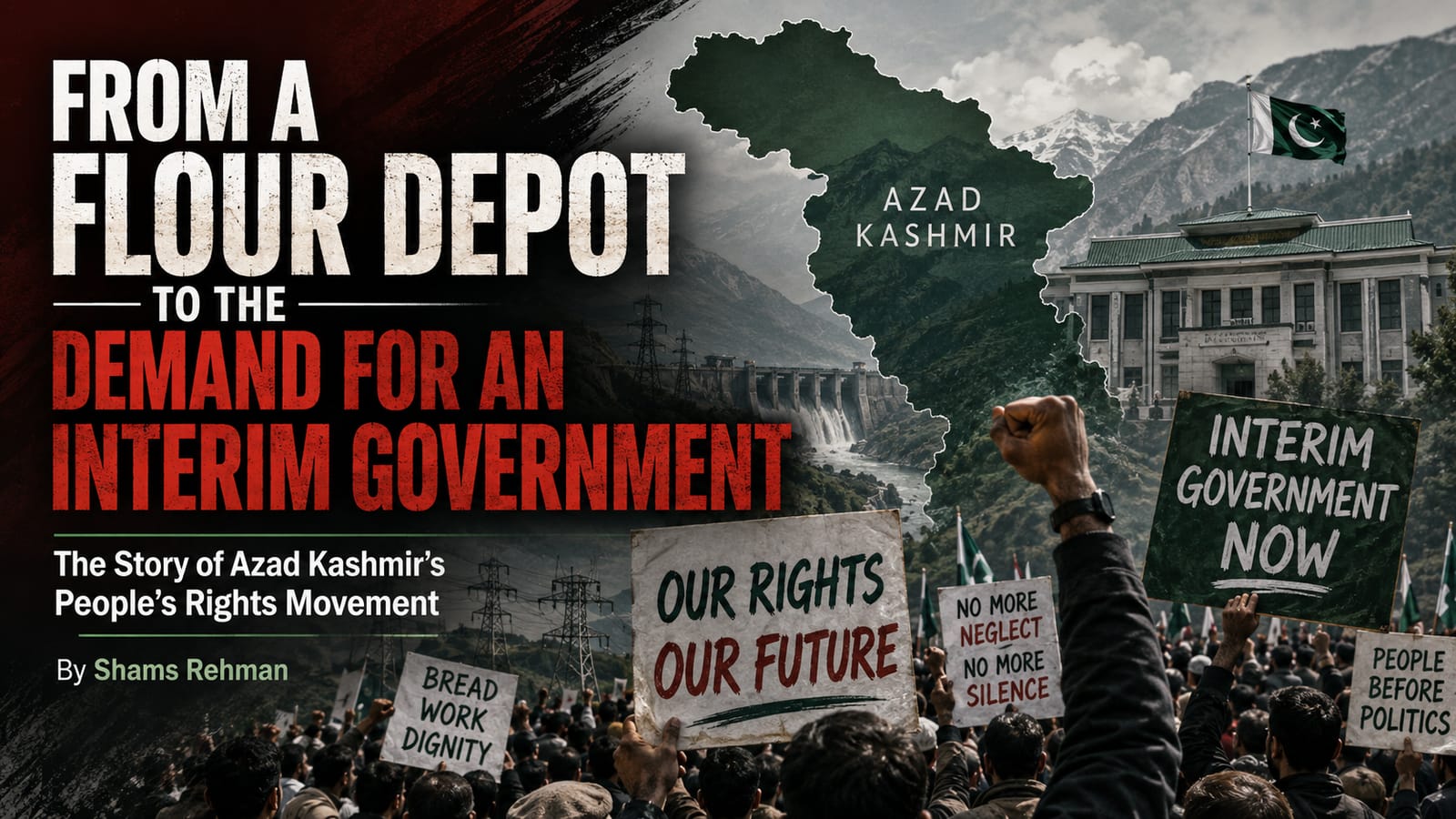
The Story of Azad Kashmir’s People’s Rights Movement
When I returned to Mirpur from Britain in 2023 after almost a decade, I found a society undergoing changes that required far more than a newspaper article to understand. Markets were expanding despite inflation, migration and remittances were continuing to reshape social relations, and a younger generation was beginning to question the inherited political order.
The most significant change, however, was political. Young people appeared to be moving away from abstract, Valley-centred rhetoric towards an AJK-centred politics rooted in their everyday lives. Electricity bills, flour prices, unemployment, education, healthcare, corruption, the control of local resources and the privileges of rulers were replacing the repetitive speeches through which the people of Azad Jammu and Kashmir had been governed for decades.
Mirpur, once a major centre of independent Kashmir politics, was again becoming politically active. This time, however, the emerging politics was more socially diverse, more concerned with material conditions and potentially more inclusive than the older politics shaped by tribal, sectarian and party loyalties. The rulers appeared detached from these changes and seemed to be sleepwalking towards a confrontation they neither understood nor knew how to handle.
What began outside a government flour depot would eventually become the largest sustained people’s rights movement in the recent history of Azad Kashmir. Three years later, after repeated agreements, broken promises, arrests, bans, internet shutdowns, disputed elections and extensive loss of life, the Joint Awami Action Committee would demand the replacement of the existing political arrangement by a neutral interim government.
The Flour Depot at Rawalakot
The immediate origins of the movement can be traced to Rawalakot in May 2023. The government had sharply increased the price of flour, and a small number of traders and civil activists began a sit-in outside the state-run wheat depot in Supply Bazaar.
There was nothing apparently revolutionary about the gathering. People were asking why subsidised flour was disappearing, why prices were rising and why a population with limited employment opportunities was being forced to bear the consequences of economic decisions taken elsewhere.
Yet the sit-in touched a nerve.
Similar protests appeared across Poonch Division. When electricity prices and the taxes included in electricity bills also rose, protests spread to Muzaffarabad and Mirpur divisions. People began burning bills, refusing payment and holding local sit-ins. The complaint was simple: Azad Kashmir produced substantial hydroelectric power, yet its residents faced expensive electricity, long periods of load-shedding and numerous taxes added to their bills.
The Human Rights Commission of Pakistan later concluded that the movement had emerged directly from economic hardship, including increases in flour and electricity prices, and from demands that local communities should benefit from their own natural resources.
Formation of the Joint Awami Action Committee
Local action committees had existed in different parts of Azad Kashmir before 2023. An Awami Action Committee had also been established in 2014, influenced partly by rights movements in Gilgit-Baltistan. What distinguished the new phase was the attempt to bring previously scattered committees into one AJK-wide organisation.
Representatives of traders, transporters, lawyers, students, employees and civil society organisations began coordinating their activities. A major consultation was convened in Muzaffarabad, attended by activists from all ten districts. After lengthy discussion, the organisation was formally named the Jammu Kashmir Joint Awami Action Committee, or JAAC.
A central core committee was formed with representation from every district, while local committees retained considerable independence. This was important. The JAAC did not operate like a conventional political party with one supreme leader. Its authority came from local committees, public meetings, traders’ associations, lawyers, transport workers and people occupying the streets.
Its first Charter of Demands called for subsidised flour, electricity supplied at or near the cost of local production, the removal of excessive taxes from electricity bills and the reduction of privileges enjoyed by ministers, senior bureaucrats and other members of the ruling establishment.
The charter also included restoration of student unions, financial and administrative powers for elected local bodies, better mobile and internet services, reform of property-transfer taxes, activation of accountability institutions, scheduled-bank status for the Bank of AJK and implementation of court decisions concerning hydropower projects.
This was not initially a movement for independence, accession or a new constitutional status. Nor was it organised against Pakistan. It was primarily a movement for affordable food and electricity, accountable government and a fairer distribution of public resources.
That distinction was repeatedly made by its leaders but repeatedly ignored by its opponents.
The First Agreements—and the First Broken Promises
Following strikes and demonstrations in late 2023, the AJK government opened negotiations with the JAAC. An understanding was reached in December 2023, followed by government notifications in February 2024.
The government accepted several demands in principle but delayed practical implementation. The most contentious question was the price of electricity. Officials said they needed time to determine the actual cost of power generated from Mangla and other local hydropower projects. JAAC maintained that the bills should be stripped of what it considered unjustified taxes and that electricity should be supplied at production cost.
The government later claimed that the dispute had largely been settled because tariffs had been frozen or reduced. JAAC responded that issuing statements was not the same as implementing the signed agreement. It demanded separate notifications, departmental instructions and a clear implementation programme for every accepted point.
After months of delay, the committee announced a long march to Muzaffarabad for 11 May 2024.
May 2024: The Government Misreads the Movement
In the weeks before the march, additional police and paramilitary personnel began arriving from Pakistan. The AJK government initially said the forces were required to protect Chinese nationals and hydropower installations. A government communication later showed that the deployment was also connected to the anticipated JAAC protest.
This transformed the political atmosphere.
For almost a year, JAAC leaders had repeatedly emphasised the peaceful nature of the movement. Their frequently repeated phrase was that during the entire campaign, “not even a single flowerpot had been broken.”
They asked why a peaceful campaign over flour and electricity required civil armed forces from Pakistan. Some activists believed that the government could not rely fully on the AJK Police because ordinary police officers and lower-level public employees were themselves affected by electricity prices, inflation and the withdrawal of subsidies.
Rather than engage with this changing public mood, government representatives and sections of the political class returned to a familiar vocabulary. The movement was described as anti-Pakistan, foreign-funded or advantageous to India. JAAC leaders argued that these accusations were being used to avoid discussion of corruption, maladministration and the government’s failure to implement its commitments.
The situation escalated when police launched pre-emptive raids and arrested activists in Muzaffarabad, Mirpur, Dadyal, Rawalakot and other towns. Tear gas and baton charges were used against gatherings protesting those arrests. Instead of preventing the march, the crackdown brought larger numbers into the streets.
The HRCP fact-finding mission later recorded that the government had requested six additional platoons of civil armed forces before the march and that the deployment of Frontier Constabulary, Punjab Constabulary and Pakistan Rangers marked a serious escalation.
The Long March and the May Killings
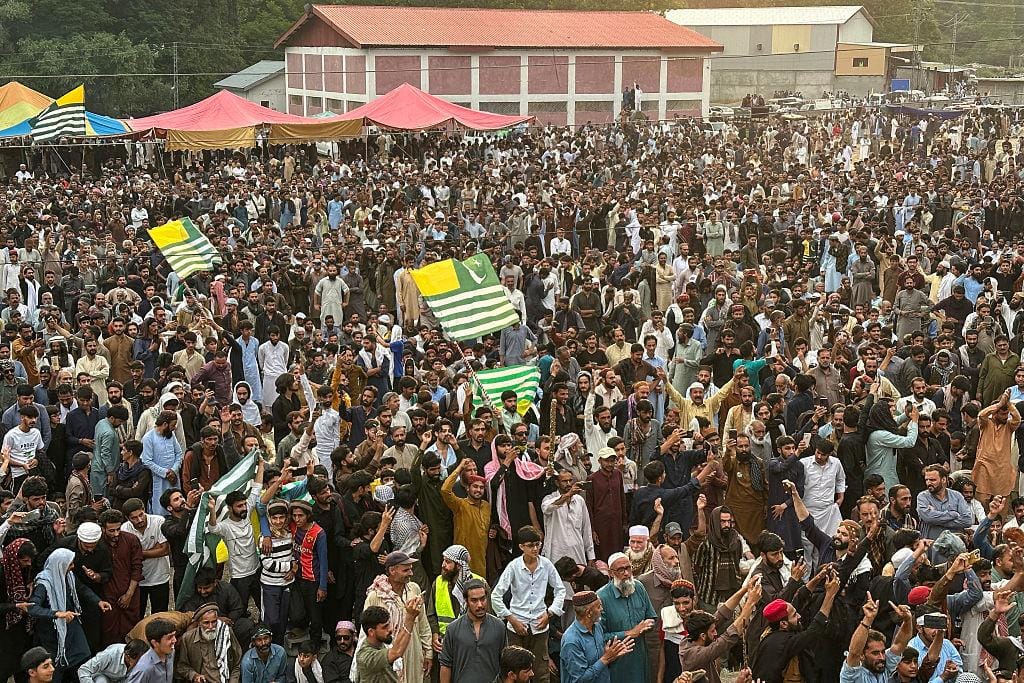
On 10 and 11 May, markets closed and transport stopped across much of Azad Kashmir. Convoys attempted to travel from Mirpur, Kotli, Poonch and other districts towards Muzaffarabad.
Police blocked roads and bridges, and clashes broke out at several points. A police sub-inspector, Adnan Qureshi, was killed near Islamgarh. Protesters and police personnel were injured in confrontations in Kotli, Sehnsa, Mirpur and Muzaffarabad.
JAAC dissociated itself from attacks on police and government property, alleging that unidentified or deliberately planted elements were attempting to discredit the movement. The circumstances surrounding some incidents remained disputed.
The confrontation became still more serious when Pakistan Rangers entered Muzaffarabad after negotiations had reportedly begun to make progress. Firing and tear-gas shelling resulted in the deaths of three young civilians and injuries to many others.
The HRCP concluded that the involvement of outside paramilitary forces, the lack of coordination with the local civil administration and the use of force contributed directly to the escalation. Its investigation also found widespread resentment over night raids, arrests and the treatment of demonstrators.
On 13 May, the federal government announced a grant of approximately Rs23 billion to subsidise flour and electricity. Flour prices were reduced, and new electricity tariffs were notified. The JAAC called off its march after announcing that its central economic demands had been accepted.
It was an important victory, but it was neither a complete victory nor the end of the movement.
The subsidy addressed the immediate price crisis. It did not settle questions about elite privileges, accountability, local government, control over resources, legal cases against activists or responsibility for the deaths.
More importantly, May 2024 had altered the political psychology of Azad Kashmir. People had discovered that collective action outside the established parties could force both Muzaffarabad and Islamabad to respond.
A Movement Beyond Political Parties
The significance of the May mobilisation was not only that it reduced electricity and flour prices. It demonstrated the growing irrelevance of the traditional political leadership.
Mainstream parties had long organised politics through patronage: government jobs, transfers, contracts, development schemes and personal access to ministers. The JAAC introduced a different form of organisation. It was issue-based, decentralised and relatively difficult for one political party or personality to control.
This did not mean that every participant had the same ideology. Nationalists, pro-Pakistan activists, socialists, traders, religious conservatives, students and politically unaffiliated citizens could all be found around the same platform. Their unity rested not on a common position regarding the final status of Jammu and Kashmir but on shared material and democratic grievances.
This broadness was both the movement’s strength and one of its future difficulties. It gave the committee mass reach, but it also meant that every expansion of the charter required delicate negotiation among people with different political perspectives.
December 2024: Defending the Right to Protest
Later in 2024, the AJK government introduced the Peaceful Assembly and Public Order Ordinance, restricting demonstrations by unregistered organisations and requiring prior permission for public gatherings.
To many activists, the ordinance appeared designed specifically to control the committees that had led the May mobilisation.
JAAC organised another territory-wide strike. Thousands gathered at Brarkot, Kohala, Holar and other entry points despite harsh winter conditions. Faced with growing opposition—including criticism from mainstream parties—the government withdrew the ordinance.
A written agreement reached at Kohala in December provided for the release of detainees, withdrawal of protest-related cases, compensation and employment for some victims’ families, restoration of a dismissed teacher, relief for certain Mangla Dam-affected households, improved flour supply, e-tendering for electricity meters, powers and funds for local representatives and a committee to prepare for student-union elections.
The government also agreed that the wider JAAC Charter of Demands would be discussed and implemented over the following six months. (Dawn)
The December mobilisation proved that May had not been an isolated eruption. The movement could remobilise across districts whenever the government attempted to restrict public organisation or failed to honour an agreement.
From Economic Relief to Structural Reform
During 2025, the movement’s agenda expanded.
The original demands for flour and electricity remained important, but the charter increasingly addressed governance, public services and political representation. Free or affordable healthcare and education, restoration of merit in public employment, health-card funding, medical equipment, an international airport for Mirpur, improved roads and tunnels, proprietary rights for Mangla Dam affectees, reforms to local government and accountability institutions, and implementation of court decisions were brought together in an enlarged charter.
What began outside a government flour depot would eventually become the largest sustained people's rights movement in the recent history of Azad Kashmir.
The movement’s logic was changing. People were no longer asking only why electricity was expensive. They were asking why public institutions remained ineffective while such a large proportion of the budget supported salaries, official transport, protocol, ministers, advisers and senior administration.
The most politically contentious demand concerned the 12 AJK Legislative Assembly seats representing refugees from Indian-administered Jammu and Kashmir settled in Pakistan.
JAAC argued that people elected from constituencies situated outside AJK could determine which party formed the government in Muzaffarabad, even though the AJK government had little authority over their everyday problems. The committee maintained that the seats had become an instrument through which Pakistani political parties manipulated governments in Azad Kashmir.
Supporters of the seats responded that they represented displaced Kashmiris, maintained a constitutional link with the wider disputed state and symbolised the unresolved character of the Kashmir question.
The dispute therefore went beyond electoral arithmetic. It brought the movement into conflict with a central component of the constitutional and ideological structure through which Azad Kashmir had been governed.
The September–October 2025 Mobilisation
Negotiations over a 38-point charter continued through 2025 but eventually broke down over two issues: the abolition of elite privileges and the future of the 12 refugee seats.
JAAC leaders said no agreement could be meaningful while these two matters remained untouched. Government negotiators replied that constitutional provisions could not be removed through negotiations with a civil-society organisation.
On 29 September, JAAC began a region-wide shutter-down and wheel-jam strike. Markets and public transport closed across major districts. The government again imposed communication restrictions and deployed security forces.
Clashes took place in several locations. At least ten people, including protesters and law-enforcement personnel, were reported killed, while many others were injured. The blackout made independent reporting difficult and created competing accounts of responsibility. (Dawn)
On 4 October, representatives of JAAC, the AJK government and the federal government signed another extensive agreement.
It promised compensation and employment for victims’ families, release of detainees, health-card funding, CT and MRI facilities, two additional educational boards, open-merit admissions, reduction of the cabinet to 20 ministers and advisers, the merger of some departments and reform of accountability institutions.
The federal government committed Rs10 billion to improve the electricity system. The agreement also covered local-government reform, property taxation, roads, tunnels, water schemes, Mangla Dam land rights, the Mirpur airport proposal and implementation of the 2019 High Court decision concerning hydropower projects.
Instead of immediately abolishing the 12 refugee seats, the parties agreed to establish a committee of legal and constitutional experts. A joint monitoring committee was also to meet regularly, determine timelines and review official perks and privileges. (Dawn)
Once again, the movement ended its strike on the basis of a written agreement.
Once again, implementation became the next battlefield.
Another Government, the Same Crisis of Trust
In November 2025, the government of Chaudhry Anwarul Haq was removed through a no-confidence motion, and Faisal Mumtaz Rathore became prime minister.
The change of government did not remove the fundamental dispute. Officials claimed that most points of the October agreement had been completed or were under implementation. At different times, government representatives cited figures such as 24 out of 44 demands completed or 35 out of 38 addressed.
JAAC disputed these claims. Its leaders argued that many government actions were partial, administrative or merely procedural, while the most important political and structural commitments remained unresolved.
The disagreement reflected a deeper problem. Governments measured implementation through committees, letters, feasibility studies and departmental notifications. The movement measured it through changes visible in people’s lives.
By early 2026, the trust required for another round of negotiations had largely disappeared.
2026: From Reform to a Crisis of Representation
The announcement of elections for the AJK Legislative Assembly intensified the dispute over the refugee seats. JAAC demanded electoral reform before the vote. It argued that conducting another election under the existing arrangement would reproduce the same system of political manipulation.
Talks continued until late May but collapsed without agreement. JAAC announced a region-wide strike for 9 June, followed by marches towards Rawalakot and Muzaffarabad and an indefinite sit-in outside the Legislative Assembly.
On 5 June—the day the election timetable was announced—the authorities proscribed JAAC under the AJK Anti-Terrorism Act and suspended internet and mobile communications. Amnesty International described the terrorism designation as disproportionate and unlawful and warned that the blackout, arrests and lethal force represented a dangerous deterioration in human rights. (Amnesty International)
The decision transformed a dispute over election reform into an open confrontation between the state and a mass civil-society movement.
The government claimed JAAC had violated earlier agreements, challenged the constitutional order and engaged in or encouraged violence. JAAC maintained that a peaceful rights platform was being criminalised because it had become too influential to ignore.
The June Crackdown
Police began arresting JAAC activists and sealing its offices. Sedition cases were registered, previously withdrawn cases were restored, and rewards were announced for the arrest of leading organisers.
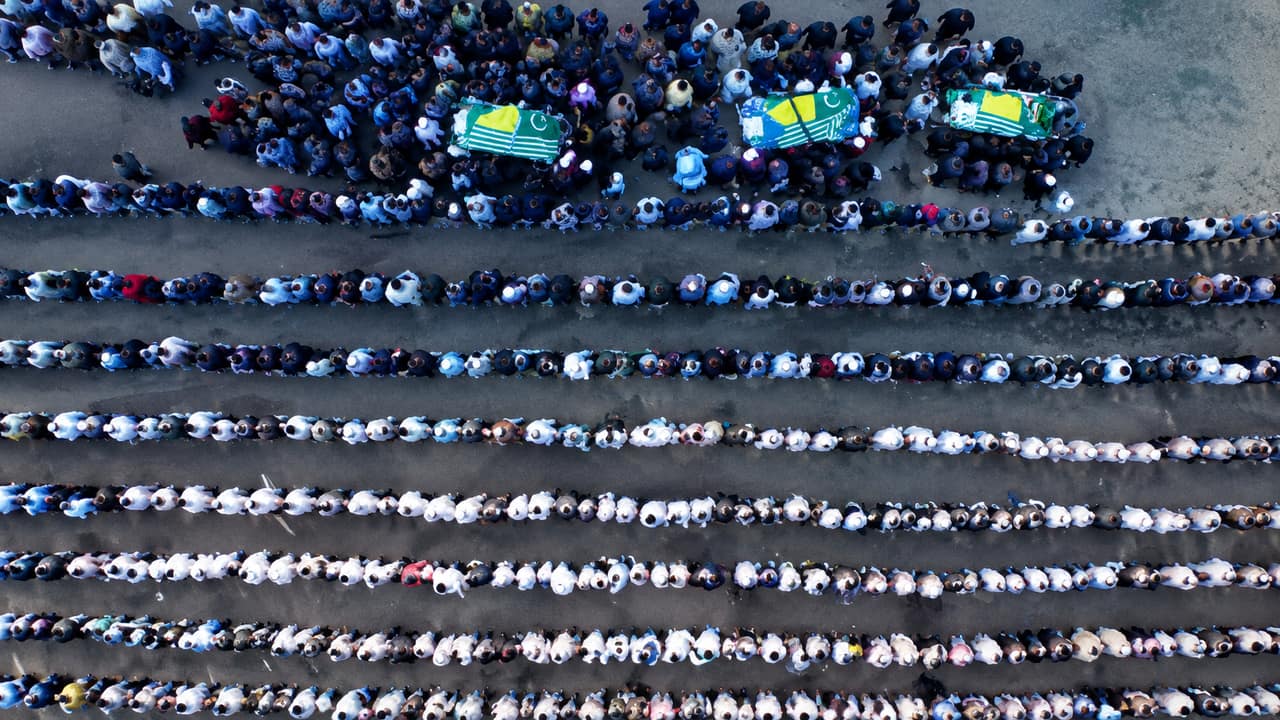
The first major bloodshed occurred in Rawalakot on the night of 7–8 June. Accounts differed sharply. Police said armed protesters had attacked law-enforcement personnel. JAAC and local witnesses said security forces had fired on an unarmed gathering near the Combined Military Hospital.
By 19 June, Reuters reported that at least 20 civilians and four police officers had been killed, 97 police personnel wounded and more than 500 people detained. Thousands of protesters remained gathered near Rawalakot, while roads, banks, fuel supplies and communications were severely disrupted. (Reuters)
The effects of the shutdown extended far beyond political activists. Daily-wage labourers could not find work. ATMs and banking systems stopped functioning. Fuel, food and medicines became scarce in some places. Students lost access to online education and applications. Families outside the region struggled to contact relatives.
Rawalakot became both the organisational centre of resistance and the main site of confrontation.
The Long Sit-in and Failed Mediation
During June and July, lawyers, religious figures, political leaders, local officials and civil-society representatives attempted mediation. JAAC demanded the withdrawal of the ban, release of detainees, termination of cases, accountability for killings, withdrawal of outside forces and implementation of its charter.
Government representatives insisted that roads should first be reopened, protests suspended and constitutional questions returned to the legislature.
A proposal for a Truth and Reconciliation Commission was later put forward by PPP chairman Bilawal Bhutto Zardari. JAAC responded but did not abandon its demand for accountability and political restructuring. Al Jazeera reported that even government figures acknowledged that elections alone were unlikely to remove the anger created by years of unimplemented agreements and the violent events of 2026. (Al Jazeera)
The situation was not uniform across AJK. Some people continued to support JAAC’s economic demands but disagreed with its position on the refugee seats. Some feared the prolonged shutdown was causing unbearable hardship. Others believed that withdrawing without achieving political reform would reward repression.
The movement had entered its most difficult stage: maintaining public unity while people were simultaneously experiencing state pressure, economic deprivation and exhaustion.
Elections Under a Blackout
The government proceeded with elections, dividing them into three phases, officially because of security concerns. JAAC called for a boycott. The PTI also boycotted, though for its own reasons, including allegations of electoral manipulation.
The first phase was held in Mirpur Division on 27 July. The PML-N won nine of the 13 seats contested, but turnout, campaigning and the legitimacy of the process were disputed. Parties participating in the election also accused one another of rigging and ballot manipulation.
At the same time, the attempt to stop a JAAC march from Rawalakot resulted in another devastating round of violence. JAAC and local journalists reported that dozens of civilians were killed on 27 and 28 July in Rawalakot and Mirpur. The Guardian reported allegations that at least 30 people were killed over the two days, while Reuters noted that communications restrictions and restricted access prevented independent verification of the larger figures. (The Guardian)
Authorities acknowledged civilian and law-enforcement deaths but accused armed and India-backed elements of infiltrating the protests. JAAC rejected those claims, arguing that the familiar allegation of foreign sponsorship was once again being used to conceal the political roots of the crisis.
The United Nations human rights office called for an independent investigation into the deaths, an end to arbitrary arrests, restoration of communications and inclusive dialogue. (Al Jazeera)
By this stage, the movement was no longer confronting only the AJK government. It was confronting the entire security, constitutional and electoral framework through which the region was being governed.
From a Charter of Demands to an Interim Government
In a statement circulated on 2 and 3 August 2026, the Joint Awami Action Committee demanded the establishment of a neutral interim government.
It also called for the disputed election process to be annulled, for fresh, free and fair elections to be conducted under the interim arrangement, and for an independent or United Nations-supervised investigation into the killings and alleged human-rights violations. JAAC representatives presented these demands as a response to the loss of public confidence in the existing government, election authorities and investigative institutions. (Facebook)
This was a major political turning point.
The movement that began by demanding subsidised flour was now questioning whether the government possessed the legitimacy to remain in office or supervise elections.
The demand did not emerge overnight. It developed through a repeated cycle:
protest, negotiation, written agreement, delayed implementation, renewed protest, repression and another agreement.
Each cycle widened the movement’s agenda. Flour led to electricity. Electricity led to elite privileges. Elite privileges led to accountability. Accountability led to local control. Local control led to electoral representation. Electoral representation led to the question of who had the right to govern.
What the Demand Means
The interim-government demand expresses the depth of the current crisis, but it also raises questions that JAAC will need to answer clearly.
Who would select such a government? What would be its constitutional basis? How long would it remain in office? Would it include political parties, lawyers, local-government representatives, women, students, trade unions, refugees and civil society? What authority would it possess over security institutions and the election administration? How would it avoid becoming another arrangement imposed from Islamabad or negotiated among existing elites?
Without a clear roadmap, the demand could be interpreted in different ways by different sections of the movement. A neutral caretaker arrangement for fresh elections is very different from an unelected government exercising indefinite authority.
These questions do not invalidate the demand. They show how far the movement has travelled and how much more politically precise it must now become.
JAAC also faces the continuing challenge of preserving its original democratic character. The state must independently investigate allegations of armed infiltration rather than use them to criminalise an entire population. At the same time, the movement must ensure that no armed individual or group is allowed to determine its direction or provide justification for further violence.
The Political Change the Rulers Failed to Read
When this movement first appeared, the rulers treated it as a temporary reaction to inflation. When it expanded, they described it as a traders’ agitation. When women, students, lawyers, workers and entire communities joined, they called it politically motivated. When it survived arrests and force, they described it as foreign-sponsored. Finally, when it challenged the electoral structure, they declared it a terrorist organisation.
At every stage, the official response avoided the central reality: a substantial section of the population no longer accepts that Azad Kashmir can be governed through speeches, patronage, security narratives and promises that remain on paper.
The movement has undoubtedly changed during its three-year journey. It has made mistakes. Its leadership has not always spoken with one voice. Some speeches have been emotional or politically unwise. The campaign over the refugee seats has divided opinion, and the prolonged shutdown has imposed serious costs on ordinary families.
But none of these weaknesses explains away the movement or justifies collective punishment, communication blackouts, arbitrary detention or firing on civilians.
The movement remains, in its social origins and principal character, a people’s rights movement. It grew because established institutions failed to provide affordable necessities, accountable government and meaningful representation. The attempt to convert these grievances into a security problem has not eliminated them. It has deepened them.
A Historical Threshold
Azad Kashmir has now reached a threshold.
The government can continue trying to defeat a political movement through force, bans, arrests and accusations. That path may temporarily clear roads or disperse gatherings, but it cannot restore legitimacy.
JAAC can continue mobilising, but it must transform mass anger into a transparent, inclusive and democratically reasoned political programme. It must explain not only what should be abolished but what should replace it.
Pakistan’s rulers must understand that solidarity with Kashmir cannot mean supporting rights on one side of the Line of Control while suppressing them on the other. The relationship between Pakistan and Azad Kashmir cannot remain based on mistrust, administrative control and the manipulation of local political elites. It must be reconstructed on the principles of dignity, consent, democratic representation and an equitable share in resources.
The flour-depot sit-in in Rawalakot was not expected to become a territory-wide movement. The organisers who first gathered there were not planning to demand an interim government. That demand has been produced by the history of the state’s response.
The road from subsidised flour to an interim government is therefore not evidence that the original movement was secretly pursuing some hidden political objective. It is evidence of what happens when modest and legitimate public demands are repeatedly delayed, misrepresented and answered with force.
The people of Azad Kashmir did not begin this journey by demanding the removal of a government.
The repeated failures of government brought them to that demand.
Comments (0)