

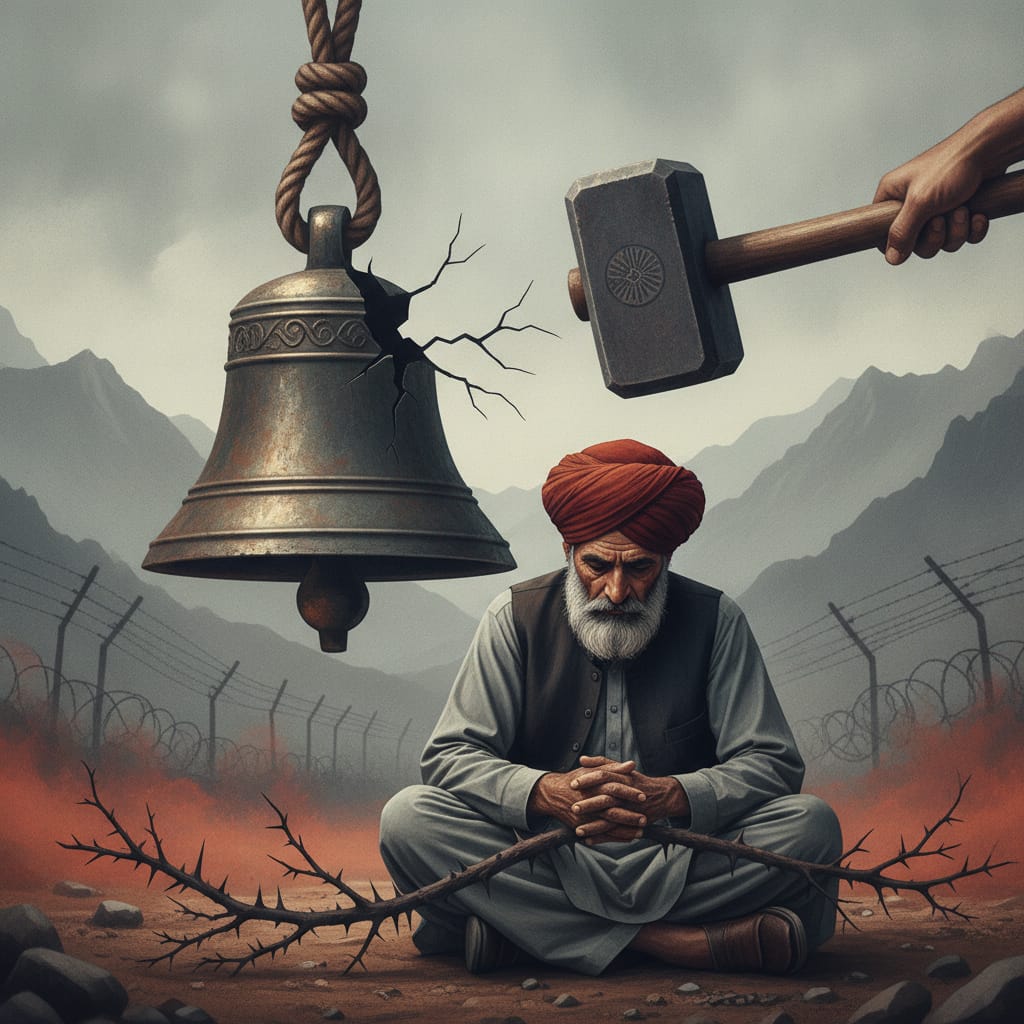
Reports of civilian deaths, injuries, arrests, alleged enforced disappearances, communications shutdowns and restrictions on journalism during recent public protests in the Pakistan-administered part of the disputed state of Jammu and Kashmir have brought the crisis to a point where Islamabad now faces more than domestic political and public pressure. Questions of international human-rights accountability and possible sanctions are also coming into view.
In July, UN High Commissioner for Human Rights Volker Türk expressed concern over the situation in Pakistan-administered Jammu and Kashmir, calling for an end to violence and respect for human rights. In June, Amnesty International pointed to internet shutdowns, mass arbitrary arrests and the use of lethal force during the crackdown.
This is no longer merely an internal political dispute. In August, the Financial Times reported that at least 89 civilians had been killed during protests in Pakistan-administered Jammu and Kashmir since June 2026. On June 9, The Guardian published details of the death of a British citizen, Mohammad Akhtar, in Kotli, as well as the detention of another British national. Although casualty figures and accounts of individual incidents vary among sources, and some claims remain difficult to independently verify, one fact is clear: developments in Pakistan-administered Jammu and Kashmir are now attracting the attention of international media, the United Nations and global human-rights organisations.
Islamabad must understand that if the use of state force continues in this manner; if civilian deaths and alleged human-rights abuses are not independently investigated; if families are denied information about missing relatives; if detainees are not brought before courts in accordance with the law; and if journalists continue to be prevented from reporting freely, Pakistan may soon face more than international condemnation. Calls for targeted human-rights sanctions against those responsible could gather momentum.
This is not a hypothetical risk. Britain already has a global human-rights sanctions regime under which individuals and entities involved in serious human-rights violations may be sanctioned. Under the British framework, conduct within a state that amounts to a serious violation of a person’s right to life, or freedom from torture and cruel, inhuman or degrading treatment, can fall within the scope of sanctions.
In practical terms, if credible evidence establishes the involvement of a particular government official, commander or other responsible individual in extrajudicial killings, torture or other grave human-rights violations, there is already a legal mechanism for action. Britain’s regime permits asset freezes, restrictions on access to financial resources, and travel or entry bans. The British government describes this system as a means of targeting those responsible for serious violations, rather than punishing the ordinary citizens of an entire country.
The European Union also has an available route. Its Global Human Rights Sanctions Regime allows it to target individuals and entities responsible for serious abuses anywhere in the world. The EU explicitly includes extrajudicial killings, torture, enforced disappearances and arbitrary arrest or detention among the violations that may trigger action. Under the regime, the assets of designated persons may be frozen and they may be barred from entering the European Union.
The immediate risk for Pakistan, therefore, is not necessarily that the entire country will face sweeping economic sanctions of the kind imposed on Iran or North Korea. The more realistic and immediate danger is targeted sanctions against specific individuals and institutions. If the evidence becomes sufficiently strong, the overseas assets of a particular military or civilian official could be frozen; their financial dealings could be restricted; they could be denied entry to Britain or Europe; and associated institutions or business interests could also be targeted. Britain and the European Union already possess the legal foundations for such measures.
The more realistic and immediate danger is targeted sanctions against specific individuals and institutions.
A further concern for Islamabad is the expanding international documentation of events in Pakistan-administered Jammu and Kashmir. Reuters reported in August that Pakistan had broadened existing restrictions on foreign media, introducing government-permission requirements for the movement and reporting activities of Pakistani journalists, local assistants and locally based staff working for foreign media outlets. When such restrictions are imposed at a time of reports of civilian deaths and a crackdown in Pakistan-administered Jammu and Kashmir, they inevitably intensify international questions over why independent reporting and investigations need to be constrained.
Pakistan must also recognise that, in the modern era, the record of a major tragedy or crackdown does not remain confined to local newspapers or official files. A video, a photograph, a medical report, an eyewitness account, a court petition, a family’s testimony and a credible international investigation can together form a verifiable chain of evidence. Such evidence may later provide the basis for demands for international action against an individual. That is why, if allegations of human-rights abuses in Pakistan-administered Jammu and Kashmir persist, every death, every arrest, every alleged disappearance and every act of torture may become part of a future case for international accountability.
The best course for Pakistan is not to persuade the world that no problem exists. It is to open the door to transparent and independent investigations. The deaths of civilians must be impartially examined, those responsible must be identified, detainees must be brought before courts in accordance with the law, families must receive immediate information about missing relatives, journalists must be allowed to report freely, and the unnecessary or disproportionate use of force against civilians must end. These are the measures most likely to steer Pakistan away from the prospect of international sanctions.
Otherwise, the question in the days ahead will not simply be: who fired on whom in the Pakistan-administered part of the disputed state of Jammu and Kashmir? It will also be: who gave the order to fire, who supervised it, who refused to stop it, who obstructed the investigation, and who protected those responsible?
This is the point at which a local human-rights issue can evolve into a matter of international sanctions.
Pakistan should also be clear that, should sanctions ever be imposed, their strongest moral and legal justification would not be the punishment of Pakistani citizens. It would be accountability for the individuals allegedly responsible for violations. Britain’s sanctions regime rests on precisely this principle: targeting those responsible for serious human-rights abuses rather than an entire population. If the Kashmiri diaspora begins pursuing this path, it could not only bring those allegedly responsible for abuses in Pakistan-administered Jammu and Kashmir to justice, but also open avenues for exposing brutality in Pakistan’s own provinces.
The choice facing Islamabad is therefore clear. It can continue a policy of suppressing protests through force, and face mounting international pressure, investigations, diplomatic criticism and possible targeted sanctions. Or it can seek a political solution to a political problem, recognise citizens’ rights, investigate the use of force, and hold those responsible accountable.
The sound of gunfire in the mountains of Jammu and Kashmir may be muted in Islamabad for a time. But when the bullet strikes an innocent civilian, its echo is heard in London, Brussels, Geneva, Washington, Toronto, Rome, Milan, Barcelona, Berlin, The Hague, Scotland, Ireland, Copenhagen, Stockholm and Oslo—simultaneously and with equal force.
And if that echo reaches the door of international sanctions—as now appears increasingly possible—the question will not be why sanctions are being considered against Pakistan. The question will be why Islamabad chose a path that compelled the world to consider them.
There is still time to abandon the path of force and choose the path of law, dialogue, transparent investigations and human rights. The protection of human rights in Pakistan-administered Jammu and Kashmir is not only a matter for the Kashmiri people; it has become a question of Pakistan’s own international future.
Comments (0)