

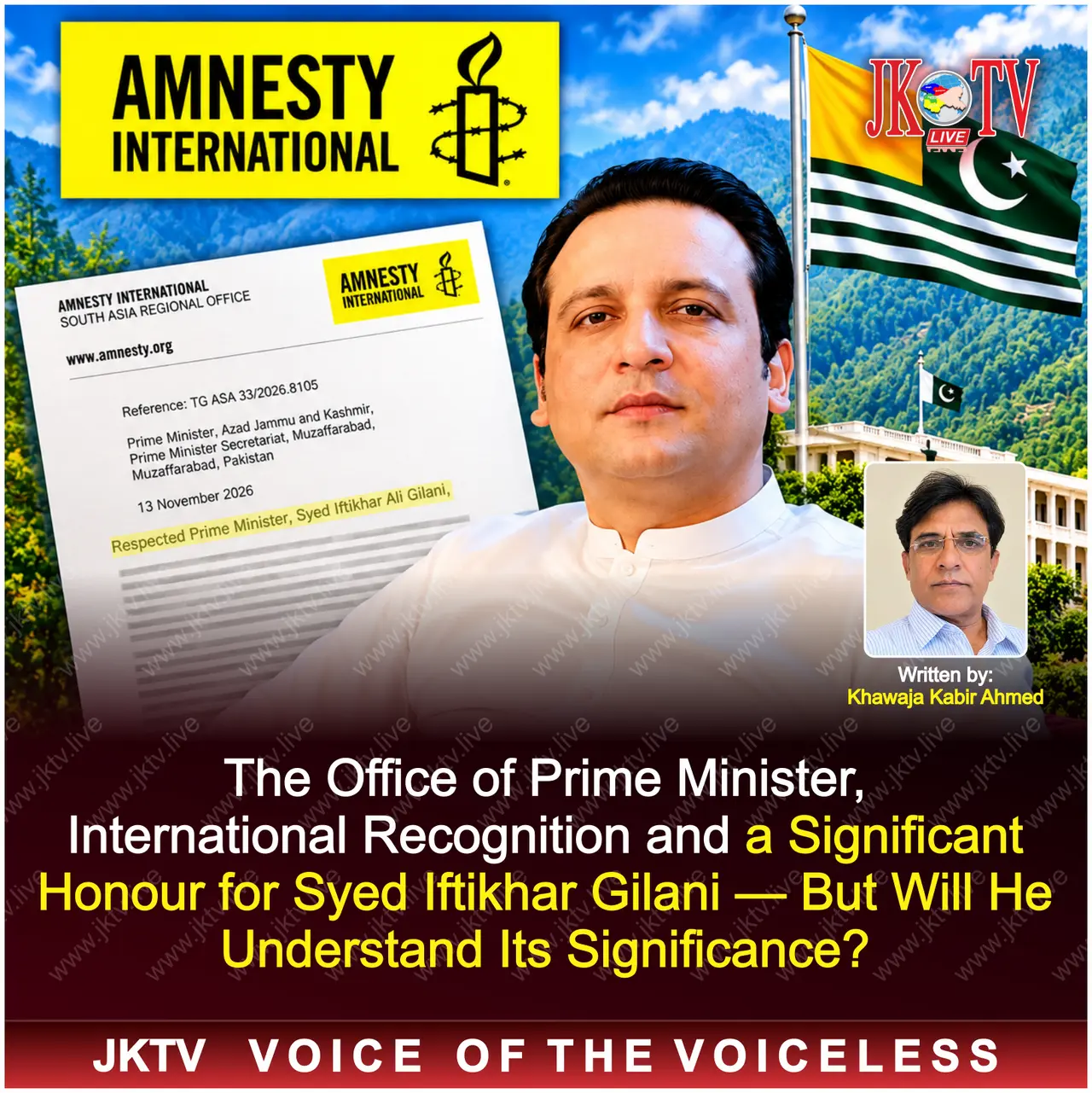
The office of Prime Minister of the Pakistan-administered State of Jammu and Kashmir is not merely an administrative position; it is also closely connected to the political identity of the region and the representation of its people. Unfortunately, however, those who have held this office have often prioritised their personal interests and political power over the importance of the office itself. As a result, the office has repeatedly been undermined, and this continues to happen even today.
There have been very few occasions when an individual holding this position has been addressed by a credible international institution with the dignity and respect befitting the office. The available documentary record contains a number of significant examples in this regard.
In 1999, the records of the UK Parliament's Foreign Affairs Committee included a submission by Sultan Mahmood Chaudhry in which he described himself as the Prime Minister of Azad Jammu and Kashmir. However, this was a document submitted by him; the British Parliament itself had not addressed him in that capacity.
Subsequently, in 2001, Amnesty International, in its document ASA 33/014/2001, formally addressed the office of the Prime Minister of Azad Jammu and Kashmir, using the words "Dear Prime Minister".
On 3 July 2024, in connection with the case of Ahmed Farhad, Amnesty International issued its document Second UA 46/24, addressing the then Prime Minister, Chaudhry Anwar-ul-Haq, by both his name and official title. The letter began with the words, "Dear Prime Minister Chaudhry Anwar-ul-Haq".
Will he regard this office merely as a seat of power, or will he also recognise the responsibility attached to it towards public rights, political identity and fundamental human freedoms?
Now, on 13 November 2026, Amnesty International has once again addressed the same office at the international level by issuing an open letter to Syed Iftikhar Ali Gilani, referring to him as the Prime Minister of (Pakistan-administered State of) Azad Jammu and Kashmir. The letter concerns the protection of human rights, civil liberties and the ban imposed on the Jammu Kashmir Joint Awami Action Committee in the region.
Thus, Syed Iftikhar Ali Gilani has also received the distinction of being addressed by a respected international human rights organisation, such as Amnesty International, in his capacity as Prime Minister. According to the available documentary record, this is the third clear example of its kind, following those of 2001 and 2024.
However, an important question arises: will Syed Iftikhar Ali Gilani understand the historical, political and international significance of this distinction? Will he regard this office merely as a seat of power, or will he also recognise the responsibility attached to it towards public rights, political identity and fundamental human freedoms?
For while the respect shown to the office of Prime Minister by an international institution is important in itself, the true dignity of this office can only be upheld when the person holding it also respects its standing, responsibilities and public mandate (which, in the case of the incumbent, he does not even possess).


Comments (0)