

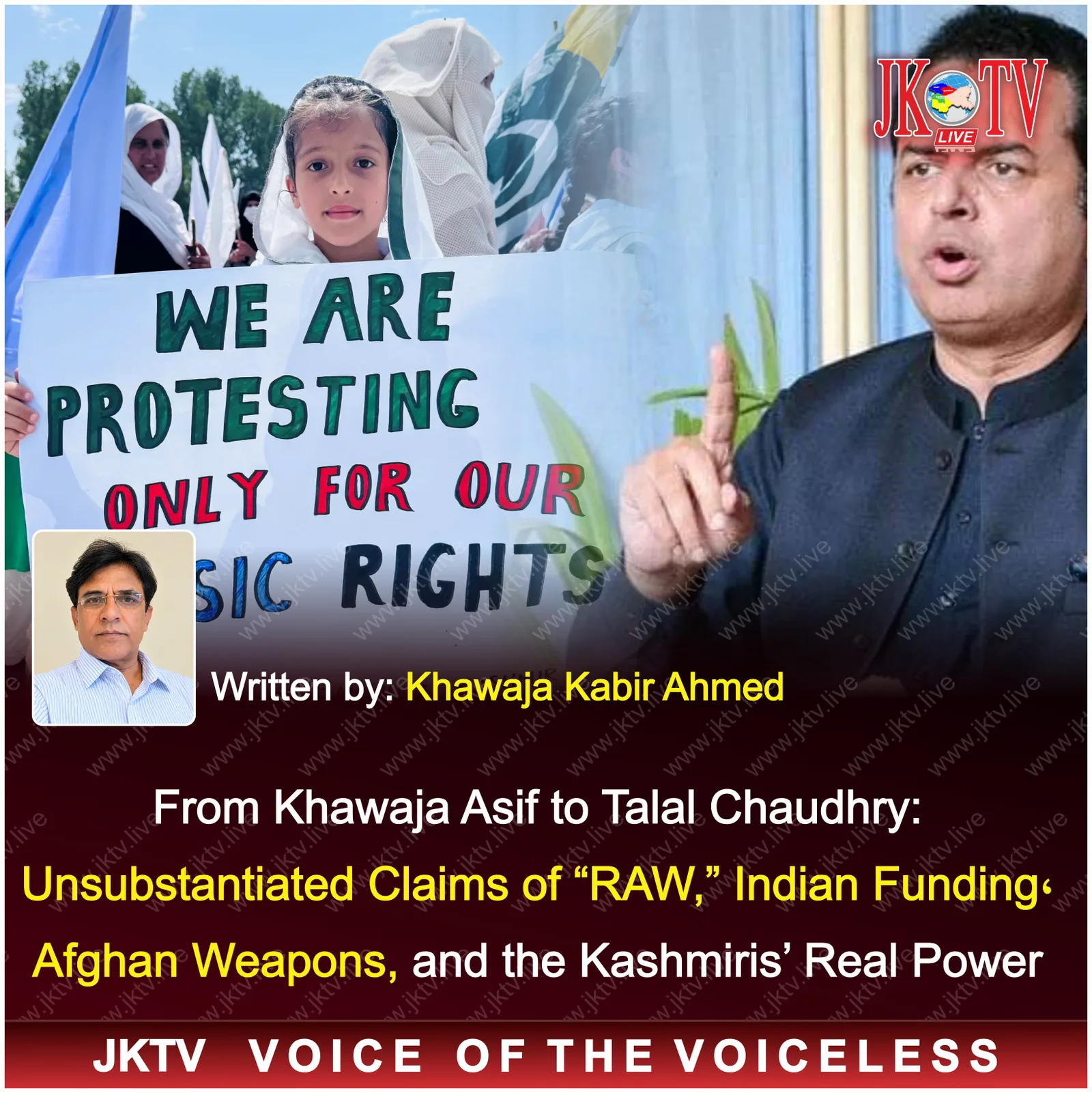
Pakistan’s Federal Minister for Defence, Khawaja Asif, accused the Jammu Kashmir Joint Awami Action Committee of being linked to “RAW” and Indian funding, while Pakistan’s Minister of State for Interior, Talal Chaudhry, claimed on 16 September 2026 that weapons were being transported from Afghanistan through an alleged network to certain individuals associated with the Jammu Kashmir Joint Awami Action Committee in Pakistan-administered Jammu Kashmir. In his press conference, Talal Chaudhry also presented details concerning an arrested individual, alleged audio recordings, and a network involved in the transportation of weapons. According to the government, this material forms the basis of its allegations. However, the independent, judicial or forensic verification of this evidence, and whether there is any proven connection between these allegations and the broader Jammu Kashmir Joint Awami Action Committee movement, remain separate questions.
The fundamental question here is not simply whether to accept or reject any claim made by the Government of Pakistan merely because it has been made by the government. The real question is: where should the line be drawn between a serious allegation and an established fact?
The Jammu Kashmir Joint Awami Action Committee emerged as a public movement organised around demands for fundamental human, economic, political and civic rights. Its demands have included electricity, flour, education, healthcare, employment, political representation, better governance and an end to privileges. Therefore, turning an allegation concerning an individual, group or alleged network into a general verdict against the entire movement and its supporters would itself be a separate and more serious claim, requiring separate and clear evidence.
The statement of any federal minister or minister of state in Pakistan is important in its own right, but holding government office does not, by itself, turn an allegation into judicial evidence. If Khawaja Asif has evidence of “RAW” involvement or Indian funding, that evidence should be presented to the public and the relevant legal authorities along with financial records, bank transactions, documents and other verifiable material. Likewise, if Talal Chaudhry has evidence of the transportation of weapons from Afghanistan and a connection between that network and individuals associated with the Jammu Kashmir Joint Awami Action Committee, that evidence should be examined through a full investigation, forensic assessment and judicial proceedings.
But there is another fundamental question that both Pakistan’s Minister of State for Interior, Talal Chaudhry, and Defence Minister Khawaja Asif should answer. Since one is the Interior Minister and the other is the Defence Minister, the people of Pakistan should ask them:
If weapons were being transported from Afghanistan to Pakistan-administered Jammu Kashmir, through which route did they arrive?
Pakistan-administered Jammu Kashmir does not directly border Afghanistan. To reach Pakistan-administered Jammu Kashmir from Afghanistan, weapons would have to pass through a substantial part of Pakistan’s territory. There are numerous administrative and security-monitoring points along this entire route. For years, strict restrictions, closures and obstacles to trade and travel have also been reported at Pakistan-Afghanistan border crossings.
In such circumstances, the question is not merely which part of Afghanistan the alleged weapons came from. The real question is also: after entering Pakistan from Afghanistan, through which route did those weapons reach Pakistan-administered Jammu Kashmir?
Did they come by land? If so, through which routes? Through which districts? How many checkpoints did they cross? In which vehicle did they travel? At which locations was the vehicle searched? Where was it not searched? Which individuals were allegedly part of the network along this entire route? And if the government has answers to these questions, why should the evidence not be made public?
This question is also important because, during the current situation in Pakistan-administered Jammu Kashmir, numerous reports have emerged concerning strict monitoring and restrictions on movement. In particular, there have been reports of blockades and surveillance on routes leading to Rawalakot and protest sites.
More importantly, a delegation of political leaders from Pakistan’s opposition, which wanted to travel to Rawalakot to express solidarity with and hold talks with the Jammu Kashmir Joint Awami Action Committee at its sit-in, was stopped on the way. The delegation also included Pakistan’s former Prime Minister and the Leader of the Opposition in Pakistan’s National Assembly and Senate. If even this delegation of political leaders could not reach the protest site, then the question becomes even more significant: how could weapons allegedly have reached Pakistan-administered Jammu Kashmir from Afghanistan in such a heavily monitored environment? If a delegation of political leaders could not get through, how did the alleged weapons get through?
And the question is not limited to the political delegation. Over the past several months, there have also been reports that the supply and movement of food, medicines and other essential commodities have been affected in different areas of Pakistan-administered Jammu Kashmir, particularly in protest-affected areas. Human rights circles and some international media reports have pointed to difficulties in accessing food, life-saving medicines, essential items for children and other basic necessities, although Pakistani authorities have denied claims of a complete blockade. However, verified information received from the ground indicates that all forms of supplies have been halted.
Here, an ordinary citizen’s question is entirely natural: if there are obstacles to transporting a patient’s essential medicine, a child’s necessities, a family’s food supplies and everyday essential items, then how did weapons allegedly travel from Afghanistan to Pakistan-administered Jammu Kashmir?
When routes are under strict surveillance, checkpoints are in place, movement is restricted, supplies of essential goods for ordinary citizens are affected, and even delegations of political leaders are not allowed to proceed, then what route was open to the alleged weapons?
The real question is: where should the line be drawn between a serious allegation and an established fact?
For an ordinary citizen, the route for medicine and food is difficult, but the route for alleged weapons was open? If that is indeed what happened, then this is not merely a question concerning the Jammu Kashmir Joint Awami Action Committee; it is a question concerning the entire system of state surveillance and oversight.
This question is also important because many voices of ordinary citizens in Pakistan-administered Jammu Kashmir are not able to reach the outside world fully under the current communications and political conditions. When communications restrictions are imposed, local journalism faces difficulties, and independent reporting is limited, independently verifying the situation on the ground itself becomes a major challenge.
Therefore, alongside the government’s claims, the complaints of ordinary citizens and the situation on the ground should also be given equal importance. If supplies of food and medicines continued normally, the government should present details of those supplies, supply routes and official figures to the public. If supplies were disrupted, the reasons, duration and responsibility should also be made clear.
Now let us return to the allegation concerning weapons allegedly coming from Afghanistan.
If, according to the government, weapons reached Pakistan-administered Jammu Kashmir from Afghanistan, where is the documented detail of this entire journey? What was the point of entry from Afghanistan? What route did they take after entering Pakistan? Through which cities, districts and checkpoints did they pass? What vehicle or means of transport was used? Who received them? Who transported them? And after reaching Rawalakot, to which individuals allegedly associated with the Jammu Kashmir Joint Awami Action Committee did they ultimately reach, and how?
If the weapons were transported by air, then there is another question: on which flight? At which international or domestic airport in Pakistan-administered Jammu Kashmir? Who received them? Who transported them? And through what monitoring system did they pass before reaching Pakistan-administered Jammu Kashmir?
If the government claims that the weapons travelled through a long and difficult land route, a mountain pass or some other route, then the complete details of that route and verifiable evidence should also be presented. Because the question is not simply, “Where did the weapons come from?”
The real question is: “How did they reach Pakistan-administered Jammu Kashmir despite such strict surveillance?”
If such a network genuinely existed, then this is not merely a question concerning the Jammu Kashmir Joint Awami Action Committee. It is a question concerning Pakistan’s entire system of border control, intelligence, police, administration and law enforcement.
The same principle should apply to the allegations of Indian funding. If it is alleged that Indian money was used for the activities of a movement, then the flow of the money, financial records, recipients, banking or remittance records, the nature of the contacts and relevant legal evidence should be presented. Simply saying that “the institutions have evidence” is not enough. Public confidence requires evidence that can be examined and tested, as well as legal proceedings.
The demands of the Jammu Kashmir Joint Awami Action Committee are public in nature. Demands for electricity, flour, education, healthcare, employment, political representation, better governance and an end to privileges are not, in themselves, evidence of a foreign agenda. If an individual has engaged in illegal activity under the cover of these demands, that individual should face action according to law; but maintaining a distinction between an alleged offence by an individual and the collective character of an entire public movement is also a fundamental requirement of justice.
If the government genuinely believes that an individual associated with the movement possessed, purchased, sold or cooperated with an illegal network involving weapons, then the individual’s name, the case, the legal basis for the arrest, the recovered material, the forensic report and the judicial proceedings should be made public. If a crime is proven, the law should take its course. But using an alleged offence by an individual against the collective character of the entire movement would require further and clear evidence.
The purpose here is not to immediately declare either the government or the Jammu Kashmir Joint Awami Action Committee truthful or untruthful. The real issue is evidence, law and accountability. Whatever evidence the government possesses should be presented; whatever response the Jammu Kashmir Joint Awami Action Committee has to these allegations should also be made public; and then an independent legal and judicial process should do its work.
Instead of discrediting public movements or turning political disagreement into an allegation of national security, the state should transparently substantiate its claims. If there is an allegation of “RAW” funding, evidence should be presented. If there is an allegation of Indian financial assistance, financial records should be made public. If there is an allegation of weapons being transported from Afghanistan, evidence of the weapons’ recovery, the route of transportation, the contacts of the suspects and their alleged connection with the Jammu Kashmir Joint Awami Action Committee should be presented before the courts.
It is easy to make allegations through the power of the state, but restoring public trust is difficult. Following the statements by Khawaja Asif and Talal Chaudhry, the responsibility now also rests with the Government of Pakistan to substantiate its claims with verifiable evidence.
If a crime is proven against an individual, the law should take its course; if an allegation is made against an entire movement, the same standard of evidence must apply.
The claims linking the Jammu Kashmir Joint Awami Action Committee’s struggle for public rights to “RAW,” Indian funding or Afghan weapons have now reached a stage where evidence matters more than political statements. The questions of independent examination of that evidence, its legal status and its proven connection with the movement now remain before the public. The people, particularly the citizens of Pakistan-administered Jammu Kashmir, do not place their trust in conventional allegations and propaganda.
Pakistani ministers, the government and state institutions should understand that the people of this region are pursuing their struggle for basic rights with awareness, complete perseverance and sincerity. They are peaceful and unarmed. They are willingly presenting their chests before the heavy weapons of your forces. They continue their struggle for their rights on the basis of truth and sincerity. Their determination does not need any weapons. Their perseverance, their sincerity and their awareness, together with their peaceful message, are their greatest power—and surely it is this power that has also defeated your heavy military weapons.
Do not hold press conferences—present evidence. Do not make allegations—take action according to law. If an individual has committed a crime, prosecute that individual; do not declare an entire public movement guilty on the basis of an allegation. And if evidence exists, bring it forward transparently. Ultimately, the judgment should not be based merely on statements by ministers, but on facts, law and verifiable evidence.

Comments (0)