
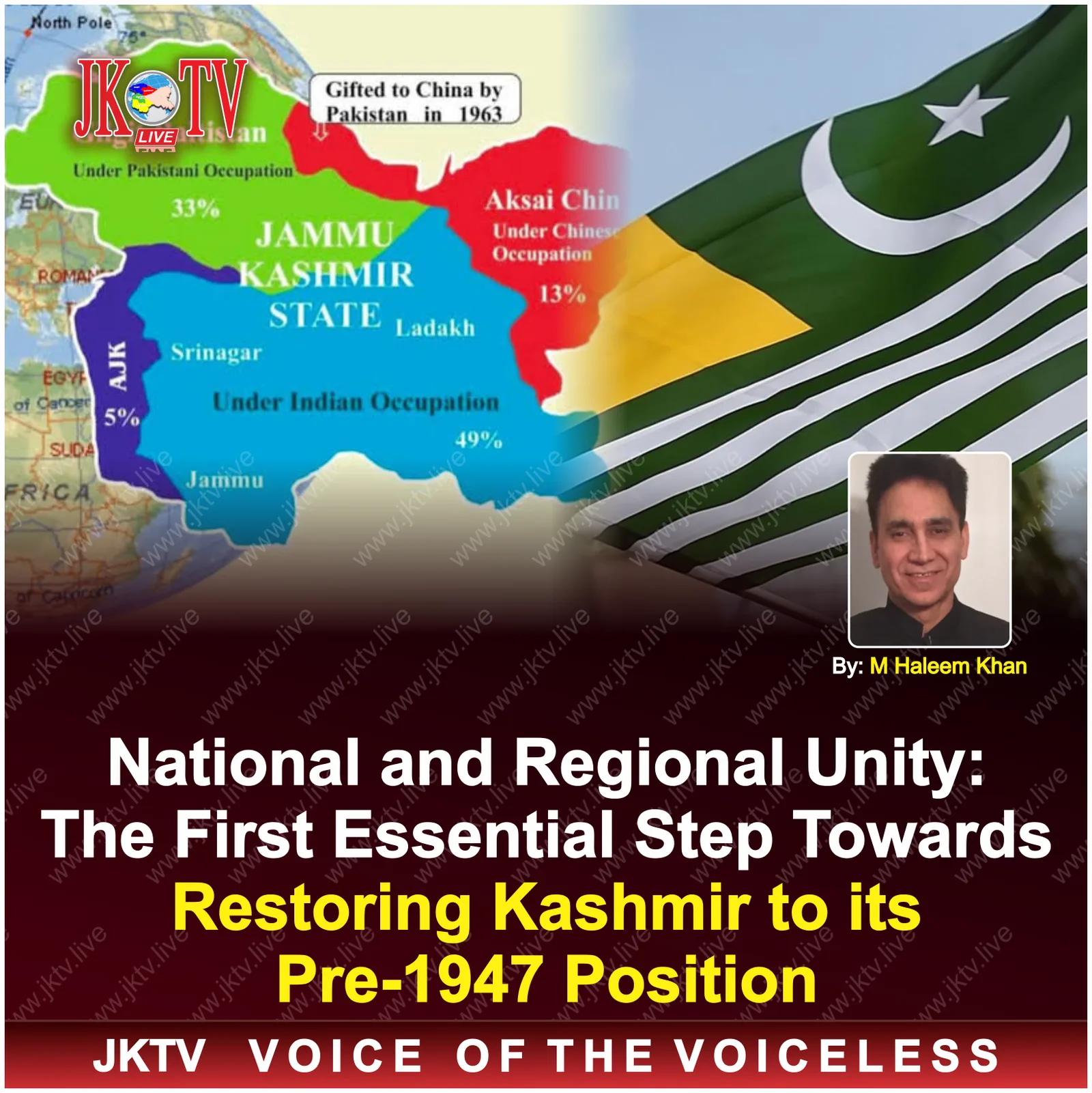
Jammu Kashmir was an independent princely country under the Dogra Raj from 1846 to 1947. In 1846, after the First Anglo-Sikh War, the British East India Company through the Treaty of Amritsar sold the territory to Maharaja Gulab Singh for 75 lakh Nanakshahi Rupees. This created one of the largest princely states in the Indian subcontinent.
At that time, the subcontinent under British paramountcy included territories that today form several sovereign countries - India, Pakistan, Bangladesh (then East Bengal), Myanmar (then Burma, separated from British India administration in 1937), Sri Lanka (then Ceylon), and Maldives among others. The British directly ruled British India, while over 560 princely states including Jammu Kashmir existed under British suzerainty.
The People's Struggle for Rights
The clear facts are: The people of Jammu Kashmir cherished the idea of a free Jammu Kashmir but were resolutely against the autocratic rule of the Maharajas. From 1846 onward, they struggled for God-given basic rights and for a people's rule.
It is also a historical fact that the Maharajas were powerful because they had defence, communications and external affairs pacts with the British Crown and had a free hand to crush demands for rights and power-sharing.
During this long struggle, many Kashmiri leaders sacrificed their lives. The resistance of leaders from Poonch region like Sardar Shams Khan and Sardar Malli Khan is still remembered in folk history, as are countless others who faced brutal repression for demanding representation.
This struggle never stopped. A landmark event was in 1931, when a public demonstration in Srinagar took place. During the call for prayer (Azan), more than 22 Kashmiris were martyred while trying to complete the Azan. The sacrifice compelled Maharaja Hari Singh to initiate limited reforms and share some power with the people.
It is also a fact that in the early 1940s, ordinary citizens were gaining some power-sharing through the Praja Sabha and other reforms. Had India and Pakistan not gained independence in 1947 in such a hasty manner, the political trajectory could have led to a fully constitutional monarchy where the Maharaja would be symbolic and Jammu Kashmir would have continued as an independent country.
The Right to Independence Under the Indian Independence Act
The Indian Independence Act of 1947 is very clear. It gave princely states three choices:
Remain independent
Join the federation of India
Join the federation of Pakistan
It is a historical fact that Maharaja Hari Singh and a large majority of Kashmiris wanted to remain independent and aspire to become a member of the United Nations.
Maharaja Hari Singh offered a Standstill Agreement - the same kind of agreement he had with the British - to both India and Pakistan as a gesture of goodwill, seeking friendly relations with both new dominions.
The founder of Pakistan, Quaid-e-Azam Muhammad Ali Jinnah, accepted and signed the agreement. India did not respond immediately, which in retrospect showed its intention to seek a merger. This had no natural connection with the political will of the state, because the Hindu ruler wanted an independent Kashmir, and more than 80% of the population were Muslims who had been struggling for self-rule since 1846. While as Muslims their natural affinity could have been towards Pakistan, Quaid-e-Azam himself understood that Kashmiris wanted to remain independent and would have excellent relations with Pakistan.
WE HAVE A DREAM TO RESTORE JAMMU KASHMIR TO ITS PRE-1947 POSITION AND ESTABLISH AN INDEPENDENT, DEMOCRATIC, SOCIAL WELFARE, NON-MILITARIZED COUNTRY ON THE FACE OF THE EARTH.
Jammu Kashmir Faces Aggression on October 22, 1947
On October 22, 1947, Pashtun tribal lashkars attacked Jammu Kashmir. They entered via Muzaffarabad towards Baramulla, looting civilian property, burning villages and causing immense human suffering. This is documented as Operation Gulmarg, planned by Major General Akbar Khan.
On the other side, in Jammu province, with the support of armed groups including the Rashtriya Swayamsevak Sangh (RSS) and Maharaja's forces, Hindu extremist armed bands attacked Muslim civilians in Jammu in late October - early November 1947. According to scholars including Ian Stephens and Alastair Lamb, between 20,000 to over 200,000 Muslims were killed, women were abducted, houses burned, and hundreds of thousands forced to cross the border into Pakistan.
These twin tragedies gave India an excuse to land its forces in Kashmir. Maharaja Hari Singh signed the Instrument of Accession on October 26, 1947. Indian troops were airlifted to Srinagar on October 27. The result was the division of the state - approximately 66% under Indian administration and 33% under Pakistani administration.
On India's complaint, the United Nations got involved. The UN Security Council made a historic and irresponsible mistake: it made India and Pakistan parties to the Jammu Kashmir dispute without any formal consultation with the people of Jammu Kashmir. The Security Council passed dozens of resolutions suggesting a referendum for the people to join India or Pakistan, under UN supervision, which never occurred.
Here an important question must be asked: The country belongs to Kashmiris. Why was the UN ordering Kashmiris to become part of either aggressor? Why were India and Pakistan not forced to end the occupation? With respect, by its inaction, the UN became a partner in crime against Kashmiris.
Conclusion: The Path Forward
Had the Pashtun tribal militants not attacked J&K with support from the Pakistani establishment, and had the extremist attack on Jammu not happened, Jammu Kashmir would have been an independent country today.
WE HAVE A DREAM TO RESTORE JAMMU KASHMIR TO ITS PRE-1947 POSITION AND ESTABLISH AN INDEPENDENT, DEMOCRATIC, SOCIAL WELFARE, NON-MILITARIZED COUNTRY ON THE FACE OF THE EARTH.
This dream can only come true if Kashmiris restore National and Regional Unity and understanding among themselves. We must include all regions - Jammu, Kashmir Valley, Ladakh, Gilgit-Baltistan, and Azad Kashmir - and all communities - Muslims, Hindus, Sikhs, Buddhists and Christians.
We must struggle peacefully on all fronts, using all available world platforms including the UN, OIC, European Union, Amnesty International and all other international humanitarian and human rights organizations. The future state we envision must be based on realistic and democratic principles: secular democracy, social welfare, demilitarization, rule of law, and friendship with all neighbours.
Comments (0)