

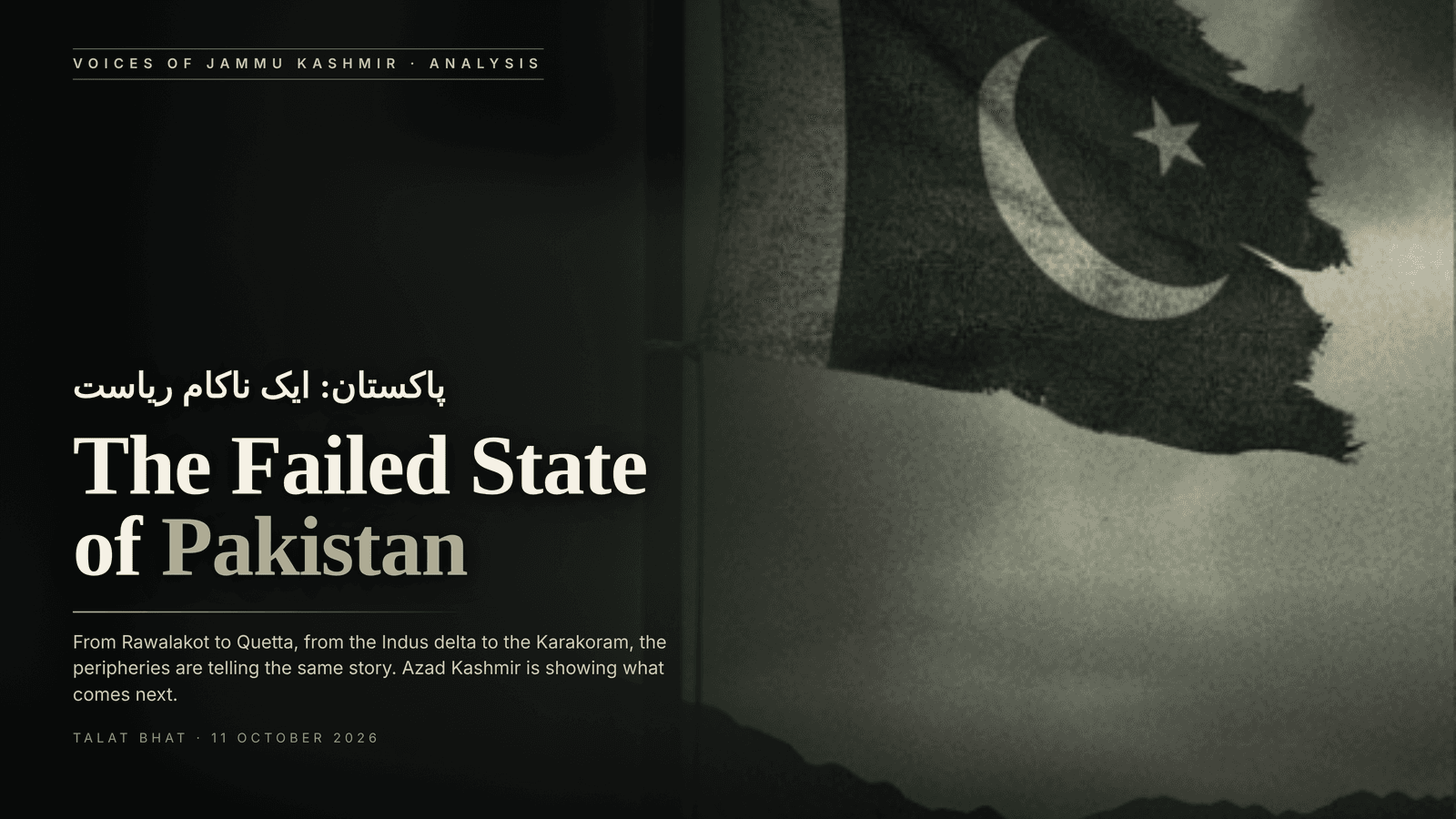
On Sunday, October 11, 2026, President Asif Ali Zardari signed the summary under which, invoking Articles 232 and 234 of the Constitution, emergency and Governor's Rule were imposed in Khyber Pakhtunkhwa. The presidential proclamation stated that terrorism has reached an extraordinary intensity, attacks on government installations, infrastructure, and law enforcement agencies are escalating, and the provincial government has failed to control terrorism and lawlessness. The Chief Minister, provincial ministers, advisors, special assistants, and the Advocate General were ordered to step down immediately. The Governor will now exercise the powers of every provincial institution except the provincial assembly.
A closer reading of this proclamation reveals that it is not merely an indictment of a provincial government, but an admission of failure. A state that, seventy-nine years after its inception, can govern one of its major provinces only by suspending its elected government is essentially admitting that its own system no longer functions. This order came at a time when Tehreek-e-Insaf's march demanding the release of Imran Khan was advancing toward Islamabad, and when the party leadership was characterizing the decision as a grave political blunder. Whatever one's opinion of Tehreek-e-Insaf, the pattern of behavior is clear: whenever politics becomes inconvenient, Islamabad reaches for the emergency clause.
Khyber Pakhtunkhwa is no exception. It is merely the latest entry in a long list.
Balochistan: Richest Land, Poorest People
A major portion of Pakistan's mineral wealth lies in Balochistan, yet nearly half of its population lives below the poverty line. For two decades, families have been searching for their sons, brothers, and husbands who were abducted and never presented before any court. The Baloch Yakjehti Committee transformed this very grief into a broad, peaceful civil rights movement. In June 2026, an anti-terrorism court in Quetta sentenced its leader, Dr. Mahrang Baloch, to life imprisonment in connection with a death during the 2024 Gwadar gathering—a trial the movement describes as baseless and unfair. Amnesty International has demanded her release.
Alongside this peaceful movement, an armed separatist insurgency continues, demanding an independent Balochistan, while the state's response remains reliant on military operations. This is the tragedy: the voices that demand rights within the framework of the law are imprisoned by the state, which effectively hands the stage over to those who argue that the law will never deliver anything.
Sindh: A Province Being Robbed of Its River
Sindh lies at the tail end of the Indus River, and it understands what that means. A federal plan to dig new canals from the river for corporate farming in Punjab brought lawyers, nationalists, students, artists, and farmers onto the highways in 2025, and these protests have not yet ended. Even in July 2026, rallies across the province were demanding the closure of the Jalalpur and other controversial canals, accusing the Centre of violating the 1991 Water Apportionment Accord. For Sindh, this is not an engineering dispute. The question is whether a province has any authority over the water that sustains its land.
Gilgit-Baltistan: Minerals Without Consent
Gilgit-Baltistan, which is part of the former princely state of Jammu and Kashmir, has lived for seventy-nine years without constitutional status, without representation in Pakistan's parliament, and without authority over its own land. New land and minerals laws declared forests, pastures, mountains, and minerals to be state property. The people of Shigar, Hunza, Nagar, and Skardu responded with the region's largest protests, demanding the cancellation of mineral leases granted to outsiders. Leaders of the Gilgit-Baltistan Awami Action Committee were arrested.
Then came the deal. On September 8, 2025, the Pakistan Army's own engineering and construction arm, the Frontier Works Organization, signed a memorandum of understanding with the Missouri-based American company US Strategic Metals, the first phase of which was worth approximately $500 million and included antimony, copper, gold, tungsten, and rare earth elements. Within a few weeks, Prime Minister Shehbaz Sharif and Field Marshal Asim Munir appeared in photographs at the White House presenting rare earth mineral samples to President Donald Trump. The first shipment departed for the US in October 2025.
Whatever one's opinion of Tehreek-e-Insaf, the pattern of behavior is clear: whenever politics becomes inconvenient, Islamabad reaches for the emergency clause.
The reserves being publicized are in Balochistan, Khyber Pakhtunkhwa, and Gilgit-Baltistan—precisely the very regions whose people are protesting. Were they asked? Was their elected assembly consulted? Was this agreement even placed before Pakistan's parliament? The opposition demanded that it be made public. Gilgit-Baltistan's minerals are being offered to a foreign power by an institution that is not accountable to any voter in Gilgit-Baltistan. This is not investment; this is plunder without consent.
Azad Kashmir: The movement that refuses to break
And then there is Azad Kashmir.
The Jammu Kashmir Joint Awami Action Committee was born in 2023 out of the simplest demands a citizen could make: affordable electricity, affordable flour, and an end to the privileges of an elite that runs an impoverished region like a personal fiefdom. It is an alliance of traders, transporters, lawyers, students, and ordinary families. In October 2025, the government signed an agreement recognizing its 38-point charter. This agreement was never implemented.
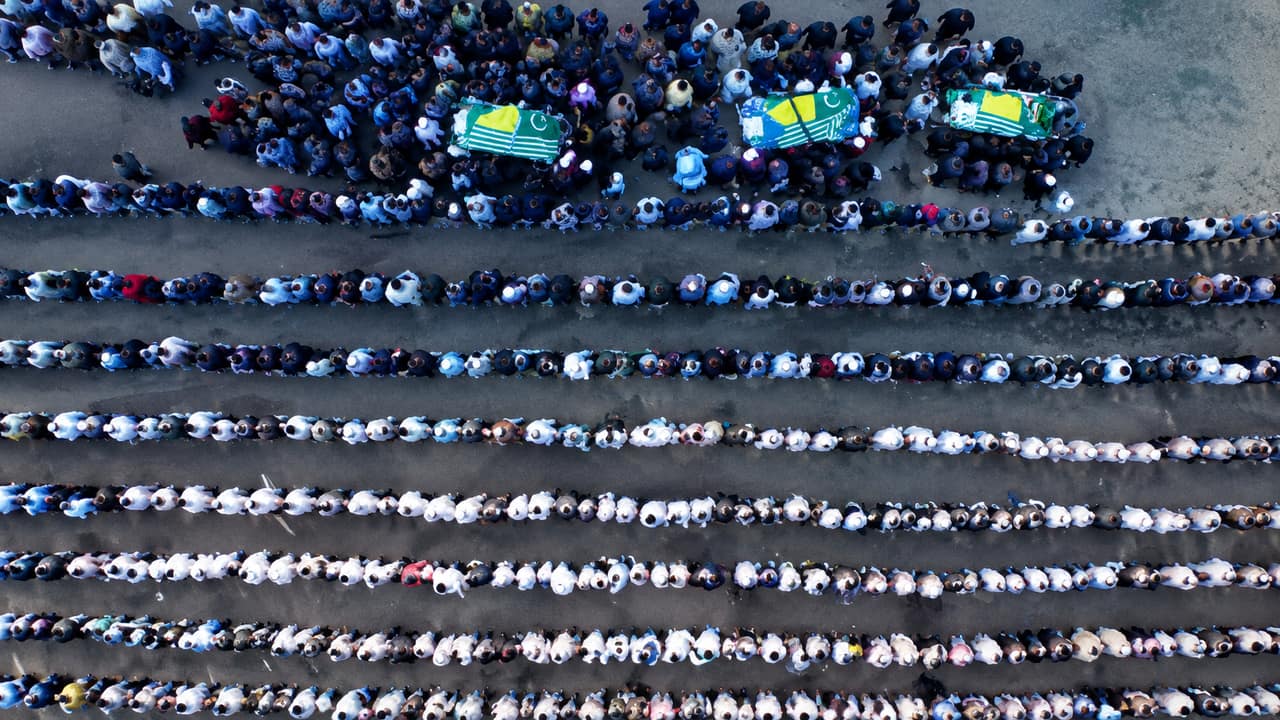
At the center of this charter is the question of democracy: the twelve Legislative Assembly seats reserved for refugees living in Pakistan, through which Islamabad-based parties determine who governs in Muzaffarabad. When negotiations failed, the state did not engage in dialogue. On June 5, 2026, it banned the Action Committee under the Anti-Terrorism Act, placing a civil rights movement on the same list as armed militant groups. Communications were cut off. Bounties were put on the heads of leaders, and they were pursued. Activists were killed in clashes—numbers over which the state and the movement still disagree today—and families say some bodies were not returned.
Despite this, the Rawalakot sit-in that began in early June has now been ongoing for more than four months. Thousands of people have participated in turns. Shops were closed, roads were blocked, and yet the people stood firm. Elections were held in July under this very shadow, and the parties that won are now promising negotiations with the very movement they had outlawed.
What distinguishes Azad Kashmir is not the scale of anger. Balochistan, Sindh, and Gilgit-Baltistan are just as furious. The difference lies in the method. The Action Committee has repeatedly insisted that its struggle is peaceful and not against Pakistan or its people. It has not taken up arms. It has not divided along sectarian, tribal, or party lines. It presented its demands in writing, accepted negotiations, signed agreements, and then held the state accountable to its own signature. Solidarity marches took place in Lahore, Islamabad, and London, and now establishment politicians are also warning that this movement is gaining support across Pakistan and among the Kashmiri diaspora living in Europe.
Why this matter is important beyond Kashmir
A failed state is not only one that collapses. A failed state is also one that is no longer able to keep the promise made to its citizens: equal rights, fair representation, a fair share in the land and its wealth, and the freedom to protest without being labeled terrorists. By this standard, Pakistan is failing simultaneously in Khyber Pakhtunkhwa, Balochistan, Sindh, Gilgit-Baltistan, and Azad Kashmir. The common thread is not ethnicity or religion. It is a centralist, security-driven system that views the peripheries as resources to be managed rather than people deserving of representation.
Azad Kashmir shows another way. It shows that people can confront a powerful state without violence, without losing their self-respect, and without waiting for anyone's permission. Its lesson is not just for Kashmiris. It is for the farmer of Sindh, the son of a miner in Balochistan, the shepherd of Shigar, and that voter in Peshawar whose government was dismissed this weekend. And it is a lesson for all of South Asia, on both sides of the Line of Control and beyond, where states of every flag have learned to respond to rights with emergency laws.
The people of Rawalakot are not asking for a miracle. They are asking for electricity with bills they can afford to pay, representatives whom they choose themselves, and a state that stands by its word. If Pakistan cannot give this to its citizens, then the problem does not lie with the citizens.
Kashmir is showing the way. The question is whether Islamabad is willing to see it.
Comments (0)