

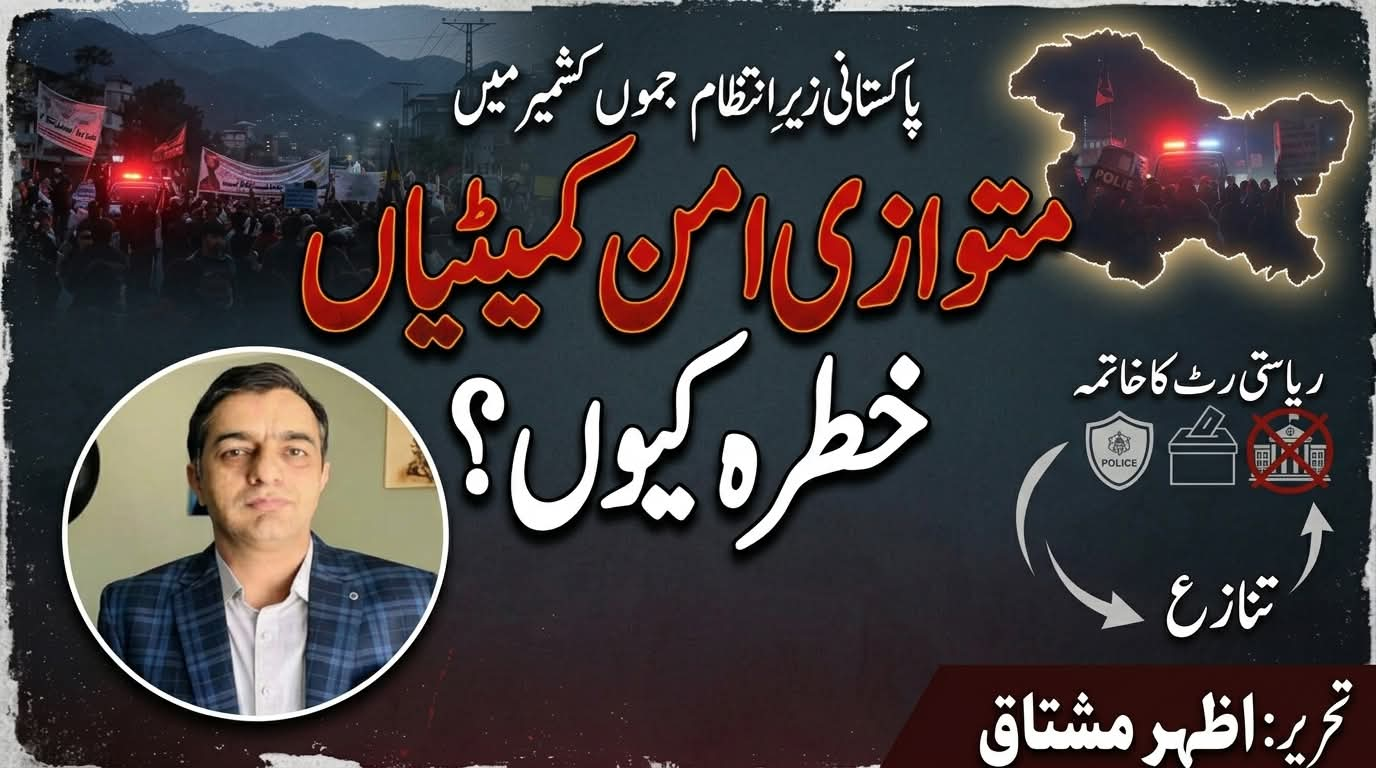
As soon as the name "Peace Committee" or "peace" is mentioned, the first natural feeling regarding any conflict-ridden or terrorism-affected region should be one of pleasantness; because in an era of terror, war, and brutality, those who invoke peace are like a gust of cool breeze. It has often been observed that when tensions rise along conventional borders or two traditional rivals are trading bloodthirsty statements against each other, a handful of peace lovers in such circumstances are considered a metaphor for soft flowers in a wilderness of thorns.
However, when voices of social and civil rights within the borders become a powerful pressure group and the public, while remaining within the bounds of the social contract, begins demanding the rights stipulated in the sacred book called the Constitution in public squares and intersections, the imposed ruling elite begins labeling it as mischief, rebellion, or treason. In such a situation, when parallel structures called "Peace Committees" begin to be erected to suppress these movements, the leadership of social and civil rights must certainly become alarmed.
The history of peace committees in Pakistan consists of two different types of committees. If their establishment is viewed in the post-9/11 context, local armed groups (militias) were organized in the former FATA or Waziristan to support the Pakistan Army against Taliban attacks, which were given the name "Peace Committee." Later, these committees came to consist of religious leaders supportive of the government and military institutions, local elders, and favored social activists.
In FATA, Swat, Waziristan, Malakand, Tank, and the border areas of Khyber Pakhtunkhwa, the duties of these peace committees also came to include the collection of local taxes and the administration of justice at the local level. But with the passage of time, serious allegations were leveled against these committees by the local population, including kidnapping for ransom, suppressing local voices through oppression and tyranny, and extrajudicial violence. That was the reason they were later transformed into "Village Defence Committees."
It is a reality that many local elders of these committees themselves became victims of terrorism, but alongside this, it is also noteworthy that their establishment weakened the state's formal justice system and protective institutions. Public trust was severely damaged, resulting in a deep divide between the local police, law enforcement agencies, and the public.
It is not at all difficult to guess that these peace committees could also prove to be similar to the peace committees of Khyber Pakhtunkhwa, Lyari, or Balochistan in the future.
According to a recent report by BBC Urdu, an attempt has been made to reorganize the ambiguous role of peace committees in the Bannu and Lakki Marwat districts of Khyber Pakhtunkhwa. In the past, the local police had significant involvement in the formation of peace committees in Lakki Marwat and Bannu, and under police patronage, these committees had the authority to take direct action against any alleged terrorist group. However, in view of serious public concerns and complaints, these committees have now been bound under a new code of conduct not to carry out any military or direct action themselves. The Pashtun Tahafuz Movement (PTM) and other political activists have been objecting to the suspicious role of peace committees across Khyber Pakhtunkhwa for nearly a decade. Their position is that peace committee members are fostering unrest in the region by subjecting ordinary citizens to extrajudicial punishments, and that in the presence of the constitution and the law, the establishment of such committees is completely unconstitutional.
The question arises here that the establishment of peace committees in Khyber Pakhtunkhwa was for state assistance at the local level against terrorism originating from across the Durand Line, so that it would be easier for the state to deal with this monster. But on the contrary, in Pakistani-administered Jammu and Kashmir, there has so far been no such notable incident of terrorism that would raise fears of disrupting the peace of the region. During the protests of the Awami Action Committee ongoing for the past few months, when the administration and law enforcement agencies were nowhere to be seen throughout Pakistani-administered Jammu and Kashmir in general and Poonch Division in particular, even then no such unpleasant incident occurred at the public level that could be linked to terrorism; whereas during all this time, several individuals have lost their lives as a result of clashes between forces and protesters.
In such a situation, the sudden emergence of peace committees in some cities of Pakistani-administered Jammu and Kashmir and looking at their composition gives rise to several questions. It is not at all difficult to guess that these peace committees could also prove to be similar to the peace committees of Khyber Pakhtunkhwa, Lyari, or Balochistan in the future. In this current critical time, the political leadership, rights activists, and leaders of the Awami Action Committee of Pakistani-administered Jammu and Kashmir must conduct a deep and accurate analysis of this situation so that timely decisions can be made, preventing the public from having to bear the burden of extra-constitutional and extrajudicial actions in the future, and preventing the leaders of these so-called "peace committees" from pursuing personal grudges and enmities under the pretext of unrest.
Azhar Mushtaq, Canada
October 11, 2026
(Note: AI assistance was used for the image used with this article)
Comments (0)