
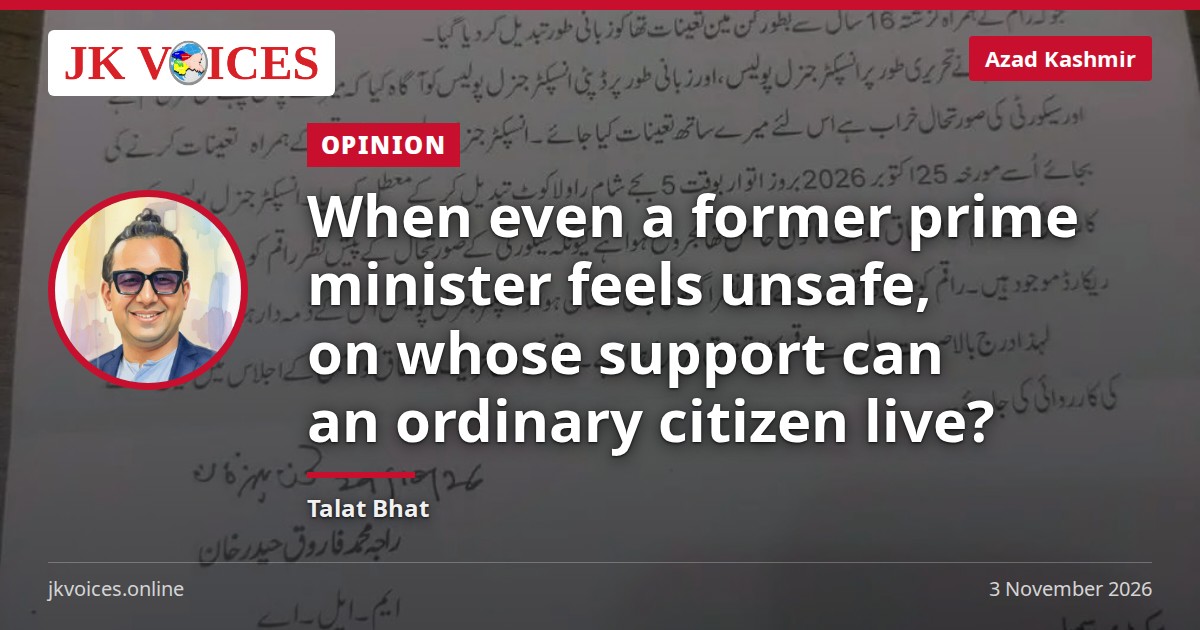
Two-time Prime Minister and current Member of the Assembly, Raja Muhammad Farooq Haider Khan, submitted a privilege motion to the Secretary of the Assembly on October 29, 2026. In it, he wrote that if he suffers any loss of life due to the current threats, the Inspector General of Police will be responsible.
This sentence is not the plea of an ordinary citizen. It is the written statement of a person who has held the highest administrative office in this region. Therefore, the first question that arises is: where a prominent member of the ruling class holds the police chief responsible for his life, how safe would the life of a laborer, student, journalist, or political worker be?
What is stated in the privilege motion?
According to Raja Farooq Haider, under Section 7-A of the Azad Jammu and Kashmir Ministers' Privileges Act 1975, a former prime minister should receive a full police contingent along with other privileges. He has only been provided a guard of one senior ranker and four constables.
Assistant Sub-Inspector Muhammad Saeed of Bagh district had been deployed with him as a gunman for the past 16 years. According to the former prime minister, he was transferred on a verbal order. He informed the IG Police in writing and the DIG verbally that his security contingent was already short and the security situation was precarious. In response, on Sunday evening, October 25, 2026, at 5 o'clock, the officer was suspended and transferred to Rawalakot. It was also claimed in the motion that there are "countless threats on record" against him.
The questions that no one has answered
First question: If the threats are genuinely on record, who are these threats from? Are they from an armed group, a political opponent, or the powerful circles whose names merely mentioning in this region is considered a danger in itself? The public has the right to know who poses a threat to their former prime minister.
Second question: After being informed of the threats, why did the police suspend the 16-year-long gunman instead of increasing security? And why was this decision necessary on a Sunday evening? If there was a departmental complaint against the officer, it should be brought forward. If there was no complaint, this action seems nothing short of a punishment.
Third question: Is the police an independent and professional institution, or a party in the tug-of-war for power? In this region, police transfers have for years served as a measure of political loyalty and a tool for political pressure. When even the personal bodyguard of a former prime minister can be removed on a verbal order, what message does it send to an ordinary policeman? That it is not the law, but orders that rule.
The day an ordinary citizen receives a threat and the police spring into action with the same seriousness demanded today by a former prime minister, that day this system will become credible.
The other side of the picture: Is security a right or a privilege?
There is also a bitter aspect to this matter that cannot be ignored. Raja Farooq Haider has built his case on the Ministers' Privileges Act. In other words, in his view, his protection is a legal privilege that comes with the office.
Yet this is the very system against which the people of this region took to the streets in recent years. Ending the privileges of the ruling elite was among the core demands of the public movement. The public's question was: why should a region yearning for electricity, flour, and employment bear the burden of vehicles, guards, and protocol for former rulers?
Therefore, the real question is not how many constables a former prime minister should get. The real question is: when will protection be recognized as the constitutional right of every citizen in this region? So far, it remains the privilege of only a few offices.
The day an ordinary citizen receives a threat and the police spring into action with the same seriousness demanded today by a former prime minister, that day this system will become credible. Not before that.
The state's silence is also a statement
So far, no clear stance has emerged from the IG Police or the government on this motion. This silence is an answer in itself. If the police's decision was correct, it should be presented before the public with reasoned arguments. If it was wrong, it should be withdrawn and responsibility should be fixed.
The way forward
We demand that:
- The privilege motion be presented for an open hearing before the assembly's privileges committee, and the IG Police appear in person to provide an explanation.
- An independent inquiry be conducted into the threats received by Raja Farooq Haider, and as far as possible, their nature be made public.
- The reasons for the suspension of ASI Muhammad Saeed be provided in writing.
- Transparent legislation be enacted to free police transfers and postings from political interference.
- A policy of equal protection for every citizen be formulated, rather than protection based on privilege.
The people of this part of the State of Jammu and Kashmir have made immense sacrifices. They want a system where protection is granted by virtue of citizenship, not office. When a former prime minister is forced to submit a written appeal for the protection of his life, it no longer remains an individual's issue. It becomes a declaration of the failure of the entire system.
Comments (0)