
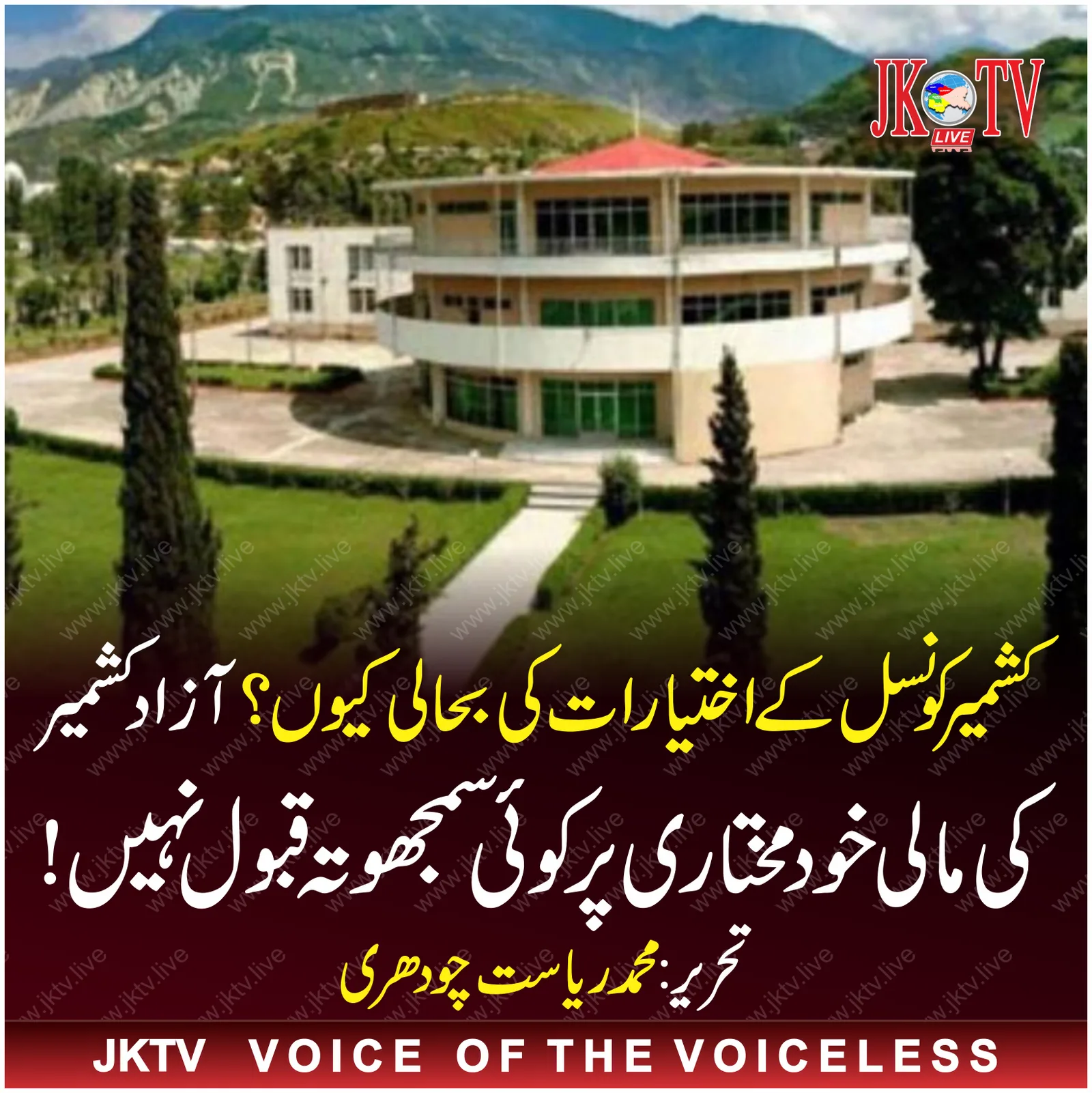
The Thirteenth Constitutional Amendment of 2018 was a significant milestone in the political history of Azad Jammu and Kashmir (AJK). During the tenure of Raja Farooq Haider Khan as Prime Minister of Azad Kashmir, with the support of the then Prime Minister of Pakistan, Mian Muhammad Nawaz Sharif, the administrative, financial and legislative powers of the Kashmir Council were curtailed, while greater authority was transferred to the Government and Legislative Assembly of Azad Jammu and Kashmir.
The fundamental objective of this initiative was to empower the people of Azad Kashmir to manage their own affairs and exercise greater control over the use of their financial resources.
Today, discussions about reactivating the Kashmir Council and expanding its role have raised serious questions among the people of Azad Kashmir. What circumstances have arisen that make it necessary to expand the role of the Kashmir Council once again, despite the experience of the past? What tangible benefits will this move bring to the people of Kashmir?
In the past, serious questions were raised about the administrative structure and powers of the Kashmir Council. Concerns were expressed that the federal bureaucracy exercised disproportionate influence over the financial and administrative affairs of Azad Kashmir. Questions were also raised regarding the allocation of development projects, the utilisation of public resources and the transparency of administrative expenditure.
The Thirteenth Constitutional Amendment of 2018 brought fundamental changes to this system of governance.
Have the problems associated with the previous system now been resolved in a way that justifies strengthening the Kashmir Council once again? If so, why are the people not being taken into confidence? Complete details of the proposed role, expenditure, powers and expected public benefits of the Council must be made available to the public.
Kashmiri Resources Are the Right of the Kashmiri People
The people of Azad Kashmir are justified in asking how many opportunities were provided to qualified local professionals and educated young people within institutions operating with their resources.
If the administrative expenditure of any institution was being met from the budget of Azad Kashmir, the public deserves a clear account of the benefits received in return.
Every institution funded by public money must disclose its expenditure, staffing structure, development projects and performance. If allegations of financial irregularities, favouritism or political interference in the use of public funds and allocation of development projects arose in the past, those matters should be examined through a transparent audit.
No institution should be placed beyond public accountability merely because of tradition or political convenience.
The Question of Representation Without a Public Mandate
Another important issue concerns representation in the Kashmir Council and the distribution of party tickets by political parties.
No institution should be placed beyond public accountability merely because of tradition or political convenience.
Democracy demands that public representation be based on merit, competence, political commitment and public confidence.
Political workers spend years among the people, struggle for their party's ideology and make sacrifices to strengthen their organisations. However, when opportunities for decision-making and representation arise, their contributions are often overlooked in favour of individuals whose public support or political services may be questionable.
Such practices discourage dedicated workers and weaken democratic traditions within political parties.
Whether representatives are nominated or elected to the Kashmir Council, the process must prioritise transparency, merit and the public interest. Political parties must also explain why ideological workers, educated young people and qualified professionals are not given appropriate opportunities for representation.
The Leadership of Azad Kashmir Must Make a Decision
The Prime Minister and President of Azad Kashmir, members of the Legislative Assembly, leaders of political parties, lawyers, journalists, teachers and responsible members of civil society must consider this matter seriously.
This is not merely a question of supporting or opposing a particular political party or personality. It concerns the constitutional powers, financial resources and future governance of Azad Kashmir.
To safeguard the financial and administrative autonomy achieved in 2018, every new proposal must be assessed on the basis of public interest, constitutional principles and transparency.
If the purpose of reactivating the Kashmir Council is genuinely to promote public welfare, improve development projects and strengthen cooperation between Pakistan and Azad Kashmir, then a clear plan, measurable objectives and an effective accountability mechanism must be presented.
Simply reactivating an institution does not improve people's lives. What matters is the tangible difference it makes to ordinary citizens in education, healthcare, employment, roads, electricity and other essential public services.
Our Demands
We demand that an open public debate be held before any constitutional or administrative changes affecting the financial autonomy of Azad Kashmir are introduced.
The powers, financial resources, staffing, expenditure and development-related responsibilities of the Kashmir Council must be clearly disclosed to the public. Past financial and administrative arrangements should be reviewed transparently, and the protection of constitutionally established powers must be ensured.
The resources of Azad Kashmir are a public trust belonging to the people of Azad Kashmir. Decisions regarding their use must be guided by public interest, transparency and accountability.
The people of Azad Kashmir must consider whether they want to strengthen their authority to make decisions about their own future or return to an administrative structure that has previously been the subject of serious concerns.
The time has come for all political parties, particularly those leaders who played a role in securing financial autonomy, to state their positions clearly on this issue.
In the politics of Kashmir, the protection of public rights, constitutional powers and national resources must take precedence over positions, offices and the pursuit of political power.
Financial autonomy is not a political favour; it is the foundation of public empowerment and accountable governance. Protecting it is our collective responsibility.


Comments (0)